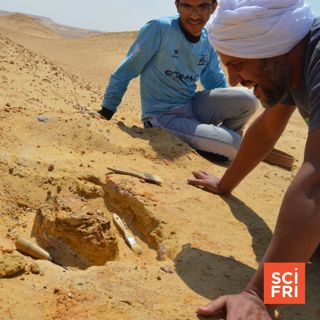

An Animal’s Size And Its Cancer Risk | Bastetodon, A 30 Million-Year-Old Apex Predator
Science Friday4 Maalis 2025

An Animal’s Size And Its Cancer Risk | Bastetodon, A 30 Million-Year-Old Apex Predator

A study finds that Peto’s Paradox, which states that larger animals are no more likely to get cancer than smaller ones, may not hold up. Also, a nearly complete predator skull was found in the Egyptian desert. Its lineage indicates that it was a top carnivore of the age.

What Does An Animal’s Size Have To Do With Its Cancer Risk?

If you throw a huge party, there’s more of a chance of problems than if you host a quiet get-together for a couple of friends. The logic is simple: Having more people around means more opportunities for chaos. Similarly, it would seem to make sense that in animals, a bigger species with more cells might have a greater chance of something going wrong with one of those cells, including mutations leading to cancer.

Back in 1977, a British epidemiologist named Richard Peto observed that that didn’t seem to be true. Bigger animals didn’t seem to have a greater risk of cancer than smaller ones. That became known as Peto’s Paradox, and has been a topic of debate among cancer biologists ever since.

Research published this week in the Proceedings of the National Academy of Sciences takes a new look at Peto’s Paradox using an unusual set of data—death reports from zoos around the world. Dr. Sarah Amend of Johns Hopkins Medical School joins Host Flora Lichtman to explain why, in their findings, Peto’s Paradox doesn’t seem to hold up—and what studying animal cancer rates could teach scientists about improving human health.

Meet Bastetodon, A 30 Million-Year-Old Apex Predator

Once upon a time, some 30 million years ago, what is now Egypt’s Western Desert was a lush forest. Humans had not evolved yet, the nearest relatives being monkey-like creatures. And through those forests stalked Bastetodon syrtos, a newly described apex predator from an extinct lineage known as the Hyaenodonts—one of the top carnivores of the age.

Researchers recently discovered a nearly complete skull of the creature. They reported on the find in the Journal of Vertebrate Paleontology. Host Flora Lichtman talks with Shorouq Al-Ashqar of the Mansoura University Vertebrate Paleontology Center about the discovery, and the picture it helps paint of ancient life.

Transcripts for each segment will be available after the show airs on sciencefriday.com.

Subscribe to this podcast. Follow our show on Instagram, TikTok, Facebook, and Bluesky @scifri and sign up for our newsletters. Got a science question that’s keeping you up at night? Call us: 877-472-4374


Hosted by Simplecast, an AdsWizz company. See pcm.adswizz.com for information about our collection and use of personal data for advertising.

Tämä jakso on lisätty Podme-palveluun avoimen RSS-syötteen kautta eikä se ole Podmen omaa tuotantoa. Siksi jakso saattaa sisältää mainontaa.

Jaksot(1338)

Why do sports announcers talk like that?

Why do sports announcers talk like that?

If you watch sports, whether the recent NBA finals or the ongoing World Cup matches, you may have noticed that the athletes aren’t the only ones putting on a show. The announcers seem to be playing a ...

19 Kesä 13min

Swords, cannibalism, poison: inside the world of killer microbes

Swords, cannibalism, poison: inside the world of killer microbes

There is a murderous crime spree happening right under—and perhaps inside—our noses. Killer microbes armed with weapons are eviscerating, assassinating, and detonating their fellow microbes. And the n...

18 Kesä 21min

When music transports you to a different place

When music transports you to a different place

Do you ever hear a song that transports you to a specific place and time? This auditory wormhole has a name: musical daydreams. Music cognition expert Elizabeth Margulis studies why they happen, and w...

17 Kesä 18min

A vast whale graveyard + Zombie sea cucumbers

A vast whale graveyard + Zombie sea cucumbers

Researchers just published details of a massive undersea graveyard of whales deep in the Indian Ocean. Spanning about 1,200 kilometers (745 miles), it contains whale remains dating back more than 5 mi...

16 Kesä 18min

Should we bring mountain lions back to the Northeast?

Should we bring mountain lions back to the Northeast?

Big cats used to roam the entire United States. You might know them as mountain lions, pumas, cougars, or catamounts. Though they go by many names, they're actually all the same species.  Their curren...

15 Kesä 12min

Blue Origin explosion hits NASA timeline + Artemis III crew

Blue Origin explosion hits NASA timeline + Artemis III crew

When Blue Origin’s New Glenn spacecraft exploded in an enormous fireball during a ground test a couple weeks ago, it sent shockwaves not only through the air, but through NASA’s timeline for the upcom...

12 Kesä 12min

Why can I handle tequila but not rum?

Why can I handle tequila but not rum?

‘Tis the season for porch beers and happy hours, and we’re taking on listener questions about how alcohol affects us. Like, is a glass of wine at dinner really good for you? And why do sugary drinks g...

11 Kesä 21min

AI + turfgrass science in the most high-tech World Cup yet

AI + turfgrass science in the most high-tech World Cup yet

The 2026 World Cup will be the largest one yet, and FIFA is trying to make it the most high-tech, too. The federation has partnered with tech giant Lenovo to launch Football AI Pro, which is designed ...

10 Kesä 19min

Suosittua kategoriassa Tiede

rss-mita-tulisi-tietaa
utelias-mieli
rss-duodecim-lehti
rss-hereilla
rss-poliisin-mieli
rss-totuuden-liepeilla
rss-laakaripodi
rss-lihavuudesta-podcast
tiedekulma-podcast
sotataidon-ytimessa
radio-antro
rss-tiedetta-vai-tarinaa