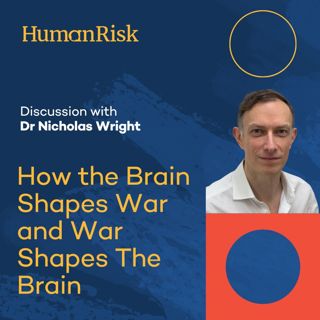
Dr Nicholas Wright on How the Brain Shapes War and War Shapes The Brain

Dr Nicholas Wright on How the Brain Shapes War and War Shapes The Brain

What can war teach us about how the human brain really works? And why is human decision-making a more significant factor than military strength in wars?

Episode Summary
On this episode, I'm exploring how the human brain truly manifests in conflict—and what that reveals about everyday decision-making. Dr Nicholas Wright, a neurologist-turned-neuroscientist who advises the Pentagon Joint Staff, joins me to discuss his new book Warhead: How the Brain Shapes War and War Shapes the Brain.

In our conversation, Nick explains why fear is functional, how “will to fight” can outweigh superior force, and why democracies remain capable of catastrophic decisions. He also explains how perception operates as a controlled hallucination anchored to reality rather than a simple sensory feed, and why that distinction matters for strategy, leadership, and risk.

Moving from fruit flies to front lines, Nick shows how simple neural chemicals regulate aggression, how the brain’s grid cells create literal maps to navigate danger and opportunity, and how both biological and organisational models can mislead when mistaken for reality. The discussion ranges from 1940 France to Kyiv, from Stalingrad to Gaza, and from deception as a vice to deception as a civic virtue.

Nick makes a compelling case for metacognition — the ability to think about one’s own thinking— as the conductor of the brain’s internal orchestra and argues that wisdom—not merely cleverness — must be deliberately designed into leaders and into the next generation of artificial intelligence.

We end with practical insights: cultivating “better ignorance,” inviting real dissent in the spirit of Churchill, and creating deliberate spaces for reflection like (I'm delighted to report) long train journeys.

Guest Biography
Dr Nicholas Wright, MRCP, PhD, is a neuroscientist researching the intersections of the brain, technology, and security at University College London, Georgetown University, and the Center for Strategic & International Studies in Washington, DC. He also serves as an adviser to the Pentagon Joint Staff. Beyond academia, Wright leads projects connecting neuroscience, artificial intelligence, and strategy, and has advised the Pentagon Joint Staff for more than a decade.

He consults on AI for SAP and edited Artificial Intelligence, China, Russia, and the Global Order (Air University Press, 2019).

His latest book, Warhead: How the Brain Shapes War and War Shapes the Brain, is published by St. Martin’s Press (US) and Pan Macmillan (UK).

AI_Generated Time-stamped Summary
[00:00:00] Introduction
[00:01:00] Nick Wright’s journey from neurologist to defense advisor, applying neuroscience to strategy and AI.
[00:04:29] How evolution shaped the human brain for survival and combat — we’re “built to win or survive a fight.”
[00:05:59] Fear as a vital yet double-edged emotion; anxiety as a side effect of peace.
[00:08:26] Origins of the book Warhead and cultural perceptions of its title.
[00:09:39] Why war remains relevant; critique of overconfidence in peace and Pinker’s “Better Angels” thesis.
[00:12:01] Lessons from France’s WWII defeat — cognition and morale outweigh material strength.
[00:14:41] Ukraine’s resistance as an example of will to fight; psychology as a decisive factor.
[00:15:42] Creativity and emotion as essential tools in decision-making; the brain as an orchestra balancing logic and instinct.
[00:18:10] What fruit flies reveal about aggression and shared neural circuitry with humans.
[00:21:13] Structure of Warhead — using neuroscience to reinterpret history and warfare.
[00:26:37] Mental models and how the brain simulates reality to guide choices.
[00:30:37] Perception vs. reality — the brain generates, not records, the world we see.
[00:35:31] The “uncanny valley” and prediction errors — why imperfect mimicry unsettles us.
[00:36:17] Moral symmetry in conflict — both sides perceive their cause as just.
[00:38:00] Deception and fog of war — manipulating human perception as a timeless weapon.
[00:41:00] WWII story of René Carmille — lying as moral resistance.
[00:43:59] Social media, attention, and the loss of reflection — the modern “disease of abundance.”
[00:45:41] Wisdom versus cleverness — Churchill’s reflective habits and valuing dissent.
[00:48:11] “Better ignorance” and intellectual humility as foundations of wise leadership.
[00:51:26] Cognitive diversity, AI, and the need to embed wisdom—not just intelligence—into machines.
[00:58:28] From WWII to China today — the enduring need for wisdom in navigating global conflict.

Links
Nick's website -
https://www.intelligentbiology.co.uk/

WarHead Nick's book -
https://www.intelligentbiology.co.uk/books

Nick on LinkedIn -
https://www.linkedin.com/in/nicholas-d-wright-bba3a065/

If you liked this episode, you might also like my discussion with Dr Mike Martin - https://www.humanriskpodcast.com/dr-mike-martin-on-war-politics/

Tämä jakso on lisätty Podme-palveluun avoimen RSS-syötteen kautta eikä se ole Podmen omaa tuotantoa. Siksi jakso saattaa sisältää mainontaa.

Jaksot(368)

Stefan Gaillard on the importance of Trial & Error

Stefan Gaillard on the importance of Trial & Error

Why is it so hard for us to admit mistakes? That's what my guest Stefan Gaillard & I explore in this episode. Stefan is the Editor of The Journal of Trial & Error, a project that seeks to promote the...

18 Marras 20201h 1min

Stuart Tootal & Greg Davies on the lessons for business from military decision-making

Stuart Tootal & Greg Davies on the lessons for business from military decision-making

What can the military teach business? Much as companies often talk about 'wars' (most obviously when it comes to talent) and 'battles' (usually for market share), it's not obvious that the two have mu...

14 Marras 202055min

John Sutherland on mitigating Board Level Human Risk

John Sutherland on mitigating Board Level Human Risk

If you were looking for a sector that had lots of examples of Human Risk, then you'd probably pick banking? And if you were trying to understand why some of the senior people within banking hadn't be...

7 Marras 202058min

Luca Dellanna on Ergodicity: why the way we often view the world, can lead to bad decisions

Luca Dellanna on Ergodicity: why the way we often view the world, can lead to bad decisions

What is ergodicity? If it's a new term to you, then listen to my guest Luca Dellanna explain why ergodic thinking is often at the heart of much of our flawed decision-making. This is Luca's second ap...

29 Loka 20201h 1min

Leanne Spencer on Wellbeing: why it matters & how we can improve it.

Leanne Spencer on Wellbeing: why it matters & how we can improve it.

We often think of our body and our mind as being somehow distinct, yet there is a strong linkage between mental health and physical wellbeing. That's what I explore with my guest Leanne Spencer on th...

27 Loka 202045min

Multi-million selling Singer Songwriter Dr Glenn Medeiros on Human Risk in the Music Industry

Multi-million selling Singer Songwriter Dr Glenn Medeiros on Human Risk in the Music Industry

On this episode, I'm exploring an industry whose product we all sample daily, but probably don't fully understand: music. In the late 1980s and early 1990s, my guest, Dr Glenn Medeiros, was a global ...

22 Loka 20201h

Professor Don Moore on Confidence and how it impacts our decision-making

Professor Don Moore on Confidence and how it impacts our decision-making

We all understand the idea of Confidence and that having it can help us succeed. Equally, not having it can also paralyse us into inaction. So what is the optimal level of confidence?That's what my ...

15 Loka 202051min

Dr Thomas Roulet on Negative Social Evaluations: the science behind the ways we judge each other

Dr Thomas Roulet on Negative Social Evaluations: the science behind the ways we judge each other

We all instinctively know the impact negative reviews have on individuals and organizations; whether TripAdvisor ratings or publicly administered regulatory sanctions. It's not good. Yet there are ma...

8 Loka 202057min

Suosittua kategoriassa Tiede

rss-poliisin-mieli
tiedekulma-podcast
rss-mita-tulisi-tietaa
docemilia
filocast-filosofian-perusteet
rss-tiedetta-vai-tarinaa
rss-lapsuuden-rakentajat-podcast
sotataidon-ytimessa
menologeja-tutkimusmatka-vaihdevuosiin
rss-duodecim-lehti
rss-lihavuudesta-podcast
radio-antro
rss-bios-podcast
rss-metsantuntijat-podcast
rss-luontopodi-samuel-glassar-tutkii-luonnon-ihmeita