Of breeds and brains
Many Minds6 Marras 2025

Of breeds and brains

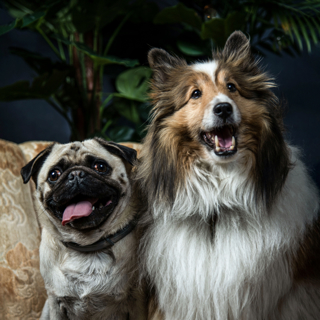
It's hard to say exactly when, but some tens of thousands of years ago, our best friends were born. I'm referring, of course, to dogs. This didn't happen overnight—it was a long process. And it not only changed how those canids behaved and what they looked like, it also changed their brains. As wolves gave way to proto-dogs, and proto-dogs gave way to dingoes and dalmatians and Dobermanns and all the rest, their brains have continued to change. What can we learn from this singular saga? What does it tell us about dogs, about domestication, and about brains?

My guest today is Dr. Erin Hecht. Erin is an Assistant Professor in the Department of Human Evolutionary Biology at Harvard, where she directs the Canine Brains Project.

Here Erin and I talk about how dogs are the most anatomically diverse species on the planet—and how their brains are no exception. We sketch the different waves in the dog domestication saga and discuss scenarios for how that saga got underway. We talk about how brains change as they get bigger and about how they change during domestication. We discuss a recent study by Erin and colleagues comparing the brains of modern dogs with the brains of pre-modern dogs like village dogs and New Guinea singing dogs. We also talk about a new study from Erin's lab finding that domestic dogs share with humans a key language-related structure. Along the way we talk about the Russian Farm Fox experiment, the stereotype of the gentle giant, the left lateralization of language, the respiratory condition known as BOAS, the dog personality inventory known as C-BARQ, the limitations of the idea of a "domestication syndrome," and the puppy kidnapping hypothesis.

Longtime listeners will recall that we had Erin on the show to talk about her work on fermentation and brain evolution. Given how much fun we had with that one, it was only a matter of time before we had her back to talk about her main line of research on dog brains. So here you go friends—hope you enjoy it!

Notes

4:30 – For one recent study of the early domestication of dogs, see here. For a review of leading hypotheses about what drove the wolf-to-dog transition, see here.

13:00 – For Dr. Hecht's initial 2019 study of brain variation across domestic dog breeds, see here.

20:00 – For a classic paper on the neurodevelopmental scaling by Dr. Barbara Finlay and colleagues, see here.

23:00 – For more of Dr. Hecht's work on neurodevelopmental scaling laws as they apply to dogs, see here. For a study reporting correlations between body size and personality in dogs, see here.

29:00 – See Dr. Hecht and colleagues' recent paper on the evolutionary neuroscience of domestication.

31:00 – See Dr. Hecht and colleagues' recent paper on brain changes seen in the Russian farm-fox experiment.

37:00 – For more on the idea of "domestication syndrome," see our recent episode with Dr. Kevin Lala and this critical discussion. For a classic treatment of the idea that domestication involves reduction in brain size, see here.

41:00 – For the recent study by Dr. Hecht and colleagues comparing the brains of modern and pre-modern dog breeds, see here.

43:00 – For video of a New Guinea Singing Dog singing, see here.

47:00 – For more about the dog personality inventory known as the C-BARQ, see here.

51:00 – For Dr. Hecht and colleagues' recent study on an analog to the "arcuate fasciculus" in dogs, see here.

58:00 – For Dr. Hecht and colleagues' study on arcuate fasciculus in chimpanzees (and its relationship to communicative behavior), see here. For more discussion of the hemispheric lateralization of language, see our recent interview with Dr. Ev Federenko.

1:04:00 – The website of the Functional Dog Collaborative.

Recommendations

Dogs: A New Understanding of Canine Origin, Behavior and Evolution, Raymond & Lorna Coppinger

Evolving Brains, John Allman

Tämä jakso on lisätty Podme-palveluun avoimen RSS-syötteen kautta eikä se ole Podmen omaa tuotantoa. Siksi jakso saattaa sisältää mainontaa.

Jaksot(162)

Babies, dogs, and the riddles of word learning

Babies, dogs, and the riddles of word learning

It's kind of astonishing, really, that kids ever learn words. Each one poses a little riddle. Does this sound string refer to a person? A category of things? Or maybe some other feature of the bloomin...

22 Touko 1h 18min

The inner life of the hand

The inner life of the hand

Newton saw in the human hand proof of the divine; Darwin saw a key to our species' success. Many others, too, have described the hand in hyperbolic terms, as a paragon of design, a cornerstone of huma...

7 Touko 1h 10min

From the archive: The cuttlefish and its coat of many colors

From the archive: The cuttlefish and its coat of many colors

Hi friends! We're skipping a beat to take care of some spring housekeeping tasks. We will be back in May! In the meanwhile, enjoy this listener favorite from our archives! ----- [originally aired Apri...

22 Huhti 1h 33min

Illuminating cave art

Illuminating cave art

Deep in our past, in the dark depths of caves, our ancestors did something strange and beautiful. Working by firelight, some doodled little designs. Others made hand stencils. Some saw a bulge of rock...

9 Huhti 1h 25min

What can AI teach us about the mind?

What can AI teach us about the mind?

Everyone is talking about AI these days. Often these conversations are about how AI might upend education, or work, or social life, or maybe civilization itself. But among cognitive scientists and psy...

26 Maalis 1h 21min

Mutualisms all the way down

Mutualisms all the way down

No one is an island. We all depend on each other in critical, often tangled ways. And when I say "we" and "each other" I don't just mean humans. Yes, we humans rely on other humans. But we also rely o...

11 Maalis 1h 8min

Seven metaphors for AI

Seven metaphors for AI

If you wanted a petri dish for understanding metaphors—how they emerge and evolve and jostle with each other—it would be hard to do better than the world of AI. We talk about AI systems variously as c...

26 Helmi 55min

Origins of the kiss

Origins of the kiss

Humans do some pretty weird things. Some of us will sit in searingly hot rooms or jump into icy ponds. Others risk their lives trying to climb to new heights or dive to new depths. And every once in a...

12 Helmi 1h 1min

Suosittua kategoriassa Koulutus

rss-murhan-anatomia
psykopodiaa-podcast
voi-hyvin-meditaatiot-2
kesken
rss-valo-minussa-2
rss-liian-kuuma-peruna
rss-narsisti
rss-niinku-asia-on
rss-rahamania
adhd-podi
psykologia
rss-vapaudu-voimaasi
aamukahvilla
rss-laadukasta-ensihoitoa
rss-mentalrace
rss-arkea-ja-aurinkoa-podcast-espanjasta
rss-hereilla
rahapuhetta
puhutaan-koiraa
ihminen-tavattavissa-tommy-hellsten-instituutti