Mapping the Invisible Universe: New Connections Between Gamma-Rays and Cosmic Structure

Mapping the Invisible Universe: New Connections Between Gamma-Rays and Cosmic Structure

**Article Reference:**

* Thakore, B., et al. (2024). "High-Significance Detection of Correlation Between the Unresolved Gamma-Ray Background and the Large Scale Cosmic Structure."


**Introduction:**

* The universe is filled with a mysterious glow of gamma rays, known as the **unresolved gamma-ray background (UGRB)**. This background could contain clues about the faintest gamma-ray sources and the nature of dark matter.

* This podcast episode explores a recent study that has found a significant correlation between the UGRB and the distribution of mass in the universe, as traced by gravitational lensing.


**Key Findings:**

* Researchers detected a correlation between the UGRB and **weak gravitational lensing** with a signal-to-noise ratio of 8.9.

* This is the first time a significant correlation has been observed at **large scales**, indicating that a substantial portion of the UGRB aligns with the mass clustering of the universe.

* **Blazars**, a type of active galactic nuclei (AGN), are a likely source for this signal.

* The study suggests that blazars contributing to this correlation are likely located in **massive halos** (around 10^14 solar masses).

* The research indicates a preference for a **curved gamma-ray energy spectrum**, specifically a log-parabolic shape, over a simple power-law. This implies that the gamma-ray sources have a complex energy distribution.

* The signal is stronger at **high energies and high redshifts**. This suggests that the sources are located far away and emit higher energy photons.


**Significance:**

* The cross-correlation technique can help in distinguishing between gamma-ray emissions from astrophysical sources and those potentially caused by **dark matter annihilation** or decay.

* This method provides insights into the properties of unresolved gamma-ray sources, such as their **redshift distribution and clustering**.

* The findings refine the understanding of **blazars** and their contribution to the UGRB, but also point towards modifications in the current understanding of blazar models.


**Implications and Future Research:**

* The study opens the door to the possibility of additional gamma-ray sources such as **star-forming galaxies or particle dark matter**.

* Future research will include cross-correlating the gamma-ray sky with galaxy clustering data to further confirm the source populations that are responsible for the signal. This will also allow for more detailed characterization of the signal's redshift dependence and absorption.

* This analysis can also help refine the **extragalactic background light (EBL)** model.


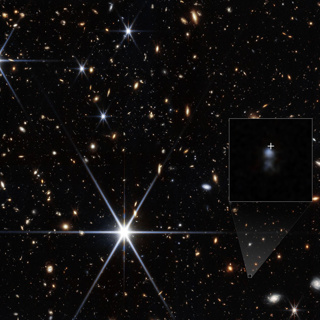
Acknowledements: Podcast prepared with Google/NotebookLM. Illustration credits: Fermi-LAT, DES

Tämä jakso on lisätty Podme-palveluun avoimen RSS-syötteen kautta eikä se ole Podmen omaa tuotantoa. Siksi jakso saattaa sisältää mainontaa.

Jaksot(101)

Record-Breaker: Catching Gamma Rays from the Distant Quasar OP 313

Record-Breaker: Catching Gamma Rays from the Distant Quasar OP 313

In this episode, we dive into a groundbreaking astronomical discovery: the detection of very-high-energy (VHE) gamma rays from the quasar OP 313. Located at a redshift of $z = 0.997$, OP 313 has shatt...

1 Kesä 20min

Ripples in Spacetime: Unpacking the GWTC-5.0 Catalog

Ripples in Spacetime: Unpacking the GWTC-5.0 Catalog

In this episode, we dive into the monumental release of the Gravitational-Wave Transient Catalog version 5.0 (GWTC-5.0) and the open data from the second part of the fourth observing run (O4b) by the ...

29 Touko 21min

SN 2017egm : Fermi-LAT's Breakthrough Gamma-Ray Detection

SN 2017egm : Fermi-LAT's Breakthrough Gamma-Ray Detection

In today’s episode, we dive into the mystery of superluminous supernovae (SLSNe)—rare, extreme astronomical events that shine 10 to 100 times brighter than standard core-collapse supernovae. For years...

22 Touko 23min

Supernovae on the RISE: Why Dead Stars Wake Up Decades Later

Supernovae on the RISE: Why Dead Stars Wake Up Decades Later

In this episode, we explore the fascinating phenomenon of core-collapse supernovae that refuse to fade away quietly. Years, or even decades, after their initial explosion, some of these stellar deaths...

20 Touko 17min

The SVOM Satellite: A New Era in Multi-Messenger Astronomy

The SVOM Satellite: A New Era in Multi-Messenger Astronomy

In this episode, we dive into the fascinating world of gamma-ray bursts (GRBs) and high-energy transients through the lens of the SVOM (Space-based Multi-band Variable Object Monitor) mission. Launche...

29 Huhti 24min

Chasing the Flash: Hunting Neutron Star Mergers with CTAO

Chasing the Flash: Hunting Neutron Star Mergers with CTAO

In this episode, we dive into the thrilling world of multi-messenger astronomy! Ever since the historic detection of GW170817, scientists have known that binary neutron star (BNS) mergers can produce ...

14 Huhti 19min

Tiling the Sky: A New Strategy for Finding Elusive GRBs

Tiling the Sky: A New Strategy for Finding Elusive GRBs

In this episode, we dive into the intense and fast-paced world of **Gamma-ray bursts (GRBs)—the most luminous and rapidly evolving transients in the Universe**. While space-based instruments like the ...

13 Huhti 19min

Fast Radio Bursts & Magnetar X-Rays: A Peculiar Discovery

Fast Radio Bursts & Magnetar X-Rays: A Peculiar Discovery

In this episode, we dive into the deep cosmos to explore a recent astronomical breakthrough linking Fast Radio Bursts (FRBs)—enigmatic, millisecond-long cosmic transients—to extreme stellar objects kn...

7 Huhti 22min

Suosittua kategoriassa Tiede

rss-mita-tulisi-tietaa
rss-hereilla
utelias-mieli
rss-duodecim-lehti
rss-radplus
rss-totuuden-liepeilla
docemilia
rss-poliisin-mieli
tiedekulma-podcast
radio-antro
rss-laakaripodi
university-of-eastern-finland
sotataidon-ytimessa
filocast-filosofian-perusteet
rss-bios-podcast
rss-tiedetta-vai-tarinaa
rss-ilmasto-kriisissa
rss-ylistys-elaimille
rss-lihavuudesta-podcast
rss-kasvikutsut