Fast X-ray Bursts and Their Optical Surprises: The Case of EP241021a

Fast X-ray Bursts and Their Optical Surprises: The Case of EP241021a

* EP241021a was discovered as a soft X-ray trigger but was not detected at gamma-ray frequencies.

* The prompt soft X-ray emission spectrum is consistent with **non-thermal radiation**, suggesting a **mildly relativistic outflow with a bulk Lorentz factor Γ≳ 4**.

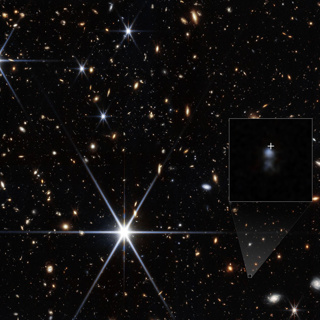
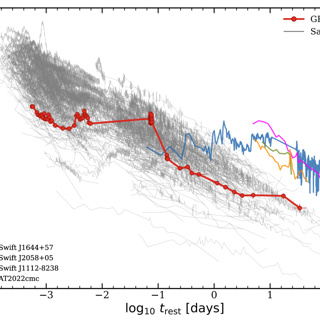
* The optical and near-infrared light curve shows a **two-component behavior**: an initial fading component (∼ t⁻¹) followed by a **rapid rise (steeper than ∼ t⁴)**, peaking at an absolute magnitude of **Mr ≈−22 mag**, before quickly returning to the initial decay. This peak magnitude is **the most luminous optical emission associated with an FXT**, surpassing EP240414a.

* Standard supernova models cannot explain either the **absolute magnitude or the rapid timescale (< 2 days rest frame)** of the rebrightening.

* The X-ray, optical, and near-infrared spectral energy distributions indicate a **red color (r− J ≈ 1 mag)** and suggest a **non-thermal origin (∼ ν⁻¹)** for the broadband emission.

* Considering a gamma-ray burst (GRB) as a possible scenario, the authors favor a **refreshed shock as the cause of the rebrightening**. This is consistent with the inferred mildly relativistic outflow.

* The results suggest a **likely link between EP-discovered FXTs and low-luminosity gamma-ray bursts**.


The source also compares EP241021a to another peculiar EP transient, **EP240414a**, which showed a roughly similar multi-wavelength behavior. Both events share features like the lack of gamma-ray emission, multiple optical emission components, a relatively flat X-ray light curve, and luminous, late-peaking radio emission. However, EP241021a has a **more luminous peak in its second optical component** and **longer timescales** for its light curve variations. Unlike EP240414a, which showed spectroscopic evidence of a supernova, **no clear supernova features were identified in the HET spectra of EP241021a**.


The authors explore various interpretations for the rebrightening, including off-axis structured jets and refreshed shocks. They disfavor a simple forward shock from an off-axis structured jet due to the steep rise observed but suggest that a **reverse shock from off-axis material in a shallow structured jet** or a **refreshed shock** are more plausible explanations. The consistency of the temporal and spectral indices with standard afterglow closure relations in a wind environment (expected for a massive star progenitor) supports the refreshed shock scenario.


The paper concludes that both EP241021a and EP240414a are likely produced by the **death of a massive star**. The non-thermal prompt emission necessitates at least a mildly relativistic outflow. The rapid optical rebrightening is challenging for supernova models and may be due to refreshed shocks or a reverse shock from off-axis material, both favoring a mildly relativistic outflow and non-thermal synchrotron radiation. The authors emphasize the need for future observations of similar events to better understand their nature.


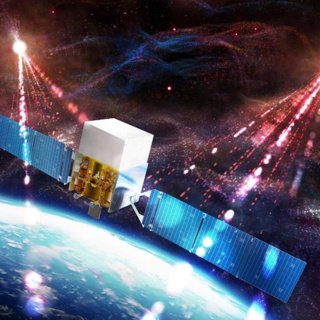
Acknowledements: Podcast prepared with Google/NotebookLM. Illustration credits: Chinese Academy of Sciences (CAS).

Tämä jakso on lisätty Podme-palveluun avoimen RSS-syötteen kautta eikä se ole Podmen omaa tuotantoa. Siksi jakso saattaa sisältää mainontaa.

Jaksot(112)

Peering Through the Ice: The Milky Way’s High-Energy Neutrino Signal

Peering Through the Ice: The Milky Way’s High-Energy Neutrino Signal

Peering Through the Ice: The Milky Way’s High-Energy Neutrino Signal Episode Summary: In this episode, we explore a major breakthrough in astrophysics: the IceCube Neutrino Observatory has established...

31 Heinä 20min

The Schmidt Observatory System unlocking the Transient Universe

The Schmidt Observatory System unlocking the Transient Universe

In this episode, we dive into the Eric and Wendy Schmidt Observatory System, a groundbreaking initiative designed to pioneer a new paradigm for astronomical research through rapid development, modular...

27 Heinä 21min

GUANO, NITRATES, and GLIMPSE: The Pipelines Powering Multi-Messenger Astronomy

GUANO, NITRATES, and GLIMPSE: The Pipelines Powering Multi-Messenger Astronomy

In this episode, we dive into the cutting-edge of time-domain and multi-messenger astrophysics with a deep look at BAT-GLIMPSE, a revolutionary new open-source pipeline developed for the Neil Gehrels ...

20 Heinä 20min

The Dynamic Radio Sky: Unveiling Transients with the SKAO

The Dynamic Radio Sky: Unveiling Transients with the SKAO

Welcome to a deep dive into the fast-paced, explosive universe of time-domain astronomy! In this episode, we explore how the upcoming Square Kilometre Array Observatory (SKAO) will revolutionize our u...

13 Heinä 19min

X-Raying the Earth: Neutrino Tomography at the South Pole

X-Raying the Earth: Neutrino Tomography at the South Pole

Welcome back to the podcast! Today, we are exploring a groundbreaking new way scientists are looking deep inside our planet. For a century, our understanding of the Earth's interior has relied almost ...

8 Heinä 23min

SVOM's First Year: From Gamma-Ray Bursts to Blazars

SVOM's First Year: From Gamma-Ray Bursts to Blazars

In this episode, we dive into the exciting early results from the SVOM (Space-based multi-band astronomical Variable Objects Monitor) mission, which launched in June 2024. Originally designed to hunt ...

6 Heinä 20min

SN 2024jlc: Bridging the Gap Between Supernova Classes

SN 2024jlc: Bridging the Gap Between Supernova Classes

In this episode, we dive into the fascinating discovery of SN 2024jlc, one of the closest and least luminous super-luminous supernovae (SLSNe) ever found. We explore how this extraordinary event is ch...

3 Heinä 20min

Cosmic Accelerators: Unlocking the Secrets of Microquasar GRS 1915+105

Cosmic Accelerators: Unlocking the Secrets of Microquasar GRS 1915+105

In this episode, we dive into the extreme and fascinating world of microquasars—binary systems where a compact object, like a black hole, feeds off a companion star and launches powerful, relativistic...

26 Kesä 20min

Suosittua kategoriassa Tiede

rss-poliisin-mieli
tiedekulma-podcast
rss-mita-tulisi-tietaa
rss-tiedetta-vai-tarinaa
utelias-mieli
rss-kasvikutsut
filocast-filosofian-perusteet
rss-ranskaa-raakana
rss-ylistys-elaimille
rss-ammamafia
rss-astetta-parempi-elama-podcast
mielipaivakirja
hippokrateen-vastaanotolla
rss-duodecim-lehti
rss-tervetta-skeptisyytta
rss-radplus