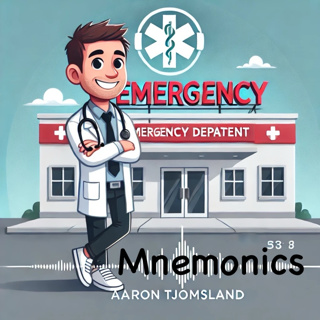
STEMI ischemic and reciprocal change patterns

STEMI ischemic and reciprocal change patterns

In a cardiac emergency, pattern recognition saves lives. The ability to rapidly identify ST-elevation myocardial infarctions (STEMIs) — and recognize their reciprocal changes — is one of the most high-yield clinical skills you can master. But memorizing lead groupings, artery territories, and reciprocal zones can feel abstract… until now.


This podcast brings EKGs to life inside a colorful, stadium-themed world where each ECG lead is a character in the crowd — making it dramatically easier to remember the key patterns of ischemia and their reciprocals. Whether you’re a student, clinician, or educator, this episode transforms clinical EKG interpretation into vivid, unforgettable storytelling.


🧠 Characters You’ll Meet:

• Inferior Peasants (II, III, aVF) — Dirty, disheveled townsfolk crowd-surfing with broken RC cars (Right Coronary Artery), holding crossed-out nitro packs to remind us: No nitro in RCA infarcts!

• Royal Ladder Holders (I, aVL, V5, V6) — Crowned kings and queens dropping through trapdoors as reciprocal ST depression hits the lateral leads, each holding golden ladders labeled Left Circumflex.

• Cavemen with Septal Bones (V1–V2) — Giant-nosed, primitive figures gripping a huge bone marked SEPTAL, standing just in front of…

• Shirtless Musclemen (V3–V4) — Tattooed with the word Anterior, these strongmen are chained to a floating AC unit labeled Left Ventricle — representing the LAD (Widowmaker).

• Posterior Posts (V7–V9) — Hydraulic pylons rising behind the wall, symbolizing posterior MI that’s often missed without reciprocal signs.


🎯 Quick Reference Patterns Covered in the Episode:


✅ Inferior MI (II, III, aVF)

• ST elevation: Inferior leads

• Reciprocal depression: I, aVL (high lateral)

→ “When the peasants rise, the royals fall.”


✅ High Lateral MI (I, aVL)

• ST elevation: High lateral leads

• Reciprocal depression: III, aVF

→ Works both ways: “The balcony royals rise, the peasants fall.”


✅ Posterior MI (V7–V9)

• ST elevation: Posterior wall (not on standard 12-lead!)

• Reciprocal depression: V1–V3

→ “When posterior posts rise, septal cavemen drop.”


✅ Anterior MI (V2–V4)

• ST elevation: Anterior leads

• Possible reciprocal depression: II, III, aVF

→ Sometimes: “When the chest heroes rise, peasants tremble.”


✅ Low Lateral MI (V5–V6)

• ST elevation: Low lateral leads

• Reciprocal depression: V1–V2 (septal)

→ “Kings and queens rise, cavemen fall.”


🔥 Bonus Insights:

• Why reciprocal changes matter: They can confirm a true STEMI, suggest a larger infarct area, and sometimes reveal hidden infarctions (like posterior MIs).

• LBBB & Reciprocal Thinking: LBBB distorts ST segments, but understanding the mirror logic behind “William” (LBBB) and “Marrow” (RBBB) helps clarify expected patterns. ST depression in V1–V2? May just be part of LBBB — unless it’s concordant…


📌 Use this episode as your visual and verbal anchor. Once you’ve seen the peasants, the royalty, the cavemen, and the Left Vent AC unit, you’ll never look at a 12-lead the same way again.

Jaksot(63)

Sick-Tachy or Tachy-sick: S.T.O.P. Secondary Compensations (Must-consider Differentials)

Sick-Tachy or Tachy-sick: S.T.O.P. Secondary Compensations (Must-consider Differentials)

When the heart rate blasts past 150, our reflex is often to grab a syringe—diltiazem, metoprolol, something to slow things down. But here’s the hard truth: if the patient is in sick-tachy—tachycardia ...

11 Syys 202540min

6 S’s & 6 H’s Heart Score: Chest Pain & Diamond Classification Risk Stratification

6 S’s & 6 H’s Heart Score: Chest Pain & Diamond Classification Risk Stratification

Chest pain is one of the most common—and highest risk—complaints in the ED. Missing acute coronary syndrome can be catastrophic, but keeping every patient in the hospital isn’t realistic either. That’...

11 Syys 202539min

LBBB Sgarbossa Criteria: 1 Excessive Disc, 2 Concordance Contact Lenses

LBBB Sgarbossa Criteria: 1 Excessive Disc, 2 Concordance Contact Lenses

When a left bundle branch block (LBBB) throws a wrench into your ECG interpretation, how do you know if it’s a STEMI… or just baseline noise?In this unforgettable episode, we ride full throttle into t...

3 Syys 202541min

EKG Basic Basic Basic Framework for EM Docs: Ischemia, Arrhythmias, Intervals, Anomalies

EKG Basic Basic Basic Framework for EM Docs: Ischemia, Arrhythmias, Intervals, Anomalies

This is the most basic, essential framework for EKG interpretation — built for emergency medicine clinicians who need clarity, speed, and confidence in the heat of the moment.Our brains are wired for ...

26 Elo 20251h 5min

Macrocytic Anemia in the ED: My Liver Bleeds a Lot (part 3)

Macrocytic Anemia in the ED: My Liver Bleeds a Lot (part 3)

Step into the macrocytic anemia caboose and remember the non-megaloblastic causes with the mnemonic My Liver Bleeds a Lot: • My → Multiple Myeloma (CRAB: Hypercalcemia, Renal failure, Anemia, Bone les...

11 Elo 202551min

Sickle Cell Crisis: 4 R’s Mnemonic — Recognize, Reverse, Radiology, Refer

Sickle Cell Crisis: 4 R’s Mnemonic — Recognize, Reverse, Radiology, Refer

In the fast-paced, high-stakes world of emergency medicine, every second matters—especially when it comes to sickle cell crisis. This podcast takes you straight to the heart of what matters most for E...

8 Elo 202522min

Hemolytic Anemias: TAG My Suitcase mnemonic

Hemolytic Anemias: TAG My Suitcase mnemonic

Hemolytic Anemias Mnemonic for the ED: TAG MY SUITCASEIn this high‑impact episode of Emergency Medicine Mind Palace, we break down hemolytic anemias into a memorable 5‑suitcase system that will stick ...

2 Elo 202519min

Suosittua kategoriassa Terveys ja hyvinvointi

unicast
rss-hanna-tikander
tiedenaiset-podcast
psykopodiaa-podcast
voi-hyvin-meditaatiot-2
rss-pitaisko-erota
rss-kuumilla-aalloilla
vakeva-elama-viisaampi-mieli-vahvempi-keho
rss-narsisti
junnut-pelissa
rss-pt-paahtio
puhu-muru
katilon-kahvitunti
rss-kyykkya-ja-kuoharia
meditaatiot-suomeksi
paritellen
fitnessvastaanotto
rss-sanelunpurku-podcast
rss-seuraava-potilas
terapiassa