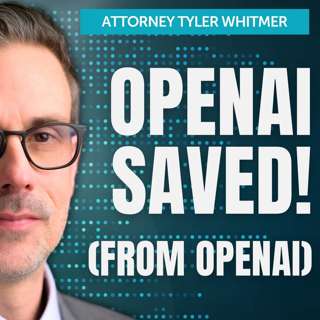
OpenAI: The nonprofit refuses to be killed (with Tyler Whitmer)
80,000 Hours Podcast11 Marras 2025

OpenAI: The nonprofit refuses to be killed (with Tyler Whitmer)

Last December, the OpenAI business put forward a plan to completely sideline its nonprofit board. But two state attorneys general have now blocked that effort and kept that board very much alive and kicking.

The for-profit’s trouble was that the entire operation was founded on the premise of — and legally pledged to — the purpose of ensuring that “artificial general intelligence benefits all of humanity.” So to get its restructure past regulators, the business entity has had to agree to 20 serious requirements designed to ensure it continues to serve that goal.

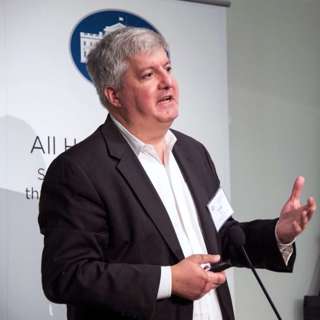
Attorney Tyler Whitmer, as part of his work with Legal Advocates for Safe Science and Technology, has been a vocal critic of OpenAI’s original restructure plan. In today’s conversation, he lays out all the changes and whether they will ultimately matter.

Full transcript, video, and links to learn more: https://80k.info/tw2

After months of public pressure and scrutiny from the attorneys general (AGs) of California and Delaware, the December proposal itself was sidelined — and what replaced it is far more complex and goes a fair way towards protecting the original mission:

  • The nonprofit’s charitable purpose — “ensure that artificial general intelligence benefits all of humanity” — now legally controls all safety and security decisions at the company. The four people appointed to the new Safety and Security Committee can block model releases worth tens of billions.
  • The AGs retain ongoing oversight, meeting quarterly with staff and requiring advance notice of any changes that might undermine their authority.
  • OpenAI’s original charter, including the remarkable “stop and assist” commitment, remains binding.

But significant concessions were made. The nonprofit lost exclusive control of AGI once developed — Microsoft can commercialise it through 2032. And transforming from complete control to this hybrid model represents, as Tyler puts it, “a bad deal compared to what OpenAI should have been.”

The real question now: will the Safety and Security Committee use its powers? It currently has four part-time volunteer members and no permanent staff, yet they’re expected to oversee a company racing to build AGI while managing commercial pressures in the hundreds of billions.

Tyler calls on OpenAI to prove they’re serious about following the agreement:

  • Hire management for the SSC.
  • Add more independent directors with AI safety expertise.
  • Maximise transparency about mission compliance.

"There’s a real opportunity for this to go well. A lot … depends on the boards, so I really hope that they … step into this role … and do a great job. … I will hope for the best and prepare for the worst, and stay vigilant throughout."

Chapters:

  • We’re hiring (00:00:00)
  • Cold open (00:00:40)
  • Tyler Whitmer is back to explain the latest OpenAI developments (00:01:46)
  • The original radical plan (00:02:39)
  • What the AGs forced on the for-profit (00:05:47)
  • Scrappy resistance probably worked (00:37:24)
  • The Safety and Security Committee has teeth — will it use them? (00:41:48)
  • Overall, is this a good deal or a bad deal? (00:52:06)
  • The nonprofit and PBC boards are almost the same. Is that good or bad or what? (01:13:29)
  • Board members’ “independence” (01:19:40)
  • Could the deal still be challenged? (01:25:32)
  • Will the deal satisfy OpenAI investors? (01:31:41)
  • The SSC and philanthropy need serious staff (01:33:13)
  • Outside advocacy on this issue, and the impact of LASST (01:38:09)
  • What to track to tell if it's working out (01:44:28)


This episode was recorded on November 4, 2025.

Video editing: Milo McGuire, Dominic Armstrong, and Simon Monsour
Audio engineering: Milo McGuire, Simon Monsour, and Dominic Armstrong
Music: CORBIT
Coordination, transcriptions, and web: Katy Moore

Jaksot(319)

#45 - Tyler Cowen's case for maximising econ growth, stabilising civilization & thinking long-term

#45 - Tyler Cowen's case for maximising econ growth, stabilising civilization & thinking long-term

I've probably spent more time reading Tyler Cowen - Professor of Economics at George Mason University - than any other author. Indeed it's his incredibly popular blog Marginal Revolution that prompted...

17 Loka 20182h 30min

#44 - Paul Christiano on how we'll hand the future off to AI, & solving the alignment problem

#44 - Paul Christiano on how we'll hand the future off to AI, & solving the alignment problem

Paul Christiano is one of the smartest people I know. After our first session produced such great material, we decided to do a second recording, resulting in our longest interview so far. While challe...

2 Loka 20183h 51min

#43 - Daniel Ellsberg on the institutional insanity that maintains nuclear doomsday machines

#43 - Daniel Ellsberg on the institutional insanity that maintains nuclear doomsday machines

In Stanley Kubrick’s iconic film Dr. Strangelove, the American president is informed that the Soviet Union has created a secret deterrence system which will automatically wipe out humanity upon detect...

25 Syys 20182h 44min

#42 - Amanda Askell on moral empathy, the value of information & the ethics of infinity

#42 - Amanda Askell on moral empathy, the value of information & the ethics of infinity

Consider two familiar moments at a family reunion. Our host, Uncle Bill, takes pride in his barbecuing skills. But his niece Becky says that she now refuses to eat meat. A groan goes round the table; ...

11 Syys 20182h 46min

#41 - David Roodman on incarceration, geomagnetic storms, & becoming a world-class researcher

#41 - David Roodman on incarceration, geomagnetic storms, & becoming a world-class researcher

With 698 inmates per 100,000 citizens, the U.S. is by far the leader among large wealthy nations in incarceration. But what effect does imprisonment actually have on crime? According to David Roodman...

28 Elo 20182h 18min

#40 - Katja Grace on forecasting future technology & how much we should trust expert predictions

#40 - Katja Grace on forecasting future technology & how much we should trust expert predictions

Experts believe that artificial intelligence will be better than humans at driving trucks by 2027, working in retail by 2031, writing bestselling books by 2049, and working as surgeons by 2053. But ho...

21 Elo 20182h 11min

#39 - Spencer Greenberg on the scientific approach to solving difficult everyday questions

#39 - Spencer Greenberg on the scientific approach to solving difficult everyday questions

Will Trump be re-elected? Will North Korea give up their nuclear weapons? Will your friend turn up to dinner? Spencer Greenberg, founder of ClearerThinking.org has a process for working out such real...

7 Elo 20182h 17min

#38 - Yew-Kwang Ng on anticipating effective altruism decades ago & how to make a much happier world

#38 - Yew-Kwang Ng on anticipating effective altruism decades ago & how to make a much happier world

Will people who think carefully about how to maximize welfare eventually converge on the same views? The effective altruism community has spent a lot of time over the past 10 years debating how best t...

26 Heinä 20181h 59min

Suosittua kategoriassa Koulutus

rss-murhan-anatomia
psykopodiaa-podcast
voi-hyvin-meditaatiot-2
rss-narsisti
adhd-podi
rss-duodecim-lehti
jari-sarasvuo-podcast
leveli
rss-liian-kuuma-peruna
rss-valo-minussa-2
rss-koira-haudattuna
rahapuhetta
rss-niinku-asia-on
salainen-paivakirja
psykologia
ihminen-tavattavissa-tommy-hellsten-instituutti
rss-uskonto-on-tylsaa
rss-luonnollinen-synnytys-podcast
rss-tietoinen-yhteys-podcast-2
rss-arkea-ja-aurinkoa-podcast-espanjasta