
DH Ep:45 The Dust Bowl Migration
Disturbing History23 Marras 2025

DH Ep:45 The Dust Bowl Migration

On April fourteenth, 1935, a wall of darkness seven thousand feet high and two hundred miles wide tore across the Great Plains at sixty miles per hour. Black Sunday wasn’t just a storm—it was the moment the Dust Bowl stopped being a hardship and became a breaking point. For hundreds of thousands of families already living in an apocalyptic landscape of dust, failed crops, and dying livestock, that day crushed whatever hope they had left.

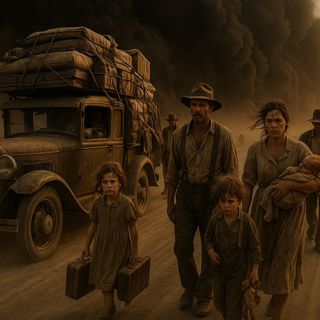
What followed should have been a story of American compassion and resilience. Instead, it became one of the ugliest chapters of organized exploitation in our history. This episode of Disturbing History plunges into the Dust Bowl migration of the 1930s, when roughly three to four hundred thousand desperate people fled the Plains for California, believing they were chasing survival and a fresh start. But the promised land waiting at the edge of the map was built to profit from desperation.

California’s booming agricultural empire had perfected a system that depended on an endless supply of hungry labor. Corporate farms flooded the country with handbills advertising work, deliberately recruiting three times more people than they needed so wages could be driven below starvation levels. Families who had escaped one catastrophe arrived only to find another—one engineered by human hands.

Through survivor testimony and contemporary investigation, we step into the ditch camps where families slept under bridges, along drainage canals, and in makeshift shelters pieced together from tin, cardboard, canvas, and palm fronds. We walk through company camps that charged rent for dirt-floor shacks without plumbing or windows, and contractor camps where workers could labor for weeks and still end up in debt.

The economics of this system were brutal and clear: cotton-picking wages collapsed from a dollar fifty per hundred pounds to forty cents, even as growers claimed poverty while continuing to pay dividends to shareholders. Behind it all stood the Associated Farmers, a soothing name masking a corporate-backed anti-union machine that used vigilantes, spies, bought law enforcement, and intimidation to crush any hint of organizing.

The violence exploded into the open during the 1933 cotton strike in Pixley, California, when armed growers fired on unarmed workers, killing Mexican strikers and injuring many more. Sheriffs deputized hundreds of farm owners and loyalists, police broke peaceful picket lines with clubs and tear gas, and organizers were beaten, jailed, and driven out on manufactured charges. The terror was so widespread that the La Follette Committee’s congressional investigation later compared California’s farm labor system to fascist regimes rising in Europe.Some of the most devastating consequences fell on children.

In the camps, child mortality soared to more than double the state average. Schooling barely existed for many, with half never making it past third grade, and children as young as five or six working long days in the fields. Women suffered not only hunger and disease but predation from foremen who coerced sexual favors for work. Men who had once owned farms and fed their families were reduced to lining up for jobs, inspected like livestock, living under a humiliation that hollowed out entire communities. When federal intervention finally arrived, it exposed the truth California growers tried to deny. Clean government camps with running water and medical care proved the misery in the fields was never inevitable—it was chosen, because it was profitable.

National attention cracked open when The Grapes of Wrath and Dorothea Lange’s photographs, including the iconic “Migrant Mother,” forced the country to look directly at what was happening. Even after the La Follette Committee documented a coordinated assault on civil rights and echoed the warning signs of European fascism, the architects of the system faced no meaningful consequences.

World War Two eased the immediate crisis by creating labor shortages, but the machinery of exploitation didn’t stop—it simply found new bodies. The Bracero Program brought Mexican workers into the same fields under conditions often worse than what Dust Bowl migrants endured. And today, agricultural labor in the United States, carried largely by Latin American immigrants, still reflects that legacy: poverty wages, substandard housing, intimidation, and discrimination that feel hauntingly familiar.

The Dust Bowl migration reveals a truth that remains hard to face—American capitalism has repeatedly relied on someone being desperate enough to exploit, and when one group escapes the grinder, another is pulled in to replace them.

Have a forgotten historical mystery, disturbing event, unsolved crime, or hidden conspiracy you think deserves investigation?

Send your suggestions to brian@paranormalworldproductions.com.

Disturbing History is a dark history podcast exploring unsolved mysteries, secret societies, historical conspiracies, lost civilizations, and the shadowy stories buried beneath the surface of the past.

Follow the show and enable automatic downloads so you never miss a deep dive into history’s most unsettling secrets.

Because sometimes the truth is darker than fiction.

Tämä jakso on lisätty Podme-palveluun avoimen RSS-syötteen kautta eikä se ole Podmen omaa tuotantoa. Siksi jakso saattaa sisältää mainontaa.

Jaksot(132)

John D. Rockefeller Junior

John D. Rockefeller Junior

Part one left the old man under an obelisk in Cleveland, ninety-seven years old, the richest human being who had ever lived, and remembered by most of America as a kindly figure who handed out dimes a...

7 Elo 57min

John D. Rockefeller Sr. The Man Who Bought the Story

John D. Rockefeller Sr. The Man Who Bought the Story

In February of 1908, a reporter for Joseph Pulitzer's New York World walked into a drugstore in Freeport, Illinois, put a photograph on the counter, and finally closed a manhunt that had run for seven...

5 Elo 1h 10min

Say My Name

Say My Name

A man in Zhengzhou spent eight years living in a $42-a-month rental and sending every spare yuan home to his wife so she'd feel secure. When he finally asked to see the bank account, she refused. Then...

2 Elo 1h 2min

The Bombing Of Pan Am Flight 103

The Bombing Of Pan Am Flight 103

At two minutes past seven on the evening of December 21, 1988, an air traffic controller at Prestwick watched a single radar return break apart into a spray of echoes over the Solway Firth. Thirty-eig...

31 Heinä 1h 17min

The Wealth Divide

The Wealth Divide

The wealth divide in America did not settle the way sediment settles. It was built, revised, briefly reversed, and then rebuilt with better engineering, and nearly every stage of it can be traced to i...

29 Heinä 1h 21min

The Distraction Machine

The Distraction Machine

For more than two thousand years, powerful institutions have understood something that gets rediscovered in every generation: an absorbed public is a manageable public. In this episode I follow that i...

26 Heinä 1h 7min

The Year Without a Summer

The Year Without a Summer

In June of 1816, snow fell on Vermont and killing frost swept through New England in the middle of what should have been the growing season. Frost returned in July and again in August, the corn crop c...

24 Heinä 1h 6min

The Watchers We Invited In

The Watchers We Invited In

How many calls from unknown numbers did you get today? The one about your car's extended warranty, the text about a package that couldn't be delivered, the voice on the line claiming your grandson is ...

22 Heinä 1h 13min

Suosittua kategoriassa Yhteiskunta

olipa-kerran-otsikko
seitseman
i-dont-like-mondays
siita-on-vaikea-puhua
sita
poks
antin-palautepalvelu
gogin-ja-janin-maailmanhistoria
kaksi-aitia
hupiklubi
mamma-mia
kolme-kaannekohtaa
yopuolen-tarinoita-2
rss-palmujen-varjoissa
aikalisa
ihme-ja-kumma
meidan-pitais-puhua
rss-haudattu
loukussa
lahko