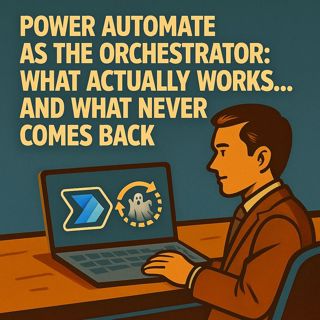
Power Automate as the Orchestrator: What Actually Works… and What Never Comes Back.

Power Automate as the Orchestrator: What Actually Works… and What Never Comes Back.

(00:00:00) The Awakening Flow
(00:00:48) The Mysterious Trigger
(00:03:21) Guarding the Flow
(00:04:12) The Silent Listener
(00:04:45) Binding the Beast
(00:05:05) The Golden Rules
(00:07:26) Microflows and Security
(00:08:09) The Copy-Paste Ritual
(00:09:10) The Secret to Success
(00:11:19) Urban Legends from the Tenant

n this reflective, metaphor‑rich episode of m365.fm, Mirko Peters uses Power Automate as a lens to explore what orchestration really means in modern cloud systems. This is not a tutorial on individual flows; it is an examination of the hidden machinery that keeps work moving: gateways, logs, retries, queues, and policies that decide what actually comes back — and what silently disappears. If you build, own, or depend on automation in Microsoft 365 and Azure, this episode helps you see your flows not as scripts, but as living infrastructure that can either carry risk away or trap it.

You will hear how every automation starts as hope — a bright idea to remove toil or speed up a process — and how that hope either hardens into reliable orchestration or dissolves into chaos when discipline is missing. Mirko describes flow as a character: sometimes fragile, sometimes stubborn, sometimes surprisingly generous when you give it the right architecture. Using vivid analogies from the transcript, he walks through “haunted bridges” that represent on‑premises and cloud gateways, “dark forests” that stand in for complex networks and dependencies, and the quiet, invisible labor of systems that only become visible when they fail.

The episode dives into the emotional side of owning automation: the loneliness of being responsible for flows no one else understands, the weight of building systems that will keep running long after you leave, and the reality that real reliability requires repetition, monitoring, and care — not just clever expressions. Mirko reframes reliability engineering as a form of storytelling: listening to logs, interpreting signals, and treating each incident as a chapter in a larger narrative about how your platform behaves under stress. Systems “whisper” about their future through small warnings, throttling, and intermittent timeouts long before they go down loudly.

At the same time, the episode is blunt about the cost of ignoring structure. Hope does not keep flows alive; licensing, Azure consumption, architecture, and operational discipline do. When flows run under personal connections, when gateways are left unmonitored, when logs are never read, even the most promising automation turns into a liability. Mirko explains why observability — correlation IDs, logs, alerts, and dashboards — is not optional add‑on work but the foundation that turns Power Automate from “it usually works” into a dependable orchestrator across Microsoft 365, Azure, and on‑premises systems.

WHAT YOU WILL LEARN
  • Why Power Automate should be treated as orchestration infrastructure, not just “flows that run in the background.”
  • How logs, gateways, monitors, queues, and licensing quietly decide which automations succeed and which silently fail.
  • How to think about reliability, observability, and operational discipline in the Microsoft 365 and Azure automation stack.
  • Why unstructured, hope‑driven automation eventually collapses under its own complexity and consumption.
  • How to listen to your systems — through logs and patterns — instead of waiting for visible outages to force attention.
WHO THIS EPISODE IS FOR
  • Power Automate makers and administrators who own critical business flows.
  • Microsoft 365 and Azure engineers responsible for gateways, integrations, and automation reliability.
  • SRE, DevOps, and platform teams bringing observability and discipline to low‑code automation.
  • Architects designing automation-heavy solutions that must survive long term in production.
  • Anyone who has ever watched a “simple” flow quietly fail and wanted a better way to design, monitor, and own automation.
ABOUT THE HOST
Mirko Peters is a Microsoft 365 expert, architect, and host of m365.fm. He works with organizations from small businesses to large enterprises on Microsoft 365 architecture, security, automation, AI integration, governance design, and system architecture. His work focuses on designing context‑driven systems that reduce complexity, enable autonomous execution, and create scalable performance across modern enterprises.


Become a supporter of this podcast: https://www.spreaker.com/podcast/m365-fm-modern-work-security-and-productivity-with-microsoft-365--6704921/support.

Denne episoden er hentet fra en åpen RSS-feed og er ikke publisert av Podme. Den kan derfor inneholde annonser.

Episoder(864)

From Excel Expert to Microsoft MVP: Empowering Millions with Data, Dashboards & AI with Karen Abecia [Microsoft MVP]

From Excel Expert to Microsoft MVP: Empowering Millions with Data, Dashboards & AI with Karen Abecia [Microsoft MVP]

aren Abecia shares the remarkable journey that transformed a passion for Microsoft Excel into a global career as one of the world's best-known Excel educators. She explains how discovering creative sp...

27 Jul 0s
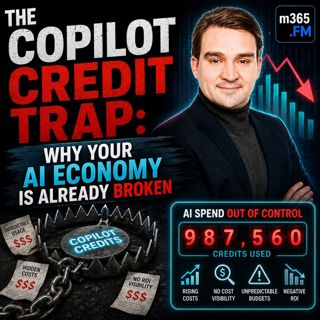
The Copilot Credit Trap- Why Your AI Economy is Already Broken

The Copilot Credit Trap- Why Your AI Economy is Already Broken

For decades, enterprise software followed a predictable financial model. Organizations purchased licenses, assigned them to users, and budgeted annual IT spending with confidence. AI changes that comp...

26 Jul 0s
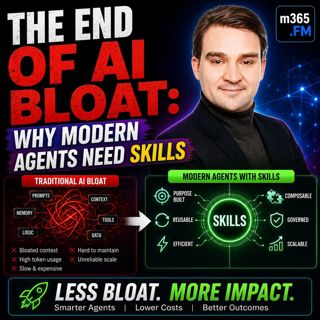
The End of AI Bloat: Why Modern Agents Need Skills

The End of AI Bloat: Why Modern Agents Need Skills

Many AI agents start out fast, responsive, and surprisingly intelligent. But after a few months of real-world use, something changes. Response times increase, costs rise, prompts become enormous, and ...

26 Jul 0s
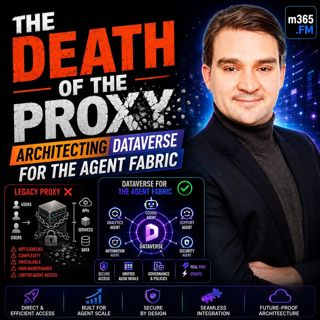
THE DEATH OF THE PROXY: Architecting Dataverse for the Agent Fabric

THE DEATH OF THE PROXY: Architecting Dataverse for the Agent Fabric

For years, Microsoft's recommended architecture for connecting AI assistants like Claude Desktop to Dataverse relied on a local STDIO proxy. It was simple, easy to install, and perfectly suited for in...

26 Jul 0s
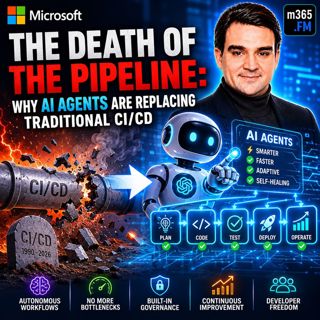
The Death of the Pipeline: Why AI Agents are Replacing Traditional

The Death of the Pipeline: Why AI Agents are Replacing Traditional

For more than two decades, CI/CD pipelines have been the backbone of modern software delivery. Developers commit code, automated builds run, tests execute, security scans complete, someone approves th...

25 Jul 0s
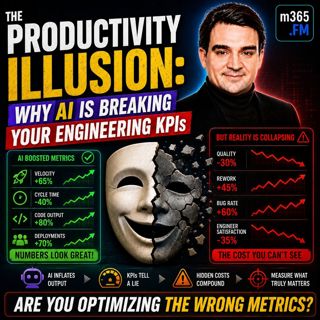
The Productivity Illusion: Why AI is Breaking Your Engineering KPIs

The Productivity Illusion: Why AI is Breaking Your Engineering KPIs

At first glance, the numbers look incredible. Deployment frequency is increasing, pull requests are being merged faster than ever, AI is generating more code, and engineering teams appear dramatically...

25 Jul 0s
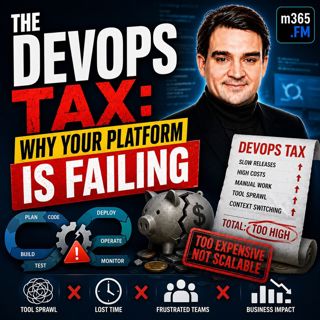
The DevOps Tax: Why Your Platform is Failing

The DevOps Tax: Why Your Platform is Failing

Welcome to another episode of Knowledge Nuggets with Mirko Peters. Today we're exploring The DevOps Tax—the hidden cost that silently reduces engineering productivity, increases cognitive overload, an...

25 Jul 0s
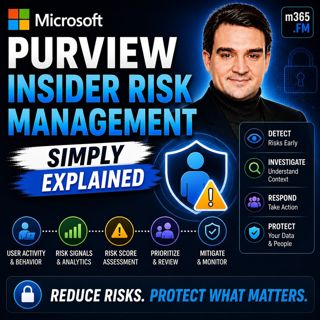
Microsoft Purview Insider Risk Management - Simply Explained

Microsoft Purview Insider Risk Management - Simply Explained

Welcome to another episode of Knowledge Nuggets with Mirko Peters. Today we're exploring Microsoft Purview Insider Risk Management, Microsoft's intelligent solution for identifying risky user behavior...

24 Jul 0s

Populært innen Politikk og nyheter

giver-og-gjengen-vg
aftenpodden
forklart
popradet
fotballpodden-2
stopp-verden
rss-gukild-johaug
aftenpodden-usa
hanna-de-heldige
dine-penger-pengeradet
rss-ness
aftenbla-bla
det-store-bildet
lydartikler-fra-aftenposten
nokon-ma-ga
unitedno
e24-podden
rss-penger-polser-og-politikk
bt-dokumentar-2
oppdatert