Power Apps Failure Patterns, With() Pattern Fixes, and Governance for Reliable Low-Code Apps

Power Apps Failure Patterns, With() Pattern Fixes, and Governance for Reliable Low-Code Apps

(00:00:00) The Fragility of Power Apps
(00:00:04) The Hidden Dangers of Low-Code Development
(00:00:29) The Anatomy of App Failure
(00:01:09) The Silent Killers of App Performance
(00:02:35) The Cycle of Patching and Drift
(00:04:13) Mapping the App's Dependency Graph
(00:08:13) The Power of Local Truth and Guardrails
(00:13:42) Components and Contracts: Building Scalable Apps
(00:18:18) The Importance of Governance and Testing
(00:22:57) Implementing a Refactor Plan and Governance Template

Your Power App works — until it doesn’t. No error. No warning. Just silence and a spinning wheel. Low-code wasn’t sold as “fragile,” but that is exactly what you get when you copy‑paste formulas, skip environments, and bury dependencies where no one can see them. In this episode of m365.fm, Mirko Peters exposes why Power Apps fail without telling you, where the fractures actually hide, and how the With() pattern, components, and real ALM turn drift into something you can prevent instead of chase at 11 p.m.

THE ANATOMY OF FRAGILITY: WHY YOUR APP ACTUALLY FAILS

Power Apps do not usually break loudly; they degrade quietly. You only notice after users complain, “It just spins.” Mirko walks through the most common failure modes you are probably already living with:
  • Formula drift from copy‑pasted logic evolving differently on different screens.
  • No environment boundary, where Studio “Play” becomes your production test.
  • Hidden dependencies in globals, collections, and shadow connectors impersonating user identity.
  • “Token thinking,” where “it worked once” becomes the QA strategy until a schema rename destroys everything.
  • Identity drift from ad‑hoc sharing and permission patches.
  • Delegation traps that behave fine at 500 rows and collapse at 50,000.
  • Latency creep as Dataverse and SharePoint joins push expensive work to the client.
  • Silent error swallowing where Patch failures vanish and duplicate rows explode.
FORENSICS: HOW TO SEE THE APP BEFORE YOU “FIX” IT

You cannot fix an app you cannot see. This section teaches you to run forensic discovery like an engineer, not a guesser. You will learn how to:
  • Map critical user flows such as Submit, Approve, and Report.
  • Inventory every dependency: tables, connectors, roles, variables, component props.
  • Surface invisible state across Set, UpdateContext, Collect, and App.OnStart caches.
  • Diff formulas across screens to reveal drift and inconsistencies.
  • Build a dependency graph that shows where trust, data, and identity actually intersect.
  • Rehearse failure intentionally by throttling connectors, renaming fields, expiring tokens, and breaking flow connections.
  • Define a health model with red/yellow/green thresholds for top user paths.
  • Instrument telemetry with correlation IDs, durations, and outcomes — without leaking PII.
THE FIX STARTS LOCAL: WITH() AS THE GUARDRAIL

The turning point in the episode is the With() pattern. With() introduces local scope, a single source of truth, and named intent that stops formula drift at its root. Mirko shows why this pattern works so well:
  • Containment: no global side effects leaking across the app.
  • Clarity: a clean flow from input → transform → payload → output.
  • Predictability: one exit path and no duplicated logic hidden on multiple controls.
  • Performance: heavy calls cached once instead of being recalculated per row.
  • Safety: schema coercion and type normalization happening in exactly one place.
You will hear concrete patterns for using With(): building query models, constructing patch payloads, routing all success/failure through a single result object, memoizing expensive transforms, and guarding inputs to avoid delegation failures before they hit production.

BEYOND A SINGLE SCREEN: COMPONENTS, UDFS & CONTRACTS

Scalability begins when you stop cloning screens and start shipping contracts. Mirko explains how to:
  • Design components that have no globals, only explicit inputs and outputs.
  • Use Enhanced Component Properties (ECP) to pass behavior, not hidden assumptions.
  • Keep connector calls and side effects out of components so they stay reusable and testable.
  • Apply themes through tokens instead of random hex codes inside controls.
He then covers User Defined Functions (UDFs) as the place for model normalization, type coercion, payload construction, telemetry formatting, and guard checks — and why you must avoid using them for side effects or global state mutation. The combination of components and UDFs lets you enforce repeatable patterns across apps and teams.

REAL ALM: ENVIRONMENTS, SOLUTIONS & SAFE RELEASES

This is where hobby apps become software. The episode lays out what real ALM for Power Apps looks like:
  • Solutions‑only for Test and Production environments.
  • A Dev → Test → Prod environment chain with clear promotion rules.
  • Branching for all changes and pull requests with formula diffs and delegation checks.
  • Connection references instead of personal connections that break on vacation day one.
  • Environment variables for URLs, endpoints, and feature flags.
  • Deployment pipelines that enforce import, smoke tests, and approvals.
  • Rollback paths with versioned managed solutions, not “hope” and Ctrl‑Z.
The rule is simple: dev is messy, prod is sacred, and solutions are the boundary between the two.PROVING IT UNDER STRESS: TESTING & MONITORING
Resilience is not proven on happy paths. You will hear how to:
  • Write UDF‑level assertions for logic that cannot be allowed to drift.
  • Build harness screens for components so you can test them in isolation.
  • Run synthetic end‑to‑end flows against your most critical scenarios.
  • Simulate token expiry, schema renames, throttling, and connectivity chaos on purpose.
  • Add monitoring and SLOs so you know when an app is degrading before users do.
A Power App that survives these drills is the kind that survives real production usage.

THE REFACTOR PLAN: TURNING CHAOS INTO CLARITY

Mirko gives you a concrete refactor plan you can apply to almost any existing app:
  • Inventory screens, variables, connectors, and dependencies.
  • Identify formula drift and duplicated logic.
  • Replace global logic with scoped With() patterns.
  • Extract shared logic into components and UDFs.
  • Adopt theme tokens for consistent look and accessibility.
  • Move the app into solutions and set up pipelines.
  • Add telemetry, health checks, and error reporting.
  • Enforce governance rules so bad patterns cannot creep back in.
The goal is not a perfect app, but one that is understandable, testable, and fixable.

GOVERNANCE TEMPLATE: RULES THAT MAKE FAILURE RARE

Governance is not bureaucracy; it is the set of rules that make midnight outages unusual instead of inevitable. The episode closes with a concrete governance template:
  • Naming by scope (app., scn., cmp., fn.) so intent is visible.
  • With() required for any formula longer than two lines.
  • No Set() or globals inside components.
  • No copy‑paste formulas across screens.
  • Delegation‑aware queries only, with explicit patterns.
  • Telemetry on all critical paths and submit actions.
  • Managed solutions only in Test/Prod.
  • No personal connections — ever.
  • A pull‑request checklist for every change.
  • Monitoring dashboards for key apps as a non‑negotiable.
WHAT YOU WILL LEARN
  • Why Power Apps fail silently and how formula drift, hidden dependencies, and delegation traps actually show up in real apps.
  • How to run forensic analysis on an app so you can see every dependency, drift point, and failure mode before refactoring.
  • How the With() pattern, components, and UDFs create local scope, clear contracts, and predictable behavior.
  • What real ALM for Power Apps looks like with environments, solutions, pipelines, and rollback.
  • How to design testing, monitoring, and governance rules that make low‑code apps feel like reliable software—not fragile prototypes.
WHO THIS EPISODE IS FOR
  • Power Apps makers who feel their apps “mostly work” until usage increases.
  • Power Platform admins and COE teams responsible for quality and governance.
  • Pro‑devs supporting business apps who want low‑code to behave like real software.
  • Architects designing scalable low‑code patterns across departments and environments.
  • Anyone who has been burned by a silent Power App failure and wants a repeatable way to prevent the next one.
ABOUT THE HOST

Mirko Peters is a Microsoft 365 and Power Platform expert, architect, and host of m365.fm. He works with organizations from small businesses to large enterprises on Microsoft 365 architecture, security, low‑code and AI integration, governance design, and system architecture.

Become a supporter of this podcast: https://www.spreaker.com/podcast/m365-fm-modern-work-security-and-productivity-with-microsoft-365--6704921/support.

Denne episoden er hentet fra en åpen RSS-feed og er ikke publisert av Podme. Den kan derfor inneholde annonser.

Episoder(862)

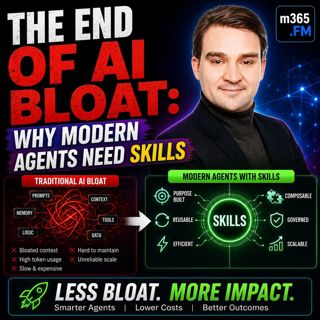
The End of AI Bloat: Why Modern Agents Need Skills

The End of AI Bloat: Why Modern Agents Need Skills

Many AI agents start out fast, responsive, and surprisingly intelligent. But after a few months of real-world use, something changes. Response times increase, costs rise, prompts become enormous, and ...

26 Jul 0s
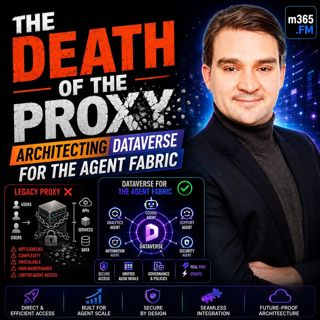
THE DEATH OF THE PROXY: Architecting Dataverse for the Agent Fabric

THE DEATH OF THE PROXY: Architecting Dataverse for the Agent Fabric

For years, Microsoft's recommended architecture for connecting AI assistants like Claude Desktop to Dataverse relied on a local STDIO proxy. It was simple, easy to install, and perfectly suited for in...

26 Jul 0s
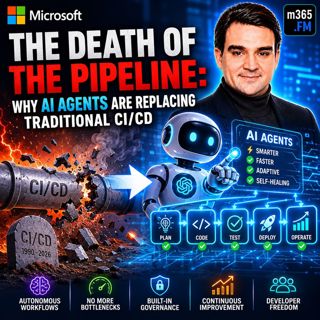
The Death of the Pipeline: Why AI Agents are Replacing Traditional

The Death of the Pipeline: Why AI Agents are Replacing Traditional

For more than two decades, CI/CD pipelines have been the backbone of modern software delivery. Developers commit code, automated builds run, tests execute, security scans complete, someone approves th...

25 Jul 0s
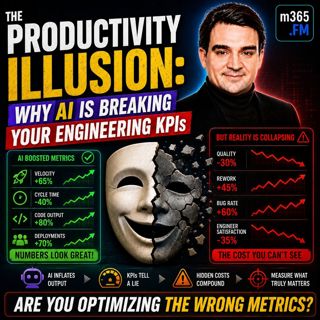
The Productivity Illusion: Why AI is Breaking Your Engineering KPIs

The Productivity Illusion: Why AI is Breaking Your Engineering KPIs

At first glance, the numbers look incredible. Deployment frequency is increasing, pull requests are being merged faster than ever, AI is generating more code, and engineering teams appear dramatically...

25 Jul 0s
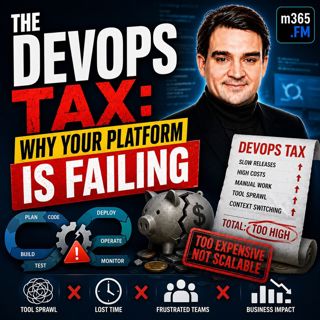
The DevOps Tax: Why Your Platform is Failing

The DevOps Tax: Why Your Platform is Failing

Welcome to another episode of Knowledge Nuggets with Mirko Peters. Today we're exploring The DevOps Tax—the hidden cost that silently reduces engineering productivity, increases cognitive overload, an...

25 Jul 0s
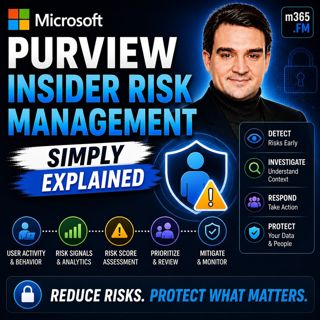
Microsoft Purview Insider Risk Management - Simply Explained

Microsoft Purview Insider Risk Management - Simply Explained

Welcome to another episode of Knowledge Nuggets with Mirko Peters. Today we're exploring Microsoft Purview Insider Risk Management, Microsoft's intelligent solution for identifying risky user behavior...

24 Jul 0s
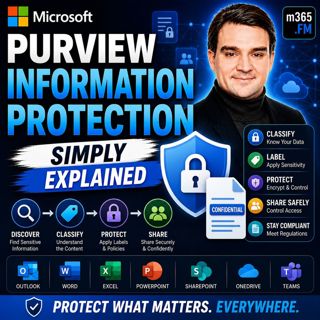
Microsoft Purview Information Protection - Simply Explained

Microsoft Purview Information Protection - Simply Explained

Welcome to another episode of Knowledge Nuggets with Mirko Peters. Today we're exploring Microsoft Purview Information Protection, the foundation of Microsoft's data classification and protection stra...

24 Jul 0s
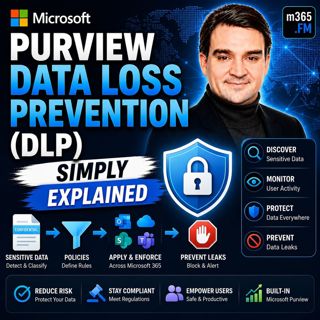
Microsoft Purview Data Loss Prevention (DLP) - Simply Explained

Microsoft Purview Data Loss Prevention (DLP) - Simply Explained

Welcome to another episode of Knowledge Nuggets with Mirko Peters. Today we're exploring Microsoft Purview Data Loss Prevention (DLP), one of the most important security capabilities in Microsoft 365 ...

24 Jul 0s

Populært innen Politikk og nyheter

giver-og-gjengen-vg
aftenpodden
forklart
popradet
stopp-verden
fotballpodden-2
aftenpodden-usa
rss-gukild-johaug
hanna-de-heldige
dine-penger-pengeradet
rss-ness
aftenbla-bla
lydartikler-fra-aftenposten
det-store-bildet
nokon-ma-ga
e24-podden
rss-utenrikskomiteen-med-bogen-og-grasvik
rss-penger-polser-og-politikk
unitedno
bt-dokumentar-2