
Microsoft Fabric & Lakehouse Identity Chaos: How to Stop Permission Sprawl and Govern Access in Modern Data Platforms

Microsoft Fabric & Lakehouse Identity Chaos: How to Stop Permission Sprawl and Govern Access in Modern Data Platforms

(00:00:00) The Importance of Identity in Data Systems
(00:01:52) The Illusion of Natural Keys
(00:03:03) The Lake House Problem
(00:06:08) The Physics of Data Entropy
(00:09:33) Identity Columns as a Solution
(00:10:58) The Clock Without a Mechanism
(00:15:14) Incident 1: Power BI's Silent Bias
(00:19:10) The Futility of Application-Level Identity
(00:23:43) Incident 2: Lakehouse Identity Collapse
(00:28:33) The Inevitability of Replay and Divergence

In this episode of m365.fm, Mirko Peters dives into one of the most quietly painful and persistently underestimated problems in modern data platforms: identity chaos. As organizations scale their analytics environments — especially within lakehouse architectures — identity, access control, and governance tend to sprawl faster than anyone wants to admit. The result is entropy. Confusing permissions, brittle security models, duplicated identities, and a growing gap between data teams and governance teams. This episode explores how Microsoft Fabric approaches this challenge and why identity management is becoming a foundational concern for lakehouse design — not an afterthought.

WHY IDENTITY CHAOS IS INEVITABLE IN GROWING DATA PLATFORMS

Every new project adds new workspaces, new roles, and new data sources. Access gets granted quickly and removed slowly — or never at all. Teams work around broken permission models because the cost of waiting for access is higher than the cost of ignoring the risk. Over time, the lakehouse becomes a place where nobody has a complete picture of who can see what, who granted that access, or whether any of it still makes sense. That is not a failure of the people involved. It is a failure of governance architecture — and it compounds with every new dataset, every new team, and every new integration added to the platform.

HOW ENTROPY SHOWS UP IN REAL-WORLD LAKEHOUSE ENVIRONMENTS

Identity chaos in the lakehouse is not a single dramatic failure. It is a slow accumulation of small decisions made without a governance framework to contain them. Fragmented access policies across workloads, disconnected tooling between data engineering and security teams, inconsistent identity models across environments, and duplicated service principals all contribute to a platform that becomes progressively harder to audit, harder to secure, and harder to trust. When compliance teams try to answer basic questions about who has access to sensitive data, the answers are either wrong or simply unavailable.

WHAT MICROSOFT FABRIC DOES DIFFERENTLY

Microsoft Fabric approaches identity not as a layer added on top of a data platform, but as a foundational design concern that runs across all workloads — data engineering, analytics, real-time intelligence, and governance. By unifying identity experiences across the platform, Fabric reduces the friction that typically drives teams to create workarounds, duplicate access grants, and shadow data pipelines. The goal is not to add another abstraction layer — it is to reduce entropy by making identity coherent, auditable, and manageable at scale without slowing down the teams that depend on the platform every day.

WHAT YOU WILL LEARN
  • Why identity sprawl is the natural and inevitable result of scaling a lakehouse without deliberate governance design.
  • How entropy manifests in real-world Microsoft Fabric and lakehouse deployments — from fragmented permissions to disconnected tooling.
  • Why traditional identity models struggle to keep up with the speed and complexity of modern analytics platforms.
  • How Microsoft Fabric unifies identity across workloads to reduce friction without sacrificing control.
  • What the relationship between identity management, data governance, and platform trust looks like in practice.
  • Why access management in a lakehouse is fundamentally different from access management in a traditional data warehouse.
  • What data leaders and platform architects should rethink about how they design identity and governance for analytics at scale.
THE CORE INSIGHT

The lakehouse promises flexibility, scalability, and speed. But without a coherent identity strategy, those benefits collapse under operational complexity. Permissions become unclear, audits become painful, and teams slow down as they wait for access or silently work around broken models. Identity chaos is not a data engineering problem. It is a governance and ownership problem — and it must be treated as a first-class design concern from the start, not resolved after the platform is already in production and already carrying sensitive data.

KEY TAKEAWAYS
  • Identity sprawl is the natural result of scaling analytics platforms without explicit governance architecture.
  • Entropy in the lakehouse is slow, cumulative, and invisible until it becomes an audit or compliance crisis.
  • Fragmented access policies and disconnected tooling between data and security teams accelerate identity chaos.
  • Microsoft Fabric's unified identity model is designed to reduce entropy across workloads, not add abstraction.
  • Lakehouse governance starts with identity — before datasets, before workspaces, before pipelines.
  • Data leaders must treat access management as a product with a lifecycle, not a configuration task completed once.
WHO THIS EPISODE IS FOR
  • Data engineers and analytics engineers working with Microsoft Fabric, lakehouses, or modern data platforms.
  • Platform and cloud architects responsible for designing scalable, secure analytics environments.
  • Security and governance leaders trying to close the gap between data teams and compliance requirements.
  • Organizations adopting or evaluating Microsoft Fabric who want to get governance right from the beginning.
  • Anyone dealing with identity chaos, permission sprawl, or access management complexity in a lakehouse environment.
ABOUT THE HOST

Mirko Peters is a Microsoft 365 expert, architect, and host of m365.fm. He works with organizations from small businesses to large enterprises on Microsoft 365 architecture, security, AI integration, governance design, and system architecture. His work focuses on designing context-driven systems that reduce complexity, enable autonomous execution, and create scalable performance across modern enterprises.

Become a supporter of this podcast: https://www.spreaker.com/podcast/m365-fm-modern-work-security-and-productivity-with-microsoft-365--6704921/support.

Denne episoden er hentet fra en åpen RSS-feed og er ikke publisert av Podme. Den kan derfor inneholde annonser.

Episoder(864)

From Excel Expert to Microsoft MVP: Empowering Millions with Data, Dashboards & AI with Karen Abecia [Microsoft MVP]

From Excel Expert to Microsoft MVP: Empowering Millions with Data, Dashboards & AI with Karen Abecia [Microsoft MVP]

aren Abecia shares the remarkable journey that transformed a passion for Microsoft Excel into a global career as one of the world's best-known Excel educators. She explains how discovering creative sp...

27 Jul 0s

The Copilot Credit Trap- Why Your AI Economy is Already Broken

The Copilot Credit Trap- Why Your AI Economy is Already Broken

For decades, enterprise software followed a predictable financial model. Organizations purchased licenses, assigned them to users, and budgeted annual IT spending with confidence. AI changes that comp...

26 Jul 0s

The End of AI Bloat: Why Modern Agents Need Skills

The End of AI Bloat: Why Modern Agents Need Skills

Many AI agents start out fast, responsive, and surprisingly intelligent. But after a few months of real-world use, something changes. Response times increase, costs rise, prompts become enormous, and ...

26 Jul 0s

THE DEATH OF THE PROXY: Architecting Dataverse for the Agent Fabric

THE DEATH OF THE PROXY: Architecting Dataverse for the Agent Fabric

For years, Microsoft's recommended architecture for connecting AI assistants like Claude Desktop to Dataverse relied on a local STDIO proxy. It was simple, easy to install, and perfectly suited for in...

26 Jul 0s

The Death of the Pipeline: Why AI Agents are Replacing Traditional

The Death of the Pipeline: Why AI Agents are Replacing Traditional

For more than two decades, CI/CD pipelines have been the backbone of modern software delivery. Developers commit code, automated builds run, tests execute, security scans complete, someone approves th...

25 Jul 0s
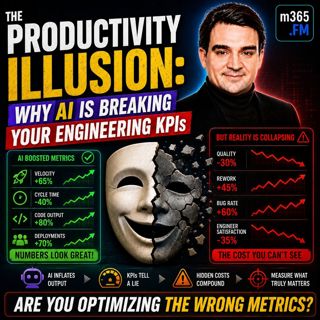
The Productivity Illusion: Why AI is Breaking Your Engineering KPIs

The Productivity Illusion: Why AI is Breaking Your Engineering KPIs

At first glance, the numbers look incredible. Deployment frequency is increasing, pull requests are being merged faster than ever, AI is generating more code, and engineering teams appear dramatically...

25 Jul 0s

The DevOps Tax: Why Your Platform is Failing

The DevOps Tax: Why Your Platform is Failing

Welcome to another episode of Knowledge Nuggets with Mirko Peters. Today we're exploring The DevOps Tax—the hidden cost that silently reduces engineering productivity, increases cognitive overload, an...

25 Jul 0s

Microsoft Purview Insider Risk Management - Simply Explained

Microsoft Purview Insider Risk Management - Simply Explained

Welcome to another episode of Knowledge Nuggets with Mirko Peters. Today we're exploring Microsoft Purview Insider Risk Management, Microsoft's intelligent solution for identifying risky user behavior...

24 Jul 0s

Populært innen Politikk og nyheter

giver-og-gjengen-vg
aftenpodden
forklart
popradet
fotballpodden-2
stopp-verden
rss-gukild-johaug
aftenpodden-usa
hanna-de-heldige
dine-penger-pengeradet
rss-ness
aftenbla-bla
det-store-bildet
lydartikler-fra-aftenposten
nokon-ma-ga
unitedno
e24-podden
rss-penger-polser-og-politikk
bt-dokumentar-2
oppdatert