Data Governance in Microsoft Fabric: How to Build Trust, Ownership, and Sustainable Analytics

Data Governance in Microsoft Fabric: How to Build Trust, Ownership, and Sustainable Analytics

(00:00:00) The Dangers of Fabric's Power
(00:00:43) Fabric's Unique Architecture
(00:01:24) The Illusion of Control
(00:14:17) The Four Drift Patterns
(00:19:05) Scenario 1: Finance's Revenue Dilemma
(00:23:08) Scenario 2: Healthcare's PHI Problem
(00:27:55) Scenario 3: Retail's Shadow Analytics Trap
(00:32:53) Scenario 4: Manufacturing's Data Junk Drawer
(00:33:00) The Single Lake Myth
(00:34:17) The Junk Drawer Effect

In this episode of m365.fm, Mirko Peters breaks down why so many data governance programs in Microsoft Fabric and modern analytics stacks stall after a promising start. Many organizations only begin their governance journey reactively—after a regulatory push, a data incident, or a leadership mandate—and then frame governance as a control exercise instead of as an enabler for better decisions. The result is resistance, workarounds, and a lot of governance that looks good in slide decks but changes very little in day‑to‑day behavior.

GOVERNANCE IS AN ORGANIZATIONAL PROBLEM, NOT A TOOL PROBLEM

Tools like Fabric, catalogs, and metadata platforms can support governance, but they cannot create accountability, trust, or shared understanding. Successful governance starts with clearly defined decision rights: who owns which data, who can change it, and who is accountable for outcomes when something goes wrong. Many organizations confuse governance with documentation or metadata management—useful practices, but not substitutes for real ownership and clear decision structures. Governance must fit how the organization already makes decisions; otherwise it will be ignored or quietly bypassed.

THE ROLE OF TRUST, CULTURE, AND PSYCHOLOGICAL SAFETY

Real governance is impossible in a low‑trust environment. When people are afraid to admit uncertainty, raise issues, or challenge metrics, problems stay hidden until they become incidents. High‑trust cultures make it safe to ask “what does this number really mean?” or “can we rely on this dataset for this decision?”. This episode shows why psychological safety and transparency about how data is used are central to governance: without them, rules become theater and teams optimize for compliance checkboxes instead of real quality.

START WITH BUSINESS VALUE, NOT POLICY SLIDES

Effective governance grows from concrete, valuable use cases. Instead of rolling out dozens of abstract policies, Mirko argues for starting with a small set of high‑impact datasets and decisions, then governing those extremely well. When governance clearly improves revenue, reduces risk, or makes critical decisions more reliable, it gains credibility and executive support. Policies, standards, and models should emerge from real usage, not from theoretical frameworks that never meet the reality of frontline work.

OWNERSHIP, ACCOUNTABILITY, AND FEDERATED MODELS

Clear ownership is non‑negotiable: someone must be responsible for definitions, access, and quality—but that does not mean they do all the work. Stewardship roles help distribute responsibility while keeping accountability visible and explicit. The episode contrasts purely centralized and purely decentralized governance and makes the case for a federated approach: local teams own their domains, while a central group sets shared principles, supports tooling, and acts as an enabler rather than a gatekeeper.

METRICS THAT MATTER AND GOVERNANCE AS A CONTINUOUS PRACTICE

Governance success is not measured by how many policies exist or how many committees meet each month. Better indicators include time to find and understand data, reduction in rework and duplication, earlier detection of data quality issues, and higher confidence in decisions that rely on data. Governance is not a one‑off project; it is a continuous practice that adapts as the organization and its data products evolve. Lightweight, iterative governance tied to real feedback usually outperforms rigid, one‑time frameworks that freeze after rollout.

WHO THIS EPISODE IS FOR
  • Data leaders and heads of analytics struggling to get real traction with governance initiatives.
  • Executives who want accountability and trust around data without drowning teams in bureaucracy.
  • Data practitioners frustrated by unclear ownership, inconsistent standards, and slide‑deck governance.
  • Organizations moving from ad‑hoc reporting toward reliable, data‑driven decision‑making.
ABOUT THE HOST

Mirko Peters is a Microsoft 365 expert, architect, and host of m365.fm. He works with organizations from small businesses to large enterprises on Microsoft 365 architecture, security, AI integration, governance design, and system architecture. His work focuses on designing context‑driven systems that reduce complexity, enable autonomous execution, and create scalable performance across modern enterprises.

Become a supporter of this podcast: https://www.spreaker.com/podcast/m365-fm-modern-work-security-and-productivity-with-microsoft-365--6704921/support.

Denne episoden er hentet fra en åpen RSS-feed og er ikke publisert av Podme. Den kan derfor inneholde annonser.

Episoder(864)

From Excel Expert to Microsoft MVP: Empowering Millions with Data, Dashboards & AI with Karen Abecia [Microsoft MVP]

From Excel Expert to Microsoft MVP: Empowering Millions with Data, Dashboards & AI with Karen Abecia [Microsoft MVP]

aren Abecia shares the remarkable journey that transformed a passion for Microsoft Excel into a global career as one of the world's best-known Excel educators. She explains how discovering creative sp...

27 Jul 0s

The Copilot Credit Trap- Why Your AI Economy is Already Broken

The Copilot Credit Trap- Why Your AI Economy is Already Broken

For decades, enterprise software followed a predictable financial model. Organizations purchased licenses, assigned them to users, and budgeted annual IT spending with confidence. AI changes that comp...

26 Jul 0s
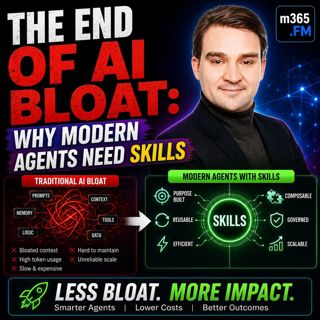
The End of AI Bloat: Why Modern Agents Need Skills

The End of AI Bloat: Why Modern Agents Need Skills

Many AI agents start out fast, responsive, and surprisingly intelligent. But after a few months of real-world use, something changes. Response times increase, costs rise, prompts become enormous, and ...

26 Jul 0s

THE DEATH OF THE PROXY: Architecting Dataverse for the Agent Fabric

THE DEATH OF THE PROXY: Architecting Dataverse for the Agent Fabric

For years, Microsoft's recommended architecture for connecting AI assistants like Claude Desktop to Dataverse relied on a local STDIO proxy. It was simple, easy to install, and perfectly suited for in...

26 Jul 0s

The Death of the Pipeline: Why AI Agents are Replacing Traditional

The Death of the Pipeline: Why AI Agents are Replacing Traditional

For more than two decades, CI/CD pipelines have been the backbone of modern software delivery. Developers commit code, automated builds run, tests execute, security scans complete, someone approves th...

25 Jul 0s
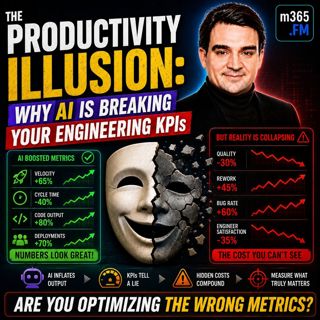
The Productivity Illusion: Why AI is Breaking Your Engineering KPIs

The Productivity Illusion: Why AI is Breaking Your Engineering KPIs

At first glance, the numbers look incredible. Deployment frequency is increasing, pull requests are being merged faster than ever, AI is generating more code, and engineering teams appear dramatically...

25 Jul 0s
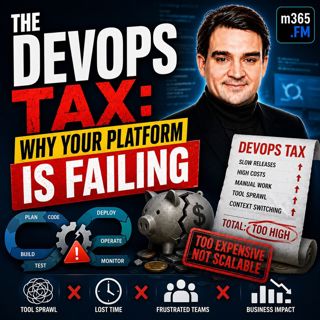
The DevOps Tax: Why Your Platform is Failing

The DevOps Tax: Why Your Platform is Failing

Welcome to another episode of Knowledge Nuggets with Mirko Peters. Today we're exploring The DevOps Tax—the hidden cost that silently reduces engineering productivity, increases cognitive overload, an...

25 Jul 0s

Microsoft Purview Insider Risk Management - Simply Explained

Microsoft Purview Insider Risk Management - Simply Explained

Welcome to another episode of Knowledge Nuggets with Mirko Peters. Today we're exploring Microsoft Purview Insider Risk Management, Microsoft's intelligent solution for identifying risky user behavior...

24 Jul 0s

Populært innen Politikk og nyheter

giver-og-gjengen-vg
aftenpodden
forklart
popradet
fotballpodden-2
stopp-verden
rss-gukild-johaug
aftenpodden-usa
hanna-de-heldige
dine-penger-pengeradet
rss-ness
aftenbla-bla
det-store-bildet
lydartikler-fra-aftenposten
nokon-ma-ga
unitedno
e24-podden
rss-penger-polser-og-politikk
bt-dokumentar-2
oppdatert