The European Union Artificial Intelligence Act

The European Union Artificial Intelligence Act

AI has become a key driver of geopolitical competition, with countries vying for technological supremacy and economic dominance. The potential of AI technologies to revolutionize industries, enhance military capabilities, and shape societal norms has far-reaching implications for the disruption of traditional geopolitical balances. As AI development accelerates, it poses unique and mounting challenges to governance frameworks, raising urgent questions about international regulation and cooperation.


What are the geopolitical risks and opportunities associated with AI development? What strategies are being developed to prevent the misuse of AI? How can states promote responsible and ethical AI development to shape the future of AI in a way that benefits humanity?


Our 2025 winter Buffett Symposium on AI and Geopolitics convened leading strategists, researchers, and policymakers to discuss the transformative opportunities and profound challenges that AI poses in geopolitics. Our speakers offered insights on how AI technologies influence global power dynamics, national security, economic development, international relations, and more, exploring the role that international governance and cooperation will play in its future. The event was co-organized by the Buffett Institute for Global Affairs, Northwestern Security & AI Lab (NSAIL), and Insight Centre at University College Cork.


The daylong program kicked off with a presentation on the European Union AI Act from Barry O’Sullivan, Professor of Computer Science and IT at the University College Cork, Ireland, Director of the Insight Research Ireland Centre for Data Analytics, and Director of the Research Ireland Centre for Research Training in AI.


The European Union Artificial Intelligence Act (EU AI Act) is the world’s first comprehensive legislation aimed at regulating AI. The EU’s risk-based framework categorizes AI systems as unacceptable, high-risk, or low-risk, with stringent requirements for high-risk applications in areas like healthcare, education, and law enforcement. The EU AI Act prioritizes ethical AI principles, including human oversight, fairness, and the protection of fundamental rights. Practices like mass surveillance, real-time biometric identification, and predictive policing are banned.


Key Takeaways

  • The Act prioritizes ethical safeguards and fundamental rights. O’Sullivan noted that it is important that the EU builds upon the regulation to increase the pace of innovation in the Union. O’Sullivan explained that there is a fear that the stringent rules for high-risk application domains like healthcare, education, employment, and public services may compromise innovation in these areas, leading developers to redirect efforts to less-regulated markets like the US and China, where innovation takes precedence, leaving the EU overly reliant on imported advanced AI technology.


  • Compliance with the EU AI Act is resource-intensive, requiring organizations to conduct risk assessments, ensure technical robustness, and train employees in AI literacy. Startups and small-to-medium enterprises may struggle to bear these costs, potentially stifling competition and favoring larger corporations.


  • The EU AI Act’s detailed requirements, including the shifting roles of providers and deployers, introduce a complex legal framework. This may lead to progress-halting debates and disputes about whether specific systems qualify as AI and how liabilities are assigned.


Read the symposium synthesis report >>

Denne episoden er hentet fra en åpen RSS-feed og er ikke publisert av Podme. Den kan derfor inneholde annonser.

Episoder(26)

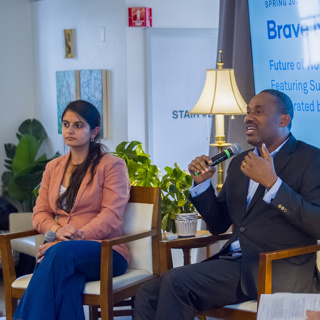
Brave New Futures: Future of Work

Brave New Futures: Future of Work

Listen to the final panel of our spring 2026 Buffett Symposium, Brave New Futures. The discussion focused on the future of work and featured:Suhani Jalota, founder of Myna Mahila and founder and leade...

23 Jun 1h 4min
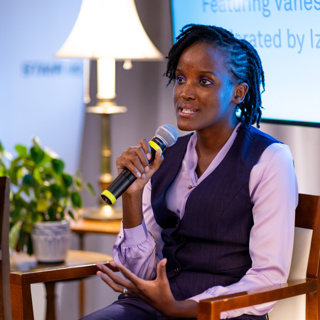
Brave New Futures: Planetary Futures

Brave New Futures: Planetary Futures

Listen to the fourth panel of our spring 2026 Buffett Symposium, Brave New Futures. The discussion focused on planetary futures and featured:⁠Vanessa Nakate⁠, climate activist, founder of the ⁠Rise Up...

19 Jun 1h

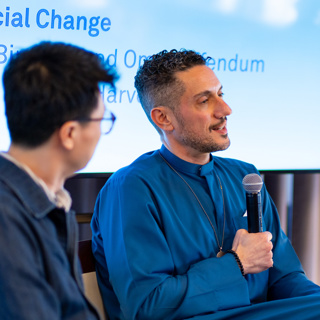
Brave New Futures: Arts of Social Change

Brave New Futures: Arts of Social Change

Listen to the third panel of our spring 2026 Buffett Symposium, Brave New Futures. The discussion focused on the arts of social change and featured:Bing Liu, filmmaker and director of the Emmy- and Os...

18 Jun 58min

Brave New Futures: New Media

Brave New Futures: New Media

Listen to the second panel of our spring 2026 Buffett Symposium, Brave New Futures. The discussion focused on new media and featured:Allison Yang, founder and CEO of Reality ReloadShuwei Fang, Fellow ...

17 Jun 58min

Brave New Futures: Human Relationships

Brave New Futures: Human Relationships

Listen to the first panel of our spring 2026 Buffett Symposium, Brave New Futures. The discussion focused on human relationships and featured:⁠Qing Wang⁠, co-founder of ⁠The Weirdo Podcast⁠⁠Nataliya K...

16 Jun 1h 2min

Ensuring Accountability for Disinformation

Ensuring Accountability for Disinformation

Our winter 2026 Buffett Symposium on disinformation convened global experts and practitioners from industry, public policy, academia, and civil society to address four urgent priorities: sustaining tr...

26 Mai 1h 37min
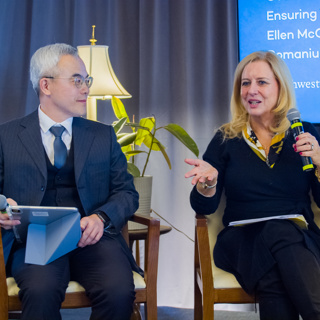
Countering State-Sponsored Disinformation and Ensuring Trustworthy Information Spaces

Countering State-Sponsored Disinformation and Ensuring Trustworthy Information Spaces

Our winter 2026 Buffett Symposium on disinformation convened global experts and practitioners from industry, public policy, academia, and civil society to address four urgent priorities: sustaining tr...

25 Mai 1h 33min

Multi-Stakeholder Collaboration for Countering Disinformation

Multi-Stakeholder Collaboration for Countering Disinformation

Our winter 2026 Buffett Symposium on disinformation convened global experts and practitioners from industry, public policy, academia, and civil society to address four urgent priorities: sustaining tr...

24 Mai 1h 35min

Populært innen Politikk og nyheter

giver-og-gjengen-vg
aftenpodden
aftenpodden-usa
fotballpodden-2
forklart
stopp-verden
popradet
lydartikler-fra-aftenposten
det-store-bildet
rss-gukild-johaug
hanna-de-heldige
dine-penger-pengeradet
rss-ness
nokon-ma-ga
aftenbla-bla
rss-espen-lee-usensurert
rss-penger-polser-og-politikk
e24-podden
grasoner-den-nye-kalde-krigen
ukrainapodden