AI lab TL;DR | Derek Slater - What the Copyright Case Against Ed Sheeran Can Teach Us About AI

AI lab TL;DR | Derek Slater - What the Copyright Case Against Ed Sheeran Can Teach Us About AI

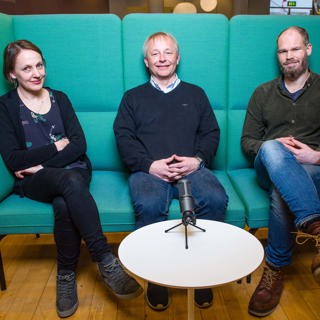
🔍 In this TL;DR episode, Derek Slater (Proteus Strategies) discusses his recent blog post on the Tech Policy Press website, titled “What the Copyright Case Against Ed Sheeran Can Teach Us About AI”, with the AI lab


📌 TL;DR Highlights

⏲️[00:00] Intro

⏲️[01:11] Q1 - Legal boundaries & creativity:

How to define the boundary between protectable expression and unprotectable building blocks in music & other creative fields?

What lessons does this offer for generative AI?

⏲️[05:13] Q2 - Consent vs. enclosure:

What is enclosure?

How can we balance it with consent in regulating AI tools?

What guiding principles should policymakers follow to not stifle innovation & creativity?

⏲️[09:35] Q3 - Technological impact on art:

What is the long-term impact of generative AI on music & artistic expression, as other technological advances ultimately revolutionised creative industries after an initial backlash?

⏲️[12:18] Wrap-up & Outro


💭 Q1 - Legal boundaries & creativity


🗣️ All creativity builds on the past. All songs are made up of a limited number of notes and chords available to the composers [and] to protect their combination would give Let’s Get It On an impermissible monopoly[, the judge said].

🗣️ Copyright has always allowed certain uses of existing content (...) by drawing lines between protectable expression and unprotectable ideas, facts, and other elements.

🗣️ Rightsholders can demand consent for some uses, but they are not allowed to enclose and cut off the basic building blocks of culture and knowledge.

🗣️ Generative AI: (...) it’s a big statistical analysis of lots and lots of texts to derive rules about syntax and how different concepts are related (...) For music, it’s analysing lots and lots of music to tease out those basic building blocks.

🗣️ [AI training] can’t be reduced to the simplicity of consent (...) because the question is: consent for what? (...) Deriving insights [and] uncopyrightable elements from protectable expression generally can be permissible.

💭 Q2 - Consent vs. enclosure


🗣️ We also recognise downsides to [copyright], (...) meaning the public can no longer freely build on and use it. (...) We’ve always had copyright protection but also limits so that enclosure (...) doesn’t go too far.

🗣️ When is it unethical to stop people from (...) using basic building block[s] of language or music? Because that information, that knowledge, those cultural artefacts, ought to belong to the public.

🗣️ I think from a copyright perspective, the first key principle is: is this protection necessary to encourage creativity (...)? If creativity is already booming, abundant, and would happen anyway (...) then there should not be an issue.

🗣️ When we think about generative AI, these are tools for productivity, for creativity, not for piracy (...). They’re not about simply reusing the works that they were trained on in the outputs. (...) That’s considered a bug, a failure (...) and something to be avoided.

🗣️ When somebody uses [an AI] tool like Suno or Udio to create a new song, that’s in line with copyright’s purpose. (...) It crosses the line (...) where that output is directly substituting, reusing that communicative expression embodied in some specific work.

💭 Q3 - Technological impact on art


🗣️ One way to think about [AI] is sort of like the synthesizer, computer-generated graphics or Photoshop, where, at first, people said, this is not music, [or] art, and over time, it became integrated into artistic processes in a variety of ways.

🗣️ [2023] Oscar winner, ’Everything Everywhere All at Once’, used the generative AI tool Runway to edit one of its famous scenes. Nobody knew that was generative AI at the time. Nobody said ‘Oh, this is a generative AI movie’, but it was part of their artistic process.

🗣️ It’s acknowledged that generative AI is driving an abundance of creativity. (...) So that fundamentally is not at odds with (...) copyright. I think most of the concerns that people have aren’t really copyright problems.

🗣️ A lot of creators are worried about how the benefits of [AI] technology will really be spread. Will they be concentrated among a few big companies or benefit [many], including creators? (...) [Those concerns] demand solutions (...) beyond copyright.

🗣️ As a fan, I feel like we are in a golden era [with AI]. Now, we just need to make really sure those benefits are widely shared.

📌 About Our Guest

🎙️ Derek Slater | Co-Founder of Proteus Strategies

𝕏 https://x.com/@derekslater

🌐 Tech Policy Press blog post

https://www.techpolicy.press/what-the-copyright-case-against-ed-sheeran-can-teach-us-about-ai/

🌐 Proteus Strategies

https://www.proteusstrategies.com/


Derek Slater is a tech policy strategist focused on media, communications, and information policy. He is the co-founder of Proteus Strategies and previously worked at Google and at the Electronic Frontier Foundation on issues related to access to information, content regulation, and online safety.

Episoder(37)

AI lab TL;DR | Joan Barata - Transparency Obligations for All AI Systems

AI lab TL;DR | Joan Barata - Transparency Obligations for All AI Systems

🔍 In this TL;DR episode, Joan explains how Article 50 of the EU AI Act sets out high-level transparency obligations for AI developers and deployers—requiring users to be informed when they interact w...

10 Des 202517min

AI lab TL;DR | Aline Larroyed - The Fallacy Of The File

AI lab TL;DR | Aline Larroyed - The Fallacy Of The File

🔍 In this episode, Caroline and Alene unravel why the popular idea of “AI memorisation” leads policymakers down the wrong path—and how this metaphor obscures what actually happens inside large langua...

27 Nov 20257min

AI lab TL;DR | Anna Mills and Nate Angell - The Mirage of Machine Intelligence

AI lab TL;DR | Anna Mills and Nate Angell - The Mirage of Machine Intelligence

🔍 In this TL;DR episode, Anna and Nate unpack why calling AI outputs “hallucinations” misses the mark—and introduce “AI Mirage” as a sharper, more accurate metaphor. From scoring alternative terms to...

26 Mai 202520min

AI lab TL;DR | Emmie Hine - Can Europe Lead the Open-Source AI Race?

AI lab TL;DR | Emmie Hine - Can Europe Lead the Open-Source AI Race?

🔍 In this TL;DR episode, Emmie Hine (Yale Digital Ethics Center) makes the case for Europe’s leadership in open-source AI—thanks to strong infrastructure, multilingual data, and regulatory clarity. W...

12 Mai 202511min

AI lab TL;DR | Milton Mueller - Why Regulating AI Misses the Point

AI lab TL;DR | Milton Mueller - Why Regulating AI Misses the Point

🔍 In this TL;DR episode, Milton Mueller (the Georgia Institute of Technology School of Public Policy) argues that what we call “AI” is really just part of a broader digital ecosystem. Instead of vagu...

21 Apr 202518min

AI lab TL;DR | Kevin Frazier - How Smarter Copyright Law Can Unlock Fairer AI

AI lab TL;DR | Kevin Frazier - How Smarter Copyright Law Can Unlock Fairer AI

🔍 In this TL;DR episode, Kevin Frazier (University of Texas at Austin school of Law) outlines a proposal to realign U.S. copyright law with its original goal of spreading knowledge. The discussion in...

7 Apr 202516min

AI lab TL;DR | Paul Keller - A Vocabulary for Opting Out of AI Training and TDM

AI lab TL;DR | Paul Keller - A Vocabulary for Opting Out of AI Training and TDM

🔍 In this TL;DR episode, Paul Keller (The Open Future Foundation) outlines a proposal for a common opt-out vocabulary to improve how EU copyright rules apply to AI training. The discussion introduces...

24 Mar 202515min

AI lab TL;DR |  João Pedro Quintais - Untangling AI Copyright and Data Mining in EU Compliance

AI lab TL;DR | João Pedro Quintais - Untangling AI Copyright and Data Mining in EU Compliance

🔍 In this TL;DR episode, João Quintais (Institute for Information Law) explains the interaction between the AI Act and EU copyright law, focusing on text and data mining (TDM). He unpacks key issues ...

3 Mar 202525min

Populært innen Vitenskap

fastlegen
rekommandert
tingenes-tilstand
forskningno
sinnsyn
rss-rekommandert
smart-forklart
liberal-halvtime
villmarksliv
jss
fjellsportpodden
pod-britannia
vett-og-vitenskap-med-gaute-einevoll
tomprat-med-gunnar-tjomlid
rss-paradigmepodden
psykopoden
dekodet-2
rss-nysgjerrige-norge
nevropodden
rss-overskuddsliv