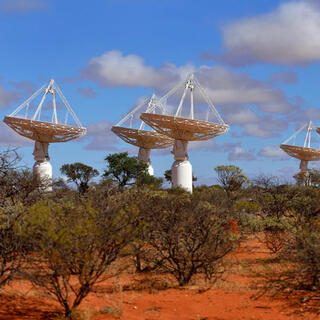
Breaking the Redshift Barrier: H.E.S.S. and the Distant Blazar PKS 0346−27

Breaking the Redshift Barrier: H.E.S.S. and the Distant Blazar PKS 0346−27

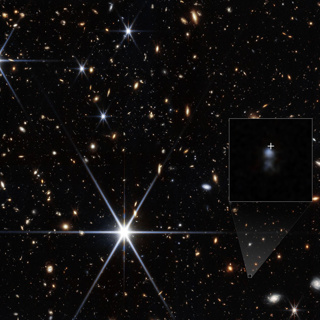
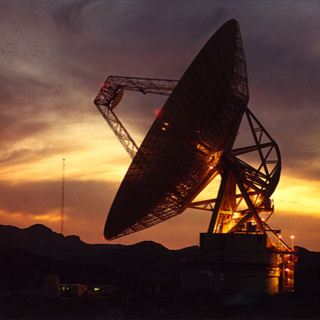
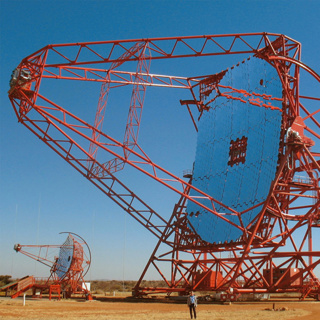
In this episode, we dive into a groundbreaking discovery in high-energy astrophysics: the detection of the blazar PKS 0346−27 at a redshift of $z = 0.991$. This makes it one of the most distant objects ever detected in very-high-energy (VHE) gamma-rays ($E > 100$ GeV). We explore how the H.E.S.S. (High Energy Stereoscopic System) telescopes in Namibia managed to capture this elusive signal despite the thick "fog" of Extragalactic Background Light (EBL) that usually absorbs such distant photons.


Key Discussion Points:

  • The Record-Breaking Detection: Why reaching a redshift of approximately 1 is a major milestone for gamma-ray astronomy and what it tells us about the evolution of the universe.
  • A Tale of Two Flares: The strange two-day delay between the high-energy flare caught by the Fermi-LAT satellite and the very-high-energy flare detected by H.E.S.S..
  • The Physics of the Jet: We break down the debate between leptonic and hadronic models. While electrons are the usual suspects, the data from PKS 0346−27 strongly favors a proton-synchrotron model, even though it requires jet power that temporarily exceeds the source’s Eddington limit.
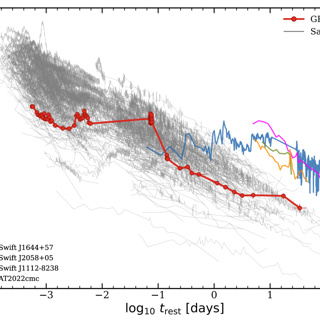
  • Multi-Wavelength Cooperation: How a global team used data from H.E.S.S., Fermi-LAT, the Swift Observatory, and the ATOM telescope to build a complete picture of this cosmic event.
  • The "Synchrotron Mirror" Hypothesis: Exploring how stationary clouds near the black hole might be reflecting radiation back into the jet to create "orphan" VHE flares.


Technical Insight: The researchers found that a traditional leptonic model (based on electrons) would require "implausible" parameters, such as a Doppler factor exceeding 80, to explain the flare. This push toward hadronic models suggests that relativistic protons may play a much larger role in the most powerful jets in the universe than previously confirmed.


Featured Article: H.E.S.S. Collaboration, et al. (2026). "H.E.S.S. detection and multi-wavelength study of the $z \sim 1$ blazar PKS 0346−27." Astronomy & Astrophysics manuscript no. 0346.


Acknowledements: Podcast prepared with Google/NotebookLM. Illustration credits: Stefan Schwarzburg

Denne episoden er hentet fra en åpen RSS-feed og er ikke publisert av Podme. Den kan derfor inneholde annonser.

Episoder(101)

Record-Breaker: Catching Gamma Rays from the Distant Quasar OP 313

Record-Breaker: Catching Gamma Rays from the Distant Quasar OP 313

In this episode, we dive into a groundbreaking astronomical discovery: the detection of very-high-energy (VHE) gamma rays from the quasar OP 313. Located at a redshift of $z = 0.997$, OP 313 has shatt...

1 Jun 20min

Ripples in Spacetime: Unpacking the GWTC-5.0 Catalog

Ripples in Spacetime: Unpacking the GWTC-5.0 Catalog

In this episode, we dive into the monumental release of the Gravitational-Wave Transient Catalog version 5.0 (GWTC-5.0) and the open data from the second part of the fourth observing run (O4b) by the ...

29 Mai 21min

SN 2017egm : Fermi-LAT's Breakthrough Gamma-Ray Detection

SN 2017egm : Fermi-LAT's Breakthrough Gamma-Ray Detection

In today’s episode, we dive into the mystery of superluminous supernovae (SLSNe)—rare, extreme astronomical events that shine 10 to 100 times brighter than standard core-collapse supernovae. For years...

22 Mai 23min

Supernovae on the RISE: Why Dead Stars Wake Up Decades Later

Supernovae on the RISE: Why Dead Stars Wake Up Decades Later

In this episode, we explore the fascinating phenomenon of core-collapse supernovae that refuse to fade away quietly. Years, or even decades, after their initial explosion, some of these stellar deaths...

20 Mai 17min

The SVOM Satellite: A New Era in Multi-Messenger Astronomy

The SVOM Satellite: A New Era in Multi-Messenger Astronomy

In this episode, we dive into the fascinating world of gamma-ray bursts (GRBs) and high-energy transients through the lens of the SVOM (Space-based Multi-band Variable Object Monitor) mission. Launche...

29 Apr 24min

Chasing the Flash: Hunting Neutron Star Mergers with CTAO

Chasing the Flash: Hunting Neutron Star Mergers with CTAO

In this episode, we dive into the thrilling world of multi-messenger astronomy! Ever since the historic detection of GW170817, scientists have known that binary neutron star (BNS) mergers can produce ...

14 Apr 19min

Tiling the Sky: A New Strategy for Finding Elusive GRBs

Tiling the Sky: A New Strategy for Finding Elusive GRBs

In this episode, we dive into the intense and fast-paced world of **Gamma-ray bursts (GRBs)—the most luminous and rapidly evolving transients in the Universe**. While space-based instruments like the ...

13 Apr 19min

Fast Radio Bursts & Magnetar X-Rays: A Peculiar Discovery

Fast Radio Bursts & Magnetar X-Rays: A Peculiar Discovery

In this episode, we dive into the deep cosmos to explore a recent astronomical breakthrough linking Fast Radio Bursts (FRBs)—enigmatic, millisecond-long cosmic transients—to extreme stellar objects kn...

7 Apr 22min

Populært innen Vitenskap

fastlegen
tingenes-tilstand
jss
rekommandert
liberal-halvtime
sinnsyn
forskningno
tomprat-med-gunnar-tjomlid
villmarksliv
rss-paradigmepodden
fjellsportpodden
kvinnehelsepodden
tidlose-historier
dekodet-2
rss-zahid-ali-hjelper-deg
rss-overskuddsliv
hva-er-greia-med
rss-rekommandert
rss-inn-til-kjernen-med-sunniva-rose
grunnstoffene