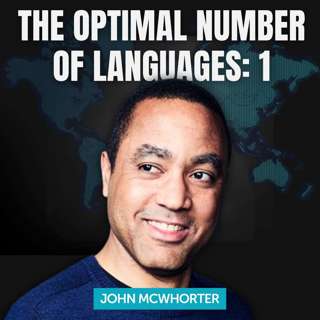

#142 Classic episode – John McWhorter on why the optimal number of languages might be one, and other provocative claims about language

#142 Classic episode – John McWhorter on why the optimal number of languages might be one, and other provocative claims about language

John McWhorter is a linguistics professor at Columbia University specialising in research on creole languages. He's also a content-producing machine, never afraid to give his frank opinion on anything and everything. On top of his academic work, he's written 22 books, produced five online university courses, hosts one and a half podcasts, and now writes a regular New York Times op-ed column.

Rebroadcast: this episode was originally released in December 2022.

YouTube video version: https://youtu.be/MEd7TT_nMJE

Links to learn more, video, and full transcript: https://80k.link/JM

We ask him what we think are the most important things everyone ought to know about linguistics, including:

  • Can you communicate faster in some languages than others, or is there some constraint that prevents that?
  • Does learning a second or third language make you smarter or not?
  • Can a language decay and get worse at communicating what people want to say?
  • If children aren't taught a language, how many generations does it take them to invent a fully fledged one of their own?
  • Did Shakespeare write in a foreign language, and if so, should we translate his plays?
  • How much does language really shape the way we think?
  • Are creoles the best languages in the world — languages that ideally we would all speak?
  • What would be the optimal number of languages globally?
  • Does trying to save dying languages do their speakers a favour, or is it more of an imposition?
  • Should we bother to teach foreign languages in UK and US schools?
  • Is it possible to save the important cultural aspects embedded in a dying language without saving the language itself?
  • Will AI models speak a language of their own in the future, one that humans can't understand but which better serves the tradeoffs AI models need to make?

We’ve also added John’s talk “Why the World Looks the Same in Any Language” to the end of this episode. So stick around after the credits!

Chapters:

  • Rob's intro (00:00:00)
  • Who's John McWhorter? (00:05:02)
  • Does learning another language make you smarter? (00:05:54)
  • Updating Shakespeare (00:07:52)
  • Should we bother teaching foreign languages in school? (00:12:09)
  • Language loss (00:16:05)
  • The optimal number of languages for humanity (00:27:57)
  • Do we reason about the world using language and words? (00:31:22)
  • Can we communicate meaningful information more quickly in some languages? (00:35:04)
  • Creole languages (00:38:48)
  • AI and the future of language (00:50:45)
  • Should we keep ums and ahs in The 80,000 Hours Podcast? (00:59:10)
  • Why the World Looks the Same in Any Language (01:02:07)

Producer: Keiran Harris
Audio mastering: Ben Cordell and Simon Monsour
Video editing: Ryan Kessler and Simon Monsour
Transcriptions: Katy Moore

Episoder(333)

#12 - Beth Cameron works to stop you dying in a pandemic. Here’s what keeps her up at night.

#12 - Beth Cameron works to stop you dying in a pandemic. Here’s what keeps her up at night.

“When you're in the middle of a crisis and you have to ask for money, you're already too late.” That’s Dr Beth Cameron, who leads Global Biological Policy and Programs at the Nuclear Threat Initiative...

25 Okt 20171h 45min

#11 - Spencer Greenberg on speeding up social science 10-fold & why plenty of startups cause harm

#11 - Spencer Greenberg on speeding up social science 10-fold & why plenty of startups cause harm

Do most meat eaters think it’s wrong to hurt animals? Do Americans think climate change is likely to cause human extinction? What is the best, state-of-the-art therapy for depression? How can we make ...

17 Okt 20171h 29min
#10 - Nick Beckstead on how to spend billions of dollars preventing human extinction

#10 - Nick Beckstead on how to spend billions of dollars preventing human extinction

What if you were in a position to give away billions of dollars to improve the world? What would you do with it? This is the problem facing Program Officers at the Open Philanthropy Project - people l...

11 Okt 20171h 51min
#9 - Christine Peterson on how insecure computers could lead to global disaster, and how to fix it

#9 - Christine Peterson on how insecure computers could lead to global disaster, and how to fix it

Take a trip to Silicon Valley in the 70s and 80s, when going to space sounded like a good way to get around environmental limits, people started cryogenically freezing themselves, and nanotechnology l...

4 Okt 20171h 45min
#8 - Lewis Bollard on how to end factory farming in our lifetimes

#8 - Lewis Bollard on how to end factory farming in our lifetimes

Every year tens of billions of animals are raised in terrible conditions in factory farms before being killed for human consumption. Over the last two years Lewis Bollard – Project Officer for Farm An...

27 Sep 20173h 16min

#7 - Julia Galef on making humanity more rational, what EA does wrong, and why Twitter isn’t all bad

#7 - Julia Galef on making humanity more rational, what EA does wrong, and why Twitter isn’t all bad

The scientific revolution in the 16th century was one of the biggest societal shifts in human history, driven by the discovery of new and better methods of figuring out who was right and who was wrong...

13 Sep 20171h 14min
#6 - Toby Ord on why the long-term future matters more than anything else & what to do about it

#6 - Toby Ord on why the long-term future matters more than anything else & what to do about it

Of all the people whose well-being we should care about, only a small fraction are alive today. The rest are members of future generations who are yet to exist. Whether they’ll be born into a world th...

6 Sep 20172h 8min

#5 - Alex Gordon-Brown on how to donate millions in your 20s working in quantitative trading

#5 - Alex Gordon-Brown on how to donate millions in your 20s working in quantitative trading

Quantitative financial trading is one of the highest paying parts of the world’s highest paying industry. 25 to 30 year olds with outstanding maths skills can earn millions a year in an obscure set of...

28 Aug 20171h 45min

Populært innen Fakta

fastlegen
dine-penger-pengeradet
relasjonspodden-med-dora-thorhallsdottir-kjersti-idem
mikkels-paskenotter
foreldreradet
rss-bisarr-historie
treningspodden
rss-strid-de-norske-borgerkrigene
jakt-og-fiskepodden
rss-sunn-okonomi
ukast
hverdagspsyken
lederskap-nhhs-podkast-om-ledelse
sinnsyn
rss-bak-luftfarten
takk-og-lov-med-anine-kierulf
fryktlos
rss-kunsten-a-leve
rss-kull
gravid-uke-for-uke