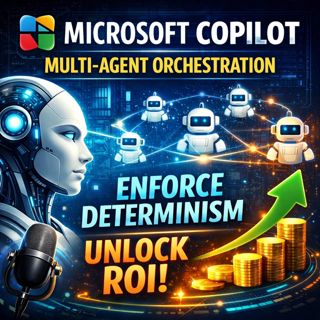
Microsoft Copilot Studio Multi‑Agent Architecture: How to Design Governed Copilot Orchestration and Deterministic AI Workflows in Microsoft

Microsoft Copilot Studio Multi‑Agent Architecture: How to Design Governed Copilot Orchestration and Deterministic AI Workflows in Microsoft

(00:00:00) The Pitfalls of Agent Sprawl
(00:00:27) The Misunderstood Nature of AI Assistants
(00:00:48) The Decision Engine Reality Check
(00:01:21) The Hidden Dangers of Prompt-Based Governance
(00:02:29) Redefining Success in AI Systems
(00:04:23) The Entropy of Agent Sprawl
(00:05:39) The Three Failure Modes of Overlapping Agents
(00:06:55) The Rise of Confident Errors
(00:07:49) The Governance Debt Trap
(00:08:18) The ROI Collapse of Unaccountable Automation

Most organizations believe that “adding more Copilot agents” means they are getting more value from AI. Agents get shipped, workflows get wired up, demos look impressive — so it is easy to assume that more assistants equal more automation. In reality, uncontrolled multi‑agent Copilot systems create ambiguity, governance debt, and irreproducible behavior long before anyone notices it in an audit, an incident review, or a budget discussion.

In this episode of M365.FM, Mirko Peters looks at Microsoft Copilot multi‑agent orchestration from the moment it usually goes wrong: when nobody can explain why an AI workflow did what it did. This is not a conversation about clever prompts or fancy UX. It is a conversation about how every new Copilot, plug‑in, and Connected Agent either reinforces a deterministic control plane or quietly turns your AI estate into a collection of ungoverned decision engines. We unpack why “agent sprawl” destroys ROI, why policy inside prompts always drifts, and why explainability alone is not enough when AI can touch real systems, data, and money.The organizations that will actually win with Microsoft Copilot are not those with the most agents. They are the ones that treat multi‑agent orchestration as part of their operating model:
  • Where a Master Agent or control plane owns state, routing, identity, and tool access.
  • Where Connected Agents behave like governed services with contracts, owners, versions, and kill switches.
  • Where execution paths are bounded, auditable, and stable enough that ROI can be measured instead of narrated.
WHAT YOU WILL LEARN
  • How small, “helpful” AI behaviors in Copilot and multi‑agent flows quietly turn into policy violations, cost surprises, and incidents you cannot reproduce on demand.
  • Why agent sprawl — overlapping Copilots, plug‑ins, and Connected Agents — is a leading cause of AI governance debt in the Microsoft ecosystem.
  • How to recognize the early signals that your Copilot architecture is drifting: ambiguous routing, duplicated logic, conflicting policies, and AI actions nobody clearly owns.
  • What disciplined multi‑agent orchestration looks like beyond prompts: control planes, deterministic gates, identity‑aware tool access, and end‑to‑end audit trails.
THE CORE INSIGHT
Microsoft Copilot systems rarely “break” in one dramatic moment. They fail gradually. Every new agent without a clear contract, every prompt that quietly embeds policy, every tool call that bypasses existing governance is a small bet that future you will still know what this AI is allowed to do — and future you rarely does. The result is an AI estate that is technically impressive but strategically untrustworthy: no one is sure what will happen if you connect one more system or let one more workflow run unattended.

Mirko argues that fixing this is less about making AI smarter and more about making decisions explicit. Governance debt in Copilot accumulates the same way it does in Microsoft 365: quietly, incrementally, and usually with good intentions. The only durable fix is to put determinism, routing, and execution under a boring, well‑governed control plane — so the next surprising AI behavior becomes debuggable and explainable, not an expensive mystery with a chat interface.

KEY TOPICS
  • Microsoft Copilot multi‑agent orchestration: Master Agent vs. Connected Agents, routing patterns, and tool usage in the Microsoft ecosystem.
  • AI governance debt in Copilot: how unmanaged prompts, tools, and agents accumulate into a fragile, hard‑to‑explain AI estate.
  • Designing deterministic AI workflows: contracts, guardrails, and identity‑based access for Copilot actions that touch real systems and data.
  • Measuring Copilot ROI beyond demos: stabilizing behavior first, then tracking throughput, error rates, and business outcomes along defined execution paths.
ABOUT THE HOST

Mirko Peters is a Microsoft 365 and Azure architect, strategist, and the host of M365.FM — a podcast focused on modern work, security, AI, and operating model design in the Microsoft ecosystem. He works with organizations from midmarket to global enterprise to turn Microsoft Copilot, Copilot Studio, and Fabric into governed operating capabilities instead of isolated AI experiments and pilots. His work centers on AI operating models, Copilot and multi‑agent architecture, Microsoft 365 and Azure governance, and the practical reality of making AI behavior deterministic, auditable, and aligned with how the organization actually runs.

Become a supporter of this podcast: https://www.spreaker.com/podcast/m365-fm-modern-work-security-and-productivity-with-microsoft-365--6704921/support.

Denne episoden er hentet fra en åpen RSS-feed og er ikke publisert av Podme. Den kan derfor inneholde annonser.

Episoder(864)

From Excel Expert to Microsoft MVP: Empowering Millions with Data, Dashboards & AI with Karen Abecia [Microsoft MVP]

From Excel Expert to Microsoft MVP: Empowering Millions with Data, Dashboards & AI with Karen Abecia [Microsoft MVP]

aren Abecia shares the remarkable journey that transformed a passion for Microsoft Excel into a global career as one of the world's best-known Excel educators. She explains how discovering creative sp...

27 Jul 0s

The Copilot Credit Trap- Why Your AI Economy is Already Broken

The Copilot Credit Trap- Why Your AI Economy is Already Broken

For decades, enterprise software followed a predictable financial model. Organizations purchased licenses, assigned them to users, and budgeted annual IT spending with confidence. AI changes that comp...

26 Jul 0s
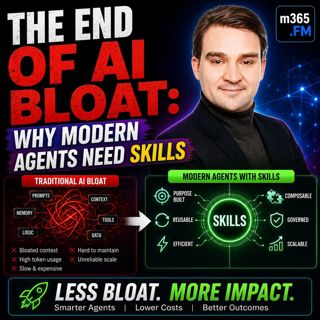
The End of AI Bloat: Why Modern Agents Need Skills

The End of AI Bloat: Why Modern Agents Need Skills

Many AI agents start out fast, responsive, and surprisingly intelligent. But after a few months of real-world use, something changes. Response times increase, costs rise, prompts become enormous, and ...

26 Jul 0s

THE DEATH OF THE PROXY: Architecting Dataverse for the Agent Fabric

THE DEATH OF THE PROXY: Architecting Dataverse for the Agent Fabric

For years, Microsoft's recommended architecture for connecting AI assistants like Claude Desktop to Dataverse relied on a local STDIO proxy. It was simple, easy to install, and perfectly suited for in...

26 Jul 0s
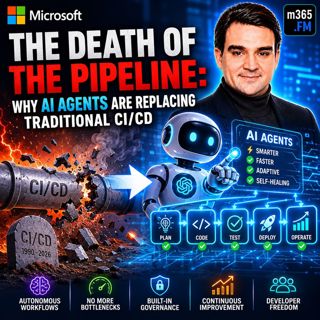
The Death of the Pipeline: Why AI Agents are Replacing Traditional

The Death of the Pipeline: Why AI Agents are Replacing Traditional

For more than two decades, CI/CD pipelines have been the backbone of modern software delivery. Developers commit code, automated builds run, tests execute, security scans complete, someone approves th...

25 Jul 0s
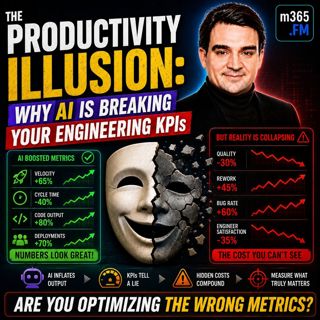
The Productivity Illusion: Why AI is Breaking Your Engineering KPIs

The Productivity Illusion: Why AI is Breaking Your Engineering KPIs

At first glance, the numbers look incredible. Deployment frequency is increasing, pull requests are being merged faster than ever, AI is generating more code, and engineering teams appear dramatically...

25 Jul 0s
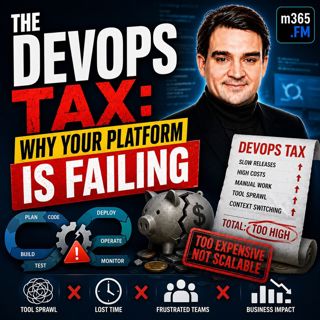
The DevOps Tax: Why Your Platform is Failing

The DevOps Tax: Why Your Platform is Failing

Welcome to another episode of Knowledge Nuggets with Mirko Peters. Today we're exploring The DevOps Tax—the hidden cost that silently reduces engineering productivity, increases cognitive overload, an...

25 Jul 0s
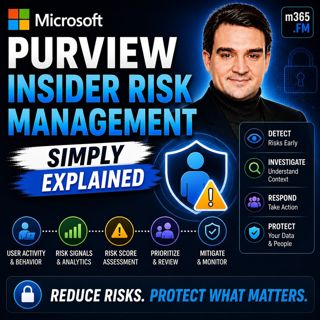
Microsoft Purview Insider Risk Management - Simply Explained

Microsoft Purview Insider Risk Management - Simply Explained

Welcome to another episode of Knowledge Nuggets with Mirko Peters. Today we're exploring Microsoft Purview Insider Risk Management, Microsoft's intelligent solution for identifying risky user behavior...

24 Jul 0s

Populært innen Politikk og nyheter

giver-og-gjengen-vg
aftenpodden
forklart
popradet
stopp-verden
rss-gukild-johaug
fotballpodden-2
aftenpodden-usa
hanna-de-heldige
dine-penger-pengeradet
rss-ness
aftenbla-bla
det-store-bildet
nokon-ma-ga
e24-podden
lydartikler-fra-aftenposten
unitedno
oppdatert
bt-dokumentar-2
liverpoolno-pausepraten