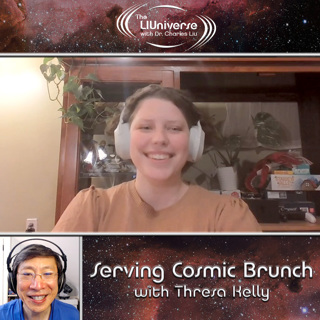
Serving Cosmic Brunch with Thresa Kelly

Serving Cosmic Brunch with Thresa Kelly

How do supermassive black holes actually form in the early universe? Is the Cosmological Constant not so constant after all? And what would be on the astrophysical menu at a Cosmic Brunch? To find out, Dr. Charles Liu and co-host Allen Liu welcome astrophysicist Thresa Kelly, who is a second year grad student working on her PhD at the Rochester Institute of Technology.

As always, though, we start off with the day’s joyfully cool cosmic thing, one of the recent studies made using the Dark Energy Spectroscopic Instrument, aka DESI, located at Kitt Peak National Observatory near Tucson, Arizona. According to the DESI team’s research, there is a about a 95% chance that the dark energy levels in the universe have changed over cosmic time. This “Dynamical Dark Energy model” offers the first, tiny hint that the Cosmological Constant may not be so constant after all.

Thresa, who is using DESI and other sources for her work putting together a catalog of AGNs, or active galactic nuclei – the supermassive black holes found at the center of galaxies, tells us about what DESI is trying to do and why it’s so important. The end goal of Thresa’s project is to estimate the black hole masses of AGNs, and she’s gotten spectra data on over 2,000 objects that have been observed using DESI. Thresa can’t get into the details of her catalog, which hasn’t been published yet and includes about 14,000 objects, but Allen and Chuck join her in a discussion of what’s going on with black hole masses, accretion discs, Eddington Luminosity, black hole growth, galactic evolution, and more.

Our first audience question comes from Kathryn, who asks, “When we look through a standard telescope looking at "past" versions of planets/stars/etc., how far back in the past are we observing?” Thresa explains how we use red shift to measure how long light from a galaxy takes to reach us to help us determine how far in the past the objects are. For instance, an AGN with a red shift of 7 can reach back to the period of “Cosmic Dawn” or, as Thresa puts it, “Cosmic Brunch” taking place 12 billion years ago.

Thresa talks about her experience in an REU, or “Research Experiences for Undergraduates,” funded by the NSF, which enabled her to spend time studying at the University of Hawaii and cemented her desire to go to grad school, get a PhD, and become a “real scientist.” She explains how each step of her career brought her from Kansas to where she is today.

Our next audience question comes from Walter: “If a quasar's jets are aimed directly away from Earth, would we then not be able to see the supermassive black hole?” Thresa says that depends on how you define “seeing” a black hole, and that even without visible light, you can discern black holes by looking at other wavelengths like x-rays and ultraviolet rays which are generated by different component areas of the black hole like the corona, accretion disk, or the torus.

Chuck notices a shelf of games behind Thresa and asks her about them. She pulls out Stardew Valley, a farming simulator she plays with her fiancé and her fellow grad students. It’s not long until Chuck, Allen and Thresa are geeking out about Dungeons and Dragons.

Finally, Chuck asks Thresa to speculate on a specific scientific discovery that may come out of her PhD thesis work. Her answer: figuring out how supermassive black holes actually form in the early universe.

If you’d like to know more about Thresa Kelly, you can find her on LinkedIn.

We hope you enjoy this episode of The LIUniverse, and, if you do, please support us on Patreon.

Credits for Images Used in this Episode:

  • DESI - The Dark Energy Spectroscopic Instrument. – Credit: KPNO/NOIRLab/NSF/AURA/P. Marenfeld
  • DESI data map of celestial objects from Earth to billions of light years away.. – Credit: Claire Lamman/DESI collaboration.
  • Montage of dwarf active galactic nuclei candidates. – Credit: DESI collaboration.
  • Map of galaxies based on redshift data. – Credit: Creative Commons / M. Blanton and Sloan Digital Sky Survey.
  • Quasar PKS 1127-145, a luminous source of X-rays and visible light. – Credit: NASA/CXC/A.Siemiginowska(CfA)/J.Bechtold(U.Arizona).
  • Model of AGN. – Credit: Creative Commons.

Denne episoden er hentet fra en åpen RSS-feed og er ikke publisert av Podme. Den kan derfor inneholde annonser.

Episoder(78)

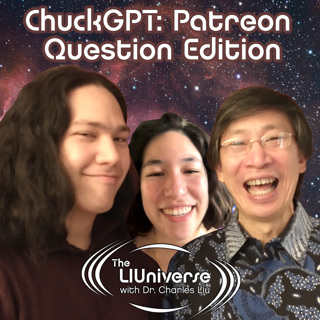
ChuckGPT - Patreon Question Edition

ChuckGPT - Patreon Question Edition

It’s time for the Season 5 finale of The LIUniverse, which means another episode of ChuckGPT where we answer our audience’s most vexing questions – this time via video from our Patreon Patrons. And to...

13 Jun 38min
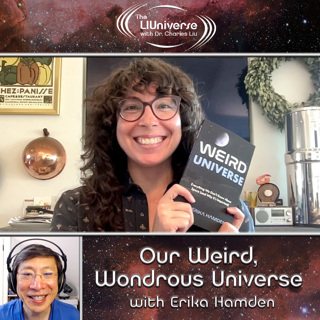
Our Weird, Wondrous Universe with Erika Hamden

Our Weird, Wondrous Universe with Erika Hamden

How do distant galaxies form? If you have two distant clouds of hydrogen, why does one turn into a star and another doesn’t? To find out, Dr. Charles Liu and co-host Allen Liu welcome Dr. Erika Hamden...

30 Mai 43min
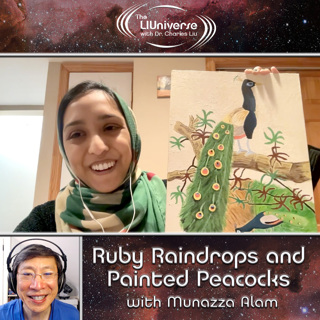
Ruby Raindrops and Painted Peacocks with Munazza Alam

Ruby Raindrops and Painted Peacocks with Munazza Alam

Are there really exoplanets with where it rains ruby and emerald raindrops? How do we measure the atmospheres of exoplanets light years away? To find out, Dr. Charles Liu and co-host Allen Liu welcome...

16 Mai 45min
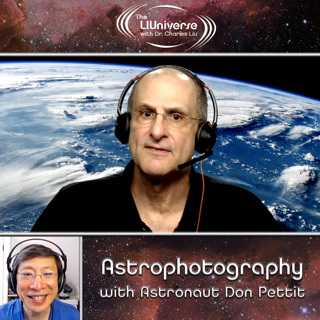
Astrophotography with Astronaut Don Pettit

Astrophotography with Astronaut Don Pettit

Can the physics you learned in High School take you to the stars? Who is behind many of your favorite pictures of space? What is it actually like to live and work in space? You might be surprised to k...

2 Mai 47min
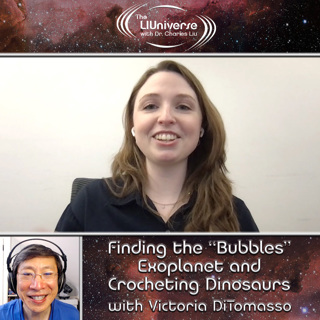
Finding the “Bubbles” Exoplanet and Crocheting Dinosaurs with Victoria DiTomasso

Finding the “Bubbles” Exoplanet and Crocheting Dinosaurs with Victoria DiTomasso

How do we find exoplanets? What is the Milky Way’s “Thick Disk” and what makes it so special? To find out, Dr. Charles Liu and co-host Allen Liu welcome Harvard astronomer Dr. Victoria DiTomasso, who ...

11 Apr 47min
Supernovas and Space Gold with Dr. Ashley Villar

Supernovas and Space Gold with Dr. Ashley Villar

How do stars die? And what happens when they do? To find out, Dr. Charles Liu and co-host Allen Liu welcome Dr. Ashley Villar, who teaches astronomy at Harvard and whose team studies supernovas as the...

21 Mar 40min
Building Worlds with Luke Skywatcher

Building Worlds with Luke Skywatcher

How do planetary systems form? If you wanted to observe them, where would you look and what would you look for? To find out, Dr. Charles Liu and co-host Allen Liu welcome Luke Keller, professor of Ast...

8 Mar 43min
Chuck GPT: Astrotech

Chuck GPT: Astrotech

How can a helicopter fly in space? How does LIGO detect gravitational waves? How do quantum electronic devices like Josephson junctions work? Could AI turn evil and destroy humanity? What about those ...

8 Feb 55min

Populært innen Vitenskap

fastlegen
tingenes-tilstand
romkapsel
abels-tarn
jss
liberal-halvtime
vett-og-vitenskap-med-gaute-einevoll
rekommandert
villmarksliv
dekodet-2
sinnsyn
fjellsportpodden
rss-overskuddsliv
rss-rekommandert
tomprat-med-gunnar-tjomlid
rss-inn-til-kjernen-med-sunniva-rose
kvinnehelsepodden
hva-er-greia-med
rss-lundqvist-podden
diagnose