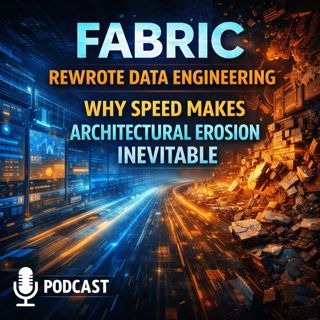
Fabric Rewrote Data Engineering: How Microsoft Fabric, OneLake, and Copilot Change Cost, Contracts, and Governance for Modern Data Engineers

Fabric Rewrote Data Engineering: How Microsoft Fabric, OneLake, and Copilot Change Cost, Contracts, and Governance for Modern Data Engineers

Every enterprise data engineering initiative begins with the same promise: pipelines. More sources landed, more models delivered, more dashboards shipped, more stakeholders “unblocked.” And Microsoft Fabric delivers on that promise — but only for the organizations that understand what they are actually building when they light up OneLake, Lakehouses, Warehouses, and Copilot across their estate. They are not just rolling out a new analytics toolset on top of their existing way of working. They are replacing the operating model of how data is produced, shaped, governed, and consumed. That distinction changes everything about how Fabric must be architected, governed, and led.

In this episode of M365.FM, Mirko Peters examines why organizations that treat Fabric as a convenience layer for data engineers consistently underperform those that treat it as a contract and control plane for the entire Microsoft data stack — and what that means for how leaders should be thinking about workspaces, OneLake, warehouses, lakehouses, and Copilot in production. This is a conversation about the structural difference between building pipelines and building data products, between letting Fabric make things “easier” and deciding what must not be easy, and between using Microsoft Fabric features and redesigning the operating assumptions those features now enforce at scale.

The organizations that will lead their industries are not those with the most Fabric workloads or the largest OneLake. They are those that have turned Fabric into an opinionated contract zone: where schemas are enforced, costs are engineered, query surfaces are constrained, and Copilot is allowed to move fast only inside boundaries that protect correctness, security, and unit economics. That is not a convenience project. It is an operating model for data engineering — and it requires everything operating models require: governance, ownership, measurement, and explicit separation between “we can technically do this” and “we have decided this is allowed here.”

WHAT YOU WILL LEARN
  • Why treating Microsoft Fabric as a “nicer Synapse” or “Power BI for engineers” leads to silent drift in cost, semantics, and ownership.
  • How Fabric’s consolidation of storage, compute, semantics, and publishing into one SaaS surface changes who must own contracts, not just who clicks deploy.
  • Why raw tables, open workspaces, and Copilot-generated SQL turn into cost and security liabilities when you don’t design explicit consumption boundaries.
  • What a contract-first Fabric architecture looks like: views and procedures as the only query surface, warehouses as enforcement zones, and execution plans as policy artifacts.
  • How to think about OneLake, capacities, and workspaces so that cost is an engineered property instead of a monthly surprise.
  • Why the modern data engineer’s job shifts from building more pipelines to designing and enforcing fewer, stronger contracts.
THE CORE INSIGHT
Fabric didn’t just change tools. It changed where ambiguity lives. In older stacks, ambiguity paid a tax in handoffs, environments, and deployment friction. In Fabric, ambiguity can ship at refresh speed from a single workspace, amplified by Copilot’s ability to generate plausible SQL and notebooks on demand. When that ambiguity touches shared capacity and shared semantics, your platform stops failing loudly and starts failing quietly: correct pipelines, wrong answers, rising cost, and growing audit discomfort.

Mirko argues that this is precisely why “Fabric made us faster” and “Fabric made us feel out of control” can both be true in the same organization. Fabric removed ceremony, not responsibility. Copilot removed typing, not consequences. If you don’t move governance, contracts, and enforcement into the engine, Fabric will faithfully multiply whatever operating model you already had — including its drift, its shortcuts, and its ownership gaps.

WHO THIS EPISODE IS FOR
  • Data engineering leaders and tech leads running or planning Microsoft Fabric in enterprise environments.
  • Power BI and Fabric architects responsible for capacities, workspaces, and semantic models.
  • Platform and governance teams trying to keep cost, security, and performance aligned as Fabric adoption grows.
  • CIOs, CDOs, and analytics leaders who feel their Fabric estate “works” but is getting more expensive, harder to reason about, and more fragile with every new project.
ABOUT THE HOST

Mirko Peters is a Microsoft 365 and Azure architect, strategist, and the host of M365.FM — a podcast focused on modern work, security, data, and operating model design in the Microsoft ecosystem. He works with organizations from midmarket to global enterprise to turn Microsoft Fabric, Power BI, and Copilot into governed data platforms rather than collections of ad‑hoc pipelines and dashboards. His work centers on data engineering with Fabric, semantic model and contract design, Azure and M365 architecture, and the hard reality of keeping cost, performance, governance, and developer velocity aligned in modern Microsoft data estates.

Become a supporter of this podcast: https://www.spreaker.com/podcast/m365-fm-modern-work-security-and-productivity-with-microsoft-365--6704921/support.

Denne episoden er hentet fra en åpen RSS-feed og er ikke publisert av Podme. Den kan derfor inneholde annonser.

Episoder(864)

From Excel Expert to Microsoft MVP: Empowering Millions with Data, Dashboards & AI with Karen Abecia [Microsoft MVP]

From Excel Expert to Microsoft MVP: Empowering Millions with Data, Dashboards & AI with Karen Abecia [Microsoft MVP]

aren Abecia shares the remarkable journey that transformed a passion for Microsoft Excel into a global career as one of the world's best-known Excel educators. She explains how discovering creative sp...

27 Jul 0s

The Copilot Credit Trap- Why Your AI Economy is Already Broken

The Copilot Credit Trap- Why Your AI Economy is Already Broken

For decades, enterprise software followed a predictable financial model. Organizations purchased licenses, assigned them to users, and budgeted annual IT spending with confidence. AI changes that comp...

26 Jul 0s
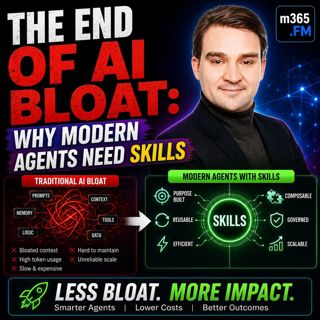
The End of AI Bloat: Why Modern Agents Need Skills

The End of AI Bloat: Why Modern Agents Need Skills

Many AI agents start out fast, responsive, and surprisingly intelligent. But after a few months of real-world use, something changes. Response times increase, costs rise, prompts become enormous, and ...

26 Jul 0s

THE DEATH OF THE PROXY: Architecting Dataverse for the Agent Fabric

THE DEATH OF THE PROXY: Architecting Dataverse for the Agent Fabric

For years, Microsoft's recommended architecture for connecting AI assistants like Claude Desktop to Dataverse relied on a local STDIO proxy. It was simple, easy to install, and perfectly suited for in...

26 Jul 0s
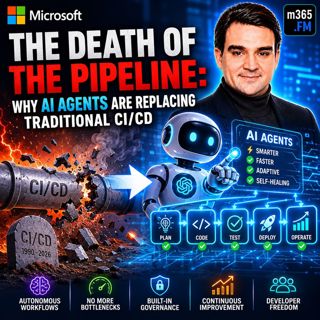
The Death of the Pipeline: Why AI Agents are Replacing Traditional

The Death of the Pipeline: Why AI Agents are Replacing Traditional

For more than two decades, CI/CD pipelines have been the backbone of modern software delivery. Developers commit code, automated builds run, tests execute, security scans complete, someone approves th...

25 Jul 0s
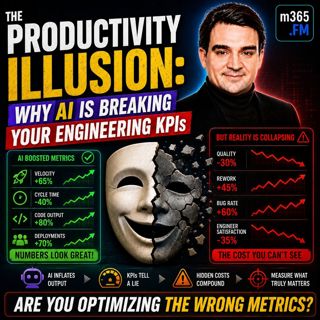
The Productivity Illusion: Why AI is Breaking Your Engineering KPIs

The Productivity Illusion: Why AI is Breaking Your Engineering KPIs

At first glance, the numbers look incredible. Deployment frequency is increasing, pull requests are being merged faster than ever, AI is generating more code, and engineering teams appear dramatically...

25 Jul 0s
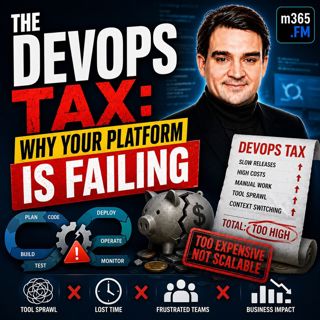
The DevOps Tax: Why Your Platform is Failing

The DevOps Tax: Why Your Platform is Failing

Welcome to another episode of Knowledge Nuggets with Mirko Peters. Today we're exploring The DevOps Tax—the hidden cost that silently reduces engineering productivity, increases cognitive overload, an...

25 Jul 0s

Microsoft Purview Insider Risk Management - Simply Explained

Microsoft Purview Insider Risk Management - Simply Explained

Welcome to another episode of Knowledge Nuggets with Mirko Peters. Today we're exploring Microsoft Purview Insider Risk Management, Microsoft's intelligent solution for identifying risky user behavior...

24 Jul 0s

Populært innen Politikk og nyheter

giver-og-gjengen-vg
aftenpodden
forklart
popradet
stopp-verden
rss-gukild-johaug
fotballpodden-2
aftenpodden-usa
hanna-de-heldige
dine-penger-pengeradet
rss-ness
aftenbla-bla
det-store-bildet
nokon-ma-ga
e24-podden
lydartikler-fra-aftenposten
unitedno
oppdatert
bt-dokumentar-2
liverpoolno-pausepraten