#179 Classic episode – Randy Nesse on why evolution left us so vulnerable to depression and anxiety

#179 Classic episode – Randy Nesse on why evolution left us so vulnerable to depression and anxiety

Mental health problems like depression and anxiety affect enormous numbers of people and severely interfere with their lives. By contrast, we don’t see similar levels of physical ill health in young people. At any point in time, something like 20% of young people are working through anxiety or depression that’s seriously interfering with their lives — but nowhere near 20% of people in their 20s have severe heart disease or cancer or a similar failure in a key organ of the body other than the brain.

From an evolutionary perspective, that’s to be expected, right? If your heart or lungs or legs or skin stop working properly while you’re a teenager, you’re less likely to reproduce, and the genes that cause that malfunction get weeded out of the gene pool.

So why is it that these evolutionary selective pressures seemingly fixed our bodies so that they work pretty smoothly for young people most of the time, but it feels like evolution fell asleep on the job when it comes to the brain? Why did evolution never get around to patching the most basic problems, like social anxiety, panic attacks, debilitating pessimism, or inappropriate mood swings? For that matter, why did evolution go out of its way to give us the capacity for low mood or chronic anxiety or extreme mood swings at all?

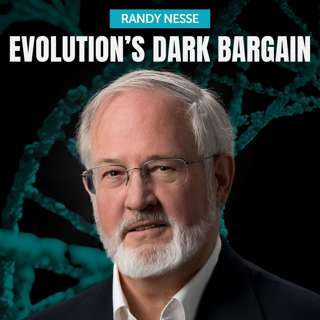
Today’s guest, Randy Nesse — a leader in the field of evolutionary psychiatry — wrote the book Good Reasons for Bad Feelings, in which he sets out to try to resolve this paradox.

Rebroadcast: This episode originally aired in February 2024.

Links to learn more, video, and full transcript: https://80k.info/rn

In the interview, host Rob Wiblin and Randy discuss the key points of the book, as well as:

  • How the evolutionary psychiatry perspective can help people appreciate that their mental health problems are often the result of a useful and important system.
  • How evolutionary pressures and dynamics lead to a wide range of different personalities, behaviours, strategies, and tradeoffs.
  • The missing intellectual foundations of psychiatry, and how an evolutionary lens could revolutionise the field.
  • How working as both an academic and a practicing psychiatrist shaped Randy’s understanding of treating mental health problems.
  • The “smoke detector principle” of why we experience so many false alarms along with true threats.
  • The origins of morality and capacity for genuine love, and why Randy thinks it’s a mistake to try to explain these from a selfish gene perspective.
  • Evolutionary theories on why we age and die.
  • And much more.

Chapters:

  • Cold Open (00:00:00)
  • Rob's Intro (00:00:55)
  • The interview begins (00:03:01)
  • The history of evolutionary medicine (00:03:56)
  • The evolutionary origin of anxiety (00:12:37)
  • Design tradeoffs, diseases, and adaptations (00:43:19)
  • The tricker case of depression (00:48:57)
  • The purpose of low mood (00:54:08)
  • Big mood swings vs barely any mood swings (01:22:41)
  • Is mental health actually getting worse? (01:33:43)
  • A general explanation for bodies breaking (01:37:27)
  • Freudianism and the origins of morality and love (01:48:53)
  • Evolutionary medicine in general (02:02:42)
  • Objections to evolutionary psychology (02:16:29)
  • How do you test evolutionary hypotheses to rule out the bad explanations? (02:23:19)
  • Striving and meaning in careers (02:25:12)
  • Why do people age and die? (02:45:16)

Producer and editor: Keiran Harris
Audio Engineering Lead: Ben Cordell
Technical editing: Dominic Armstrong
Transcriptions: Katy Moore

Episoder(318)

Emergency pod: Did OpenAI give up, or is this just a new trap? (with Rose Chan Loui)

Emergency pod: Did OpenAI give up, or is this just a new trap? (with Rose Chan Loui)

When attorneys general intervene in corporate affairs, it usually means something has gone seriously wrong. In OpenAI’s case, it appears to have forced a dramatic reversal of the company’s plans to si...

8 Mai 20251h 2min

#216 – Ian Dunt on why governments in Britain and elsewhere can't get anything done – and how to fix it

#216 – Ian Dunt on why governments in Britain and elsewhere can't get anything done – and how to fix it

When you have a system where ministers almost never understand their portfolios, civil servants change jobs every few months, and MPs don't grasp parliamentary procedure even after decades in office —...

2 Mai 20253h 14min

Serendipity, weird bets, & cold emails that actually work: Career advice from 16 former guests

Serendipity, weird bets, & cold emails that actually work: Career advice from 16 former guests

How do you navigate a career path when the future of work is uncertain? How important is mentorship versus immediate impact? Is it better to focus on your strengths or on the world’s most pressing pro...

24 Apr 20252h 18min

#215 – Tom Davidson on how AI-enabled coups could allow a tiny group to seize power

#215 – Tom Davidson on how AI-enabled coups could allow a tiny group to seize power

Throughout history, technological revolutions have fundamentally shifted the balance of power in society. The Industrial Revolution created conditions where democracies could flourish for the first ti...

16 Apr 20253h 22min

Guilt, imposter syndrome & doing good: 16 past guests share their mental health journeys

Guilt, imposter syndrome & doing good: 16 past guests share their mental health journeys

"We are aiming for a place where we can decouple the scorecard from our worthiness. It’s of course the case that in trying to optimise the good, we will always be falling short. The question is how mu...

11 Apr 20251h 47min

#214 – Buck Shlegeris on controlling AI that wants to take over – so we can use it anyway

#214 – Buck Shlegeris on controlling AI that wants to take over – so we can use it anyway

Most AI safety conversations centre on alignment: ensuring AI systems share our values and goals. But despite progress, we’re unlikely to know we’ve solved the problem before the arrival of human-leve...

4 Apr 20252h 16min

15 expert takes on infosec in the age of AI

15 expert takes on infosec in the age of AI

"There’s almost no story of the future going well that doesn’t have a part that’s like '…and no evil person steals the AI weights and goes and does evil stuff.' So it has highlighted the importance of...

28 Mar 20252h 35min

#213 – Will MacAskill on AI causing a “century in a decade” – and how we're completely unprepared

#213 – Will MacAskill on AI causing a “century in a decade” – and how we're completely unprepared

The 20th century saw unprecedented change: nuclear weapons, satellites, the rise and fall of communism, third-wave feminism, the internet, postmodernism, game theory, genetic engineering, the Big Bang...

11 Mar 20253h 57min

Populært innen Fakta

fastlegen
dine-penger-pengeradet
relasjonspodden-med-dora-thorhallsdottir-kjersti-idem
treningspodden
foreldreradet
jakt-og-fiskepodden
dopet
merry-quizmas
podme-bio-3
rss-strid-de-norske-borgerkrigene
sinnsyn
rss-kull
sovnlos
gravid-uke-for-uke
rss-var-forste-kaffe
hverdagspsyken
fryktlos
rss-kunsten-a-leve
tomprat-med-gunnar-tjomlid
dypdykk