Think Thursday: When the Brain Stops Organizing and Starts Alarming

Think Thursday: When the Brain Stops Organizing and Starts Alarming

Many people are saying the same thing lately: “I’m overwhelmed by everything.”

In this Think Thursday episode, Molly explores what overwhelm actually is from a neuroscience perspective. Is it just busyness? Or is something deeper happening in the brain?

Drawing from research on the amygdala, stress hormones, working memory, and executive function, Molly explains how overwhelm is not about volume alone. It is about perceived overload and a loss of prioritization. When the brain detects too many competing demands and not enough resources, it shifts from organizing to alarming.

This episode also revisits a recent WisdomWednesday quote about replacing “I’m overwhelmed” with “I need to decide what matters most and go slow.” Molly clarifies why that statement is directionally true but not neurologically instant. She explains how language influences prediction, prediction shapes physiology, and physiology drives behavior.

What You’ll Learn

  • Why overwhelm is a perception of overload, not simply busyness
  • How the amygdala flags cognitive threat
  • What happens to the prefrontal cortex under stress
  • Why everything feels urgent when executive function is compromised
  • The difference between descriptive and prescriptive thoughts
  • How repeating “I’m overwhelmed” reinforces neural prediction loops
  • Why prioritization restores cognitive flexibility
  • How cognitive reappraisal shifts neural activity over time

Key Concepts Explained

Perceived Overload
Overwhelm occurs when the brain interprets demands as exceeding available resources.

Amygdala Activation
When ambiguity, uncertainty, and competing priorities rise, the amygdala signals threat, increasing stress hormones like cortisol and norepinephrine.

Executive Function
The prefrontal cortex is responsible for planning, sequencing, prioritizing, and organizing. Under stress, its efficiency decreases.

Descriptive vs Prescriptive Thinking
Some thoughts label experience. Others shape future experience. Repeating “I’m overwhelmed” reinforces prediction patterns that sustain the feeling.

Cognitive Reappraisal
Research shows that reinterpreting a situation increases prefrontal cortex activity and decreases amygdala activation over time.

Why Language Matters

When you repeatedly say “I’m overwhelmed,” your brain begins scanning for confirming evidence. Increased vigilance raises stress. Stress reduces clarity. Reduced clarity reinforces overwhelm.

Replacing that statement with a prioritizing phrase does not instantly shut down the alarm system. However, it recruits executive function and begins shifting neural activity toward organization and task-based thinking.

Language guides prediction.
Prediction guides physiology.
Physiology guides behavior.


Practical Reframe

Instead of:

“I’m overwhelmed.”

Try:

  • What matters most today?
  • What is the next smallest step?
  • What can wait?

This is not positive thinking. It is restoring organizing capacity.

Overwhelm signals that prioritization has collapsed. Prioritization is a skill that can be strengthened.

Behavior Change Connection

People often abandon habits when they feel overwhelmed, not because they lack discipline, but because executive function is compromised.

You cannot build new neural pathways from a chronically alarmed state.

Restoring order supports follow-through.


★ Support this podcast ★

Denne episoden er hentet fra en åpen RSS-feed og er ikke publisert av Podme. Den kan derfor inneholde annonser.

Episoder(374)

Revisiting-Think Thursday: How Mindset Impact's the Body's Biology

Revisiting-Think Thursday: How Mindset Impact's the Body's Biology

In this Think Thursday episode, Molly revisits a timely conversation on mindset, neuroscience, and the biology of belief. Drawing on the work of Stanford health psychologist Dr. Alia Crum, she explore...

16 Apr 18min

Alcohol Awareness Month: 8 Facts Everyone Should Know About Alcohol

Alcohol Awareness Month: 8 Facts Everyone Should Know About Alcohol

In this episode of the Alcohol Minimalist Podcast, Molly shares 8 evidence-based facts everyone should know about alcohol. From cancer risk and “safe” drinking limits to binge drinking, sleep, toleran...

13 Apr 19min
Think Thursday: Paradox-The Power of "Both/And"

Think Thursday: Paradox-The Power of "Both/And"

In this Think Thursday episode, Molly explores Brené Brown’s ideas on paradox and why emotional resilience is less about certainty and more about our capacity to hold two truths at once. When we stop ...

9 Apr 16min
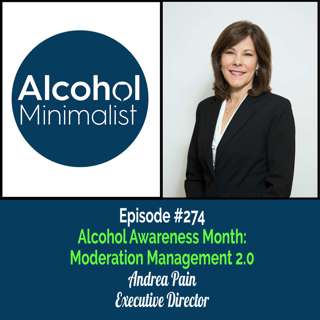
Alcohol Awareness Month:  Moderation Management 2.0 with Andrea Pain, Executive Director

Alcohol Awareness Month: Moderation Management 2.0 with Andrea Pain, Executive Director

In this episode of The Alcohol Minimalist Podcast, Molly talks with Andrea Pain, Executive Director of Moderation Management, about alcohol support options for people who want to drink less, explore m...

6 Apr 41min
Revisiting: Think Thursday-The Neuroscience of New Habit Formation

Revisiting: Think Thursday-The Neuroscience of New Habit Formation

In this revisited Think Thursday episode, Molly explains why March may be a better time than January to build lasting habits. If your New Year’s goals have faded, this conversation offers a science-ba...

2 Apr 18min

Why Your Partner Doesn't Have to Change for You to Change Your Drinking with Matt Wing

Why Your Partner Doesn't Have to Change for You to Change Your Drinking with Matt Wing

What happens when you want to drink less—but your partner doesn’t?In this episode, Molly talks with midlife sobriety coach Matt Wing about how to change your relationship with alcohol, even when your ...

30 Mar 40min
Think Thursday: The Zeigarnik Effect: Why Your Brain Won’t Let Things Go

Think Thursday: The Zeigarnik Effect: Why Your Brain Won’t Let Things Go

Episode SummaryWhy does your brain keep bringing things back up—especially when you’re trying to relax?In this Think Thursday episode, Molly expands on the Zeigarnik Effect, a psychological principle ...

26 Mar 9min

March Madness Series:  Play Until the Clock Says 0:00

March Madness Series: Play Until the Clock Says 0:00

In this final installment of the March Madness series, Molly brings the conversation full circle by focusing on the long game.After exploring your playbook, your scoreboard, and how to rebound when yo...

23 Mar 14min

Populært innen Fakta

fastlegen
dine-penger-pengeradet
rss-bisarr-historie
relasjonspodden-med-dora-thorhallsdottir-kjersti-idem
foreldreradet
treningspodden
rss-strid-de-norske-borgerkrigene
rss-kunsten-a-leve
jakt-og-fiskepodden
rss-sunn-okonomi
mikkels-paskenotter
sinnsyn
hverdagspsyken
gravid-uke-for-uke
rss-bak-luftfarten
rss-sarbar-med-lotte-erik
hagespiren-podcast
rss-kull
fryktlos
rss-mind-body-podden