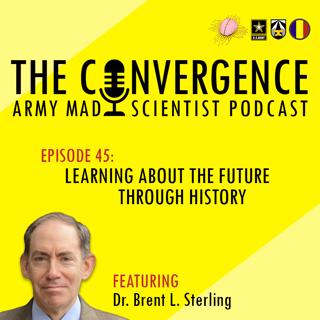
45. Learning About the Future Through History with Dr. Brent L. Sterling

45. Learning About the Future Through History with Dr. Brent L. Sterling

Brent L. Sterling has been an adjunct lecturer at the Edmund A. Walsh School of Foreign Service at Georgetown University for the past twenty years, teaching courses on security studies, military strategy, and operations. He is the author of Other People’s Wars: The US Military and the Challenge of Learning for Foreign Conflicts and Do Good Fences Make Good Neighbors? What History Teaches Us about Strategic Barriers and International Security. Dr. Sterling has spent the past thirty years as a defense analyst, including positions at the Central Intelligence Agency and consulting firms working for the U.S. Department of Defense.

In our interview with Dr. Sterling, we discuss how militaries learn (or don’t!) from foreign conflicts, what pitfalls await those trying to learn from historical conflicts, how focusing only on “relevant” observations hampers our creativity in analyzing warfare, and what strategists can do to avoid past mistakes. The following bullet points highlight key insights from our interview:

  • In Other People’s Wars, Dr. Sterling provides a longitudinal evaluation spanning the 19th and 20th centuries on what the U.S. military learned from foreign conflicts. Exploring the Crimean, Russo-Japanese, Spanish Civil, and Yom Kippur Wars as use cases, Dr. Sterlingidentifies how effectively the U.S. assimilated key lessons from each of these conflicts and developed responsive capabilities across doctrine, organization, training and education, materiel, leadership, personnel, facilities, and policy (DOTMLPF-P); drew erroneous conclusions; or failed to act altogether. Importantly, Dr. Sterling compares the success of learning from these wars across the U.S. Army, Navy, and Air Force.

  • Studying foreign conflicts allows the U.S. military to learn about new technologies, their applications, and novel problem sets, facilitating proactive responsesto problems before they are encountered in the field. For example, at the beginning of the 20th century, the U.S. Army was reconsidering the future of the bayonet. Observations from the Russo-Japanese War, where knife fighting was prevalent — especially in night assaults, given the heightened risk of friendly fire — led Army Leaders to determine that the weapon was still relevant, and should be maintained.

  • Learning from foreign wars can be a challenging endeavor, as it frequently runs counter to deeply-rooted institutional biases.Services’ culture and bureaucratic politics can limit the implementation of lessons learned from other nations’ conflicts. Insufficient access to information can also prevent the Services from fully appreciating the important implications of remote conflicts involving less than peer adversaries.

  • The U.S. military also needs to be mindful that other observers learn from foreign conflicts, too. For example, while the U.S. Army learned of the importance and adopted Anti-Tank (AT) g...

Denne episoden er hentet fra en åpen RSS-feed og er ikke publisert av Podme. Den kan derfor inneholde annonser.

Episoder(117)

119. No Winning Without Fighting: How China’s View of Hybrid Warfare Has Evolved with Dr. Howard Wang

119. No Winning Without Fighting: How China’s View of Hybrid Warfare Has Evolved with Dr. Howard Wang

“The PLA expected Russia to run the same playbook it did with Crimea on a larger scale.  And it didn’t work.” [Editor’s Note:  Today’s post welcomes back proclaimed Mad Scientist Dr. Howard Wang, who ...

9 Apr 40min

118. Sinews of War: A gaming Approach to Sustaining the Force

118. Sinews of War: A gaming Approach to Sustaining the Force

[Editor’s Note:  Regular readers of the Mad Scientist Laboratory blog site know that wargaming is a vital cognitive tool for understanding the complexities of the evolving Operational Environment (OE)...

15 Jan 53min
117. From Campus to Command: The William & Mary Wargaming Lab with Luke Miller

117. From Campus to Command: The William & Mary Wargaming Lab with Luke Miller

[Editor’s Note:  Army Mad Scientist and the Georgetown University Wargaming Society co-hosted our Game On! Wargaming & The Operational Environment Conference at Georgetown University, Washington, DC, ...

11 Sep 202524min

116. Do Androids Dream of Electric War: The Reality of Autonomous Weapons with Dr. Mark Bailey

116. Do Androids Dream of Electric War: The Reality of Autonomous Weapons with Dr. Mark Bailey

“I think there’s a moral question that one has to ask in general about whether it’s appropriate for a machine to make a decision as to whether or not a human ought to live or die” [Editor’s Note:  As ...

28 Aug 202525min

115. 15 Layers Deep: Supporting Soldiers with Geospatial Intelligence

115. 15 Layers Deep: Supporting Soldiers with Geospatial Intelligence

[Editor’s Note:  As observed in TRADOC Pamphlet 525-92, The Operational Environment 2024-2034: Large-Scale Combat Operations: “LSCO will be marked by the democratization and proliferation of advanced ...

14 Aug 202544min

114. Data to Dominance: AI & Gaming to Create Decision Advantage with Jon Pan

114. Data to Dominance: AI & Gaming to Create Decision Advantage with Jon Pan

“Agentic warfare is here, whether we welcome it or not. The era of military planners manually gathering limited data and compiling static crisis response options on briefing slides is over.  In the ne...

31 Jul 202546min

113. Beyond Venture Capital: How the Government is Investing in Innovation

113. Beyond Venture Capital: How the Government is Investing in Innovation

[Editor’s Note:  Regular readers of the Mad Scientist Laboratory understand the transformative potential of Large Language Models (LLMs) and Artificial Intelligence (AI) have on the character of warfa...

18 Jun 202537min

112. Battle Tested:  Revolutionizing Wargaming with AI featuring Dr. Billy Barry

112. Battle Tested: Revolutionizing Wargaming with AI featuring Dr. Billy Barry

Today’s The Convergence podcast welcomes back proclaimed Mad Scientist Dr. Billy Barry, Professor of Emerging Technology at the U.S. Army War College, to discuss his latest innovation — an Artificial ...

27 Mar 202559min

Populært innen Vitenskap

fastlegen
tingenes-tilstand
rss-nysgjerrige-norge
romkapsel
liberal-halvtime
jss
rekommandert
rss-paradigmepodden
tomprat-med-gunnar-tjomlid
sinnsyn
villmarksliv
fjellsportpodden
smart-forklart
vett-og-vitenskap-med-gaute-einevoll
dekodet-2
rss-rekommandert
diagnose
rss-overskuddsliv
abels-tarn
kvinnehelsepodden