Understanding how elephants experience time might change how we protect them

Understanding how elephants experience time might change how we protect them

Khatijah Rahmat, a postdoctoral researcher at the Max Planck Institute for the History of Science in Germany, says she's trying to build legitimacy around the concept of animal temporality — the ability to experience time — specifically in elephants. Doing so could have implications for conservation and beyond.

"How we envision an animal's relationship to time influences whether we see them as feeling, remembering beings. My aim is to encourage a more dynamic view of their place in the world when we recognize them as equally temporal beings."

This week on the Mongabay Newscast, Rahmat explains three key areas of evidence for interpreting elephant temporal experience and how this knowledge could be folded into how we think about protecting elephants or animals in general.

"I think it increases the depth of empathy we can have for animals," she says. "It can really push the concepts of policy … but it also can really challenge some of our current, basic assumptions about how we think about logic and evidence."

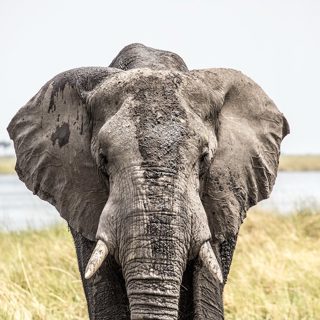
Image credit: An elephant that has just wallowed in mud in the Linyanti River in northern Botswana. Image by Roger Borgelid for Mongabay.

Please take a minute to let us know what you think of our podcast, here.

——

Timecodes

(00:00) Why study how animals experience time?

(06:58) Elephant eco-cultural identity

(11:58) Human-impacted time

(27:03) Individual elephant history

(34:44) Getting hit with a pineapple is no accident

(39:30) How this might help conservation

Denne episoden er hentet fra en åpen RSS-feed og er ikke publisert av Podme. Den kan derfor inneholde annonser.

Episoder(369)

Historic fire seasons are the 'new normal' without 'serious action' on climate change

Historic fire seasons are the 'new normal' without 'serious action' on climate change

Elizabeth Goldman is a co-director of Global Nature Watch, previously known as Global Forest Watch, a database measuring forest loss that's frequently cited in Mongabay reporting. She joins this week'...

11 Aug 28min

The 'quiet revolution' inspired by Delhi's urban wildlife

The 'quiet revolution' inspired by Delhi's urban wildlife

In her upcoming book, My Wild City: Finding Nature, Meaning, and Hope in India's Capital, conservation biologist Neha Sinha takes readers to the hidden and not-so-hidden ecosystems of India's largest...

4 Aug 54min

Why are forests in Liberia disappearing?

Why are forests in Liberia disappearing?

On this week's episode of the Mongabay Newscast, we speak with features writer Ashoka Mukpo, who traveled to southeastern Liberia to investigate what satellite images indicated was a spike in deforest...

28 Jul 38min

Oil has brought destruction to the Niger Delta; women and human rights may save it

Oil has brought destruction to the Niger Delta; women and human rights may save it

On this week's episode of the Mongabay Newscast, I speak with travel writer Noo Saro-Wiwa. She has documented the violence and natural destruction that the presence of oil companies have brought to th...

21 Jul 42min

The Mediterranean Sea's beauty hides an ecosystem under pressure

The Mediterranean Sea's beauty hides an ecosystem under pressure

The Mediterranean Sea accounts for less than 1% of the world's ocean surface water, but it contains roughly 18% of global marine biodiversity. It is home to 150 million people along its coastline (rou...

14 Jul 33min

Wildlife crossings are having a moment

Wildlife crossings are having a moment

Nearly three years ago, Newscast guest, author and journalist Ben Goldfarb discussed his book Crossings, which is about wildlife crossings and road ecology. Wildlife crossings help reconnect habitats...

7 Jul 37min

The radical plan to rethink work, wealth and planetary well-being

The radical plan to rethink work, wealth and planetary well-being

A group of more than 40 researchers spent 20 months devising a plan for the world to achieve ecological sustainability within planetary boundaries, all while seeing incomes rise for 98% of the global ...

30 Jun 52min

Addressing the 'toxic legacy' of mining in Bougainville

Addressing the 'toxic legacy' of mining in Bougainville

Theonila Roka Matbob grew up next to what was — at the time — the world's largest open-pit mine in Bougainville, an autonomous island in Papua New Guinea, operated by a subsidiary of Rio Tinto. This m...

16 Jun 33min

Populært innen Vitenskap

fastlegen
tingenes-tilstand
romkapsel
rss-nysgjerrige-norge
liberal-halvtime
rekommandert
jss
villmarksliv
dekodet-2
abels-tarn
sinnsyn
vett-og-vitenskap-med-gaute-einevoll
fjellsportpodden
rss-overskuddsliv
rss-rekommandert
rss-paradigmepodden
tomprat-med-gunnar-tjomlid
diagnose
rss-inn-til-kjernen-med-sunniva-rose
nordnorsk-historie