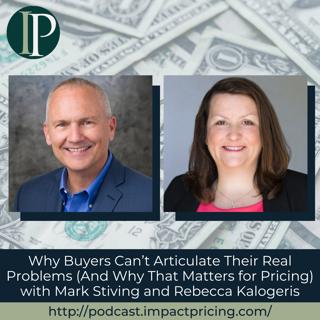
Why Buyers Can't Articulate Their Real Problems (And Why That Matters for Pricing) with Mark Stiving and Rebecca Kalogeris

Why Buyers Can't Articulate Their Real Problems (And Why That Matters for Pricing) with Mark Stiving and Rebecca Kalogeris

If value comes from solving problems… why do buyers struggle to explain the problems they actually have?

In Episode 4 of the Buyer Decision Series, Mark Stiving and Rebecca Kalogeris explore why buyers often jump straight to solutions instead of clearly articulating their problems.

But the real value conversation doesn't start with features or products — it starts with understanding the problem behind the purchase.

Discover why the sellers who understand a buyer's problems best are the ones buyers trust most… and why that trust increases the confidence needed to say yes.

Why you have to check out today's podcast:

  • Understand why value only exists when a real problem is being solved—and why no problem means no value.
  • Learn why buyers often jump to solutions and features instead of articulating their real problems.
  • See why the best sales conversations focus less on products and more on diagnosing the buyer's situation.

Catch Up on the #BuyerDecisionSeries:

"If there's no problem, there's no value."

— Mark Stiving

Topics Covered:

00:00 – The Question Most Buyers Never Stop to Ask. Mark opens with a simple but powerful question: what problem are we actually trying to solve? The starting point behind value — and why most buyers skip it.

02:00 – The Rule That Explains Why Value Only Exists When Problems Exist. Mark introduces the second half of the Second Law of Value: value is the result of solving problems. If there's no meaningful problem, there's no reason to pay.

02:28 – The "Drill Aisle" Mistake Buyers Make. Why buyers walk into a store asking for a drill instead of understanding what they actually need — and how jumping straight to solutions leads to bad decisions.

05:12 – Why Feature-Focused Buyers Often Choose the Wrong Solution. From cars to CRM systems, buyers instinctively compare features instead of identifying the deeper problems they're trying to solve.

08:09 – The Question That Instantly Builds Buyer Trust. Why great sellers ask deeper questions about context and behavior — revealing problems the buyer hasn't fully articulated.

09:55 – The Confidence Equation Behind Every Buying Decision. Mark revisits the confidence framework — payoff, probability, and anticipated regret — and explains why understanding problems increases the probability a buyer believes your solution will work.

11:04 – The "Doctor Test" for Great Selling. Rebecca compares great sellers to doctors: when someone clearly diagnoses your problem, you immediately trust their solution.

12:48 – The Next Puzzle: Turning Problems Into Measurable Value. Mark previews the next episode: how companies can help buyers quantify value once the real problems are understood.

Key Takeaways:

"Buyers typically are horrible at articulating their own problems." — Mark Stiving

"Nobody cares about your product. What they care about are the problems you can solve and the results they'll achieve." — Mark Stiving

"The better a salesperson is at understanding your problems, the more likely you are to believe that solution solves your problem." — Mark Stiving

"When someone can articulate your problem with nuance and detail, suddenly you believe they can solve it." — Mark Stiving

"Confidence changes when someone demonstrates they truly understand your situation." — Rebecca Kalogeris

People / Concepts Mentioned:

  • Theodore Levitt. Referenced for the famous insight: "People don't want a quarter-inch drill. They want a quarter-inch hole."
  • Jobs to Be Done. A framework focused on understanding the underlying job a customer is trying to accomplish.

Connect with Rebecca Kalogeris:

Connect with Mark Stiving:

Episoder(500)

Memecast #67: Perceived Value

Memecast #67: Perceived Value

We all want our salespeople to sell more value. What does that actually mean though? If we think about it, our customers, whether they be consumers or businesses, they buy value. They exchange money f...

20 Jul 20221min

Grants, Scholarships, and Loans as Huge Factors of Pricing in Higher Education with Christine Carragee

Grants, Scholarships, and Loans as Huge Factors of Pricing in Higher Education with Christine Carragee

Christine Carragee has been working as Carragee Consulting's Business Consultant for more than six years now. She's done two different stints at the Vendavo – first as their Senior Pricing Consultant ...

18 Jul 202221min

Blogcast #63: To Fee or Not to Fee?

Blogcast #63: To Fee or Not to Fee?

This is an Impact Pricing Blog published on June 8, 2022, turned into an audio podcast so you can listen on the go. Read Full Article Here: https://impactpricing.com/blog/to-fee-or-not-to-fee/ If you ...

15 Jul 20223min
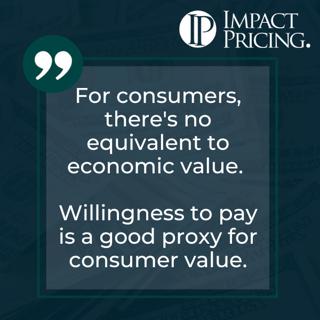
Memecast #66: Consumer Value

Memecast #66: Consumer Value

Last week, we talked about economic value and how businesses are able to calculate how much money are they going to make or save based on buying and using your product or solution. Sadly, consumers ca...

13 Jul 20221min
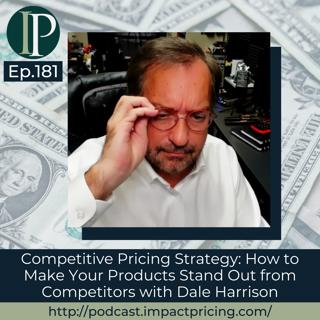
Competitive Pricing Strategy: How to Make Your Products Stand Out from Competitors with Dale Harrison

Competitive Pricing Strategy: How to Make Your Products Stand Out from Competitors with Dale Harrison

Dale Harrison has been consulting in life sciences for seven years now, but he's been an executive in biotech for 16 years. Dale started his career as a physicist. In this episode, Dale shares how he'...

11 Jul 202228min

Blogcast #62: The Power of Economic Value

Blogcast #62: The Power of Economic Value

This is an Impact Pricing Blog published on June 1, 2022, turned into an audio podcast so you can listen on the go. Read Full Article Here: https://impactpricing.com/blog/the-power-of-economic-value/ ...

8 Jul 20222min
Memecast #65: Economic Value

Memecast #65: Economic Value

It's true, every time we buy something, we buy it because we think we get more value than the price it's going to cost us. It's kind of hard for us as consumers to say how much is that value, and we t...

6 Jul 20221min

What Makes Pricing in Higher Education Difficult with Chris Uthe

What Makes Pricing in Higher Education Difficult with Chris Uthe

Christopher Uthe is the Director of Product Management at Ocelot, where he champions scalable day-to-day organizational changes to transform it to a product-driven company. He's been working in the ed...

4 Jul 202222min

Populært innen Business og økonomi

stopp-verden
dine-penger-pengeradet
lydartikler-fra-aftenposten
rss-penger-polser-og-politikk
e24-podden
rss-borsmorgen-okonominyhetene
pengesnakk
livet-pa-veien-med-jan-erik-larssen
utbytte
rss-politisk-preik
pengepodden-2
finansredaksjonen
morgenkaffen-med-finansavisen
tid-er-penger-en-podcast-med-peter-warren
stormkast-med-valebrokk-stordalen
rss-markedspuls-2
lederpodden
rss-pa-konto
liberal-halvtime
rss-sunn-okonomi