
S9 Ep20: What triggered January 6?

S9 Ep20: What triggered January 6?

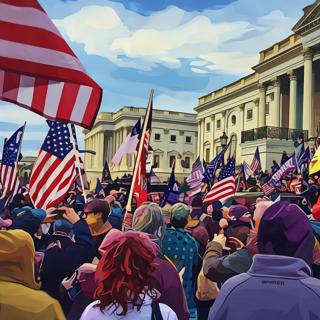
Two explanations circulated immediately after the March to Save America on January 6, 2021 turned into a riot: a mob manipulated by a demagogue, or ordinary citizens defending democracy against a stolen election. Konstantin Sonin, David Van Dijcke, and Austin Wright have used anonymised location data from forty million mobile devices to investigate why the protests escalated so dramatically.

No surprise: partisanship was the strongest predictor of attendance, proximity to Proud Boys chapters and use of the far-right social network Parler also increased participation. But political isolation amplified the movement: the communities most over-represented among those who traveled to Washington were small Republican enclaves surrounded by Democrat-leaning areas, politically and socially cut off from their neighbours. And participation also spiked in counties that experienced a "midnight swing," where the reported vote count favoured Trump on election night before shifting to Biden as mail-in ballots were counted. These were precisely the counties where the "Stop the Steal" narrative landed hardest.

The research behind this episode:

Sonin, Konstantin, David Van Dijcke, and Austin L. Wright. 2023. "Isolation and Insurrection: How Partisanship and Political Geography Fueled January 6, 2021." CEPR DP18209.

To cite this episode:

Phillips, Tim, and Konstantin Sonin. 2026. “What triggered January 6?” VoxTalks Economics (podcast).

Assign this as extra listening. The citation above is formatted and ready for a reading list or VLE.

About the guest

Konstantin Sonin is the John Dewey Distinguished Service Professor at the Harris School of Public Policy at the University of Chicago. Born in the Soviet Union, he has spent his career studying how political institutions work under stress, with particular attention to how information and misinformation shape political behaviour, elections, and collective action. He is one of the leading economists working on the political economy of authoritarian and democratic governance, and his research on protest, polarisation, and political geography has made him a central figure in the study of democratic backsliding.

Research cited in this episode

Regression discontinuity design is a statistical method used to identify causal effects by exploiting a threshold or cutoff. Sonin, Van Dijcke, and Wright use two regression discontinuity designs: one exploiting the narrow margins by which Trump lost certain states, and one exploiting the gap between the election-night vote tally and the final certified result in individual counties. In both cases, the design allows them to isolate the effect of a specific trigger on protest participation, separating it from the general background of partisan feeling.

The "midnight swing" refers to the shift in reported vote tallies that occurred in many counties on election night 2020 as large batches of mail-in ballots were counted. Because mail-in voters skewed heavily Democratic, counties where in-person votes were reported first showed strong Trump leads that reversed overnight as the mail-in totals arrived. For professional observers and election administrators, this pattern was entirely expected; it followed directly from the different rules different states used to count mail-in ballots during the pandemic. For many voters, particularly those already primed to distrust the electoral process, it read as suspicious. The paper finds that communities exposed to larger swings sent disproportionately more participants to Washington on January 6.

Network Exposure design is a methodological innovation introduced in this paper. It measures how much exposure a given community had to election-denial signals flowing through its social networks, and distinguishes this from exposure arising simply through geographic proximity to other communities. Isolated communities proved hypersensitive to information traveling through their social networks, but not to information spreading through neighbouring areas. This suggests the amplification mechanism was social, not spatial.

Political isolation in this paper refers to being a minority political community within a larger, differently-leaning area. A small Republican-voting enclave inside a Democrat-leaning county or district is politically isolated in this sense. The paper finds that isolation of this kind was a strong amplifier of partisanship in predicting participation. Two other measures of isolation, one based on mobile device travel patterns ("locational isolation") and one based on Facebook connections ("social media isolation"), produce consistent results, suggesting the effect is not an artefact of how isolation is measured.

The Proud Boys are a far-right extremist organisation active in the United States. The paper finds that communities with a local Proud Boys chapter were over-represented among those who traveled to Washington on January 6, making proximity to the organisation a robust correlate of participation, independent of general partisan leanings.

Parler was a social media platform popular among far-right users in the United States during the period leading up to January 6, 2021. Communities where Parler usage was relatively higher were also over-represented among participants in the March to Save America, suggesting that the platform played a role in amplifying mobilisation signals within the networks most susceptible to them.

Collective action theory is the study of how individuals decide to participate in group action, particularly when the costs fall on participants individually but the benefits are shared. Sonin, Van Dijcke, and Wright contribute behavioural evidence on the specific role of political isolation and network-amplified grievance in driving participation.

More VoxTalks Economics

The Grievance Doctrine What if trade policy wasn’t really about trade at all? What if it was about revenge, power, and punishment, tariffs as tantrums and diplomacy as drama? Richard Baldwin on what is driving the US policy agenda.

How protests are born, and how they die Every year we see thousands of protest movements on our city streets. Benoît Schmutz-Bloch explains why do some protests persist, and some disappear, and some remain peaceful, but others become violent.

Denne episoden er hentet fra en åpen RSS-feed og er ikke publisert av Podme. Den kan derfor inneholde annonser.

Episoder(461)

S9 Ep34: Making defence spending pay

S9 Ep34: Making defence spending pay

Defence spending is rising whether voters like it or not. The UK has committed to 2.5% of national income and aims for nearer 3.5% over the next decade, £30bn a year for each percentage point. What do...

19 Jun 26min

S9 Ep33: Did the Sewing Machine Liberate Women?

S9 Ep33: Did the Sewing Machine Liberate Women?

In January 1860 the New York Times gave its blessing to a new machine: the sewing machine. These "iron needle-women", it wrote, were the only invention that could be claimed “chiefly for women's benef...

12 Jun 19min

S9 Ep32: The digital money supply

S9 Ep32: The digital money supply

Every day, billions of transactions settle between strangers who have no idea which bank the other uses. That lack of friction is not automatic. Nine-tenths of the money in daily circulation has been ...

5 Jun 27min

S9 Ep31: How well does patent screening work?

S9 Ep31: How well does patent screening work?

Someone once held a patent on the swing. A piece of wood. Two ropes. The US Patent Office granted it. How often does that actually happen, and what does it cost when the system gets it wrong? Or, how ...

29 Mai 32min

S9 Ep30: Redefining the monetary standard

S9 Ep30: Redefining the monetary standard

The fiat money system has survived the Great Inflation, the global financial crisis, and a pandemic. But can it survive digital currencies?Bitcoin and the blockchain solved a genuine problem in comput...

22 Mai 26min

S9 Ep29: Guns and Butter

S9 Ep29: Guns and Butter

Europe's NATO members have pledged 3.5% of GDP to rearmament. The political argument is already about which social programmes will be sacrificed to pay for this, when the government chooses guns inste...

15 Mai 21min

S9 Ep28: Immigration and integration in Europe

S9 Ep28: Immigration and integration in Europe

More than one in eight people living in the EU today was born in another country. In fourteen of the bloc's largest economies, it is closer to one in six. For ten years, the same team of researchers h...

8 Mai 25min

S9 Ep27: The right to choose to die

S9 Ep27: The right to choose to die

Content note: this episode discusses assisted dying, end-of-life choices, and suicide. Some listeners may find the content distressing.In April 2024, Daniel Kahneman — one of the most influential psyc...

1 Mai 23min

Populært innen Business og økonomi

lydartikler-fra-aftenposten
stopp-verden
dine-penger-pengeradet
e24-podden
rss-penger-polser-og-politikk
rss-borsmorgen-okonominyhetene
rss-skravla-gar
rss-pa-konto
pengepodden-2
livet-pa-veien-med-jan-erik-larssen
finansredaksjonen
tid-er-penger-en-podcast-med-peter-warren
lederpodden
utbytte
okonomiamatorene
morgenkaffen-med-finansavisen
stormkast-med-valebrokk-stordalen
pengesnakk
rss-markedspuls-2
liberal-halvtime