The Degenerates: Music Suppressed By The Nazis

The Degenerates: Music Suppressed By The Nazis

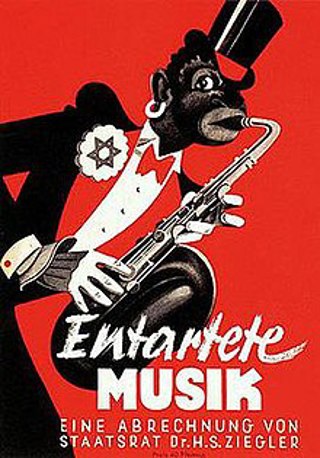
The center of Western Classical Music, ever since the time of Bach, has been modern-day Germany and Austria. You can trace a line from Bach, to Haydn to Mozart to Beethoven to Schubert to Schumann, Brahms, and Wagner, and finally to Mahler. But why does that line stop in 1911, the year of Mahler's death? Part of the answer is the increasing influence of composers from outside the Austro-German canon, something that has enriched Western Classical music to this day. There was also World War I getting in the way. But after the war, one could have expected that this line would continue again. The 1920's in Germany and the rest of Europe were a time of radical experimentation, a flowering of ideas, a sort of wild ecstasy of innovation across all the arts. So why don't we hear of these Austro-German experimenters and innovators anymore? Because of Adolf Hitler, Joseph Goebbels, and their Entartete, or Degenerate music. Hitler's worst crime was by no means his suppression of dozens of German, Austrian, and Eastern European composers, but it is a fact all the same that from the end of World War I until 1933, classical music in Germany and Eastern Europe(especially Czechoslovakia), was flourishing, with composers such as Zemlinsky, Krenek, Korngold, Schreker, Schulhoff, Haas, Krasa, and Ullmann taking up the mantle of the giants of the past and hoisting it upon themselves to carry it forward. The Nazis silenced, exiled, or killed off many of these musicians during the twelve years of 1933-1945, and those voices are forever lost, but the music they wrote before, during the War and the Holocaust, and after it, some of it masterpieces quite on the level of their predecessors, has been preserved. So why then are these composers not better known? I've chosen 12 composers, all of whom were writing music at the highest level. Some of them may be familiar to you, but many probably won't be. And through all of their trials and tribulations, one of the things I want to emphasize throughout these stories, even the bleakest ones, is that so many of them found the will to be able to compose this heart-rending, beautiful, and often optimistic music all as they witnessed unimaginable horrors. It may seem empty when the end for many of these artists was so horrific, but these compositions and the men and women who were behind them are a true testament to the resilience of the human spirit. These artists created a life for their friends, neighbors, and fellow inmates in concentration camps. They wrote music they knew would almost certainly not be heard in their lifetimes, from an urge that could not be destroyed, even by gas chambers. Join us to learn about them this week.

Episoder(284)

Mozart Requiem

Mozart Requiem

This show is a bit different today. Last year I did a live video podcast on Mozart's Requiem for my Patreon subscribers. I've now edited that show into an audio-only version for everyone to be able to...

18 Jul 20241h 6min
The Life and Music of Lili Boulanger

The Life and Music of Lili Boulanger

The history of classical music is littered with the stories of great composers who tragically died young. The composer I've been talking about for the last two episodes, Franz Schubert, died at 31. Mo...

4 Jul 202447min
Schubert Sonata in B Flat, D. 960 (Part 2)

Schubert Sonata in B Flat, D. 960 (Part 2)

There are a few tropes when it comes to Schubert's late music. The pieces are very long. They have four movements. The first two movemnts are expansive, magisterial explorations of the human psyche, ...

20 Jun 202454min
Schubert Sonata in B Flat, D. 960 (Part 1)

Schubert Sonata in B Flat, D. 960 (Part 1)

For a long time I've received emails and messages from people asking, and sometimes demanding, that I explore the solo piano repertoire. Other than a look at the Goldberg Variations of Bach, I've basi...

6 Jun 202440min

Mozart Piano Concerto in D Minor, K. 466

Mozart Piano Concerto in D Minor, K. 466

H.C. Robbins Landon, the great musicologist, once wrote about Mozart that his music was "an excuse for mankind's existence and a small hope for our ultimate survival." I couldn't agree more, especiall...

24 Mai 202448min

What is a Mode?

What is a Mode?

My first interaction with the musical term modes was Leonard Bernstein's brilliant Young People's Concert, also called What is a Mode? In that show, Bernstein showed how modes are an essential part of...

9 Mai 202444min
Brahms Piano Concerto No. 1

Brahms Piano Concerto No. 1

In 1857, Brahms wrote to his friend Joseph Joachim about his first Piano Concerto, saying, " "I have no judgment about this piece anymore, nor any control over it." Brahms first began sketching his f...

25 Apr 20241h 3min

Fast, Furious, Fortissimo

Fast, Furious, Fortissimo

Very often, when I tell people that I'm a classical musician, I am told, "wow, I love classical music! It's so relaxing!" I think almost all classical musicians have heard that before, and you know wh...

12 Apr 202446min

Populært innen Underholdning

papaya
enkel-servering
harm-og-hegseth
storefri-med-mikkel-og-herman
tore-og-haralds-podkast
tusvik-tnne
konspirasjonspodden
big-5-med-nils-og-harald-2
topp-3-med-wold-og-fladseth
ma-pa-behandling-med-morten-ramm
hovla
folk-flest-med-linn-og-nils
kjendiscrush-med-sofie-karlstad
nare-venner
vitnemal
gi-meg-alle-detaljene
rss-gammal-maiden
feedback-med-egon-holstad
christine-dancke
singel