

The Quest for the Recoilless Gun

The Quest for the Recoilless Gun

If you’ve ever shot a gun, then you will have quickly learned the first fundamental rule of shooting: recoil sucks. Depending on the calibre, weight of the firearm, and your technique, just a few minutes of shooting something like a hunting rifle can quickly leave your shoulder bruised and sore. And the bigger the firearm, the worse the problem becomes, with large-calibre military artillery pieces requiring elaborate systems of hydraulic cylinders to absorb their prodigious recoil. This, in turn, makes these weapons extremely heavy and difficult to move around the battlefield. There are two basic solutions to this problem: mount the artillery on heavy armoured vehicles… or somehow eliminate the recoil itself. Over the last century, engineers around the world have devised dozens of ingenious methods to achieve just that, creating weapons that are simultaneously powerful and long-ranged while being light and compact enough to be moved around the battlefield by regular troops or light vehicles. This is the fascinating technology behind recoilless weapons. To begin with, let’s first examine the physics behind recoil. One way to understand this phenomenon is via Newton’s Third Law - that is, “For every action, there is an equal and opposite reaction.” A more useful principle, however, is conservation of momentum. Momentum, defined as an object’s ability to resist changes in motion, is given by the simple formula mass times velocity. When an object is split into pieces and those pieces propelled in different directions - such as in the case of a bomb exploding or, more relevant to our discussion, a firearm shooting a projectile - the momentum of the overall system is conserved. In other words, if you add up the momentum - mass times velocity - of every individual piece, they will sum up to the original momentum - in the case of a stationary object, zero. Most firearms shoot a projectile significantly lighter than themselves; however, as this projectile is travelling at a very high velocity, its momentum equals that of the firearm, which, being much heavier, will recoil at a significantly lower velocity. The heavier the firearm, the slower it recoils and vice-versa. This, along with surface area in contact with your shoulder, is why, despite sometimes being quite painful, the recoil of most firearms is nowhere near strong enough to actually rip your shoulder off - unlike the projectile being fired downrange. Based on this physical analysis, it stands to reason that if you placed two identical firearms back-to-back and fired them in opposite directions, their recoil would cancel out and the whole assembly would remain stationary. This is known as the counter-shot or counter-weight principle, and was the operating principle of the first recoilless firearm to see combat: the Davis Gun. Patented by U.S. Navy Commander Cleland Davis in 1914, the Davis gun was specifically intended for use aboard aircraft. During the First World War more conventional small-calibre cannons were experimentally fitted to various aircraft for use against balloons, zeppelins, ships, submarines, ammunition dumps, and other specialized targets; however, aircraft of the period were rather flimsy constructions of wood, wire, and canvas, and were easily damaged by the recoil of such weapons. Thus, by the end of the war both the American and British navies and flying services showed great interest in Davis’s design. The Davis Gun effectively comprised two gun barrels mounted back-to-back and fired a special double-ended cartridge. On firing, a conventional shell was propelled out the forward barrel towards the target, while an equivalent mass of lead shot and grease was expelled out the rear, the recoil of the two barrels cancelling each other out. Of course, standing directly behind what is effectively a gigantic shotgun is a good way to have a very bad day, meaning the Davis gun had to be rather awkwardly mounted at the very front of the aircraft with its barrel pointing downward at a steep angle so that the counter-shot was propelled safely up and over the top wing. There were other problems as well. Since the gun had to propel two projectiles at equal velocity, the propellant charge - and thus the cartridge - was much larger than usual, making it awkward to handle. Author: Gilles Messier Host/Editor: Daven Hiskey Producer: Samuel Avila Learn more about your ad choices. Visit megaphone.fm/adchoices

Denne episoden er hentet fra en åpen RSS-feed og er ikke publisert av Podme. Den kan derfor inneholde annonser.

Episoder(344)

How  Do Germany and Japan Teach WWII? How Does Britain Teach the American Revolution? And Much More

How Do Germany and Japan Teach WWII? How Does Britain Teach the American Revolution? And Much More

In the video today, we're looking at How Do German Schools Teach About WWII? How Do the Japanese Teach About WWII? Why Wasn't There an Italian "Nuremberg / Tokyo War Crimes" Trial After WWII? How Did ...

19 Okt 2h 39min

The Forgotten Plague Where Thousands of People Couldn't Stop Dancing Until They Died

The Forgotten Plague Where Thousands of People Couldn't Stop Dancing Until They Died

In this episode of The Brain Food Show, we skip the quick fact because this one took forever to research and put together and I ran out of time. Instead we jump right into the main topic which is a v...

16 Okt 1h 2min

The Insane Story of the Plane That Refused to Land for 64 Days

The Insane Story of the Plane That Refused to Land for 64 Days

The likes of renowned aerospace engineer Burt Rutan’s Voyager aircraft, which successfully completed the world’s first nonstop, unrefueled aerial circumnavigation of the globe in December of 1986 in f...

15 Okt 20min

How Far Back in Time Could an English Speaker Go and Still Communicate Effectively?

How Far Back in Time Could an English Speaker Go and Still Communicate Effectively?

Ever wonder how far back in time you could go and still talk to people effectively? Well, wonder no more! Learn more about your ad choices. Visit megaphone.fm/adchoices

14 Okt 17min
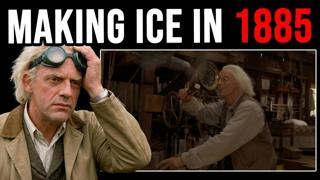
Was Doc Brown's 1885 Ice Machine Actually Possible?

Was Doc Brown's 1885 Ice Machine Actually Possible?

In the 1990 sci-fi comedy sequel Back to the Future Part III, intrepid time travelling 80’s duo Marty McFly and Dr. Emmett Brown find themselves trapped in Hill Valley, California, back in the year 18...

13 Okt 36min

The Bizarre Story of The Room, Were Nunchucks Real and Much, Much More

The Bizarre Story of The Room, Were Nunchucks Real and Much, Much More

In today's compilation episode we're looking at a handful of Hollywood vs Reality topics like the bizarre story behind "The Room", is genuine multiple personality disorder an actual thing or just a ho...

12 Okt 1h 20min

So, like, How Do Porcupines Mate? And Other Bizarre Animal Mating Practices

So, like, How Do Porcupines Mate? And Other Bizarre Animal Mating Practices

⁠⁠In this episode of The Brain Food Show, we start by looking at whether or not male humans can get pregnant and carry a baby to full term naturally. (Spoiler- yes and yes. And even breastfeed too! I...

9 Okt 44min

The Greatest Factory Ever Built

The Greatest Factory Ever Built

Following December 7, 1941 surprise attack on Pearl Harbor, which finally drew the United States into the Second World War, the attack’s architect, Imperial Japanese Navy Admiral Isoroku Yamamoto, inf...

8 Okt 37min

Populært innen Fakta

fastlegen
dine-penger-pengeradet
fryktlos
rss-kunsten-a-leve
relasjonspodden-med-dora-thorhallsdottir-kjersti-idem
rss-strid
rss-bisarr-historie
treningspodden
foreldreradet
jakt-og-fiskepodden
sinnsyn
hverdagspsyken
rss-orjasater
takk-og-lov-med-anine-kierulf
rss-kull
mikkels-paskenotter
lederskap-nhhs-podkast-om-ledelse
gravid-uke-for-uke
hr-podden-2
dopet