The Hard-Coding Trap: Why Low-Code Is the New Enterprise Standard

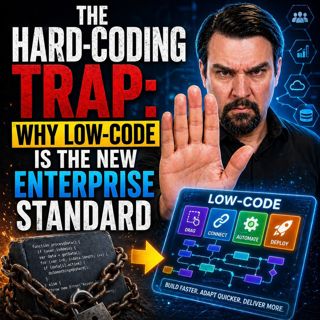
The Hard-Coding Trap: Why Low-Code Is the New Enterprise Standard

The eighteen-month development cycle isn’t just slow anymore—it’s a business liability. In today’s economy, waiting on IT isn’t neutral… it’s expensive. The traditional monolith—where every piece of logic is hard-coded, locked away, and dependent on long release cycles—is collapsing under its own weight. What used to be “enterprise-grade” is now enterprise friction. Organizations are still trying to fix this by hiring more developers. More code. More backlog. More complexity. But the top performers aren’t scaling code—they’re scaling capability. They’ve realized the bottleneck isn’t technology. It’s the governance model. This is the moment where low-code stops being an experiment and becomes the new enterprise standard.

💸 THE ECONOMIC COLLAPSE OF LEGACY DEVELOPMENT

The real cost of traditional development isn’t the software—it’s the waiting. If a broken process costs ten thousand dollars a month and sits in a backlog for over a year, the loss compounds silently. You’re not just paying for development—you’re paying for inaction. A typical enterprise custom build might start around eighty thousand dollars. A comparable low-code solution? Often a fraction of that. But the real advantage isn’t just cost—it’s speed and proximity. When business logic moves closer to the people doing the work, development becomes immediate instead of delayed. The deeper issue is technical debt. Every line of hard-coded logic becomes a future constraint. It locks your business into past assumptions and makes change expensive. In a world where priorities shift weekly, that rigidity becomes dangerous. You’re no longer agile—you’re dependent.

🧠 FROM CODERS TO CITIZEN ARCHITECTS

The biggest shift happening right now isn’t technical—it’s structural. For decades, value in software was tied to writing code. Today, value has moved to designing systems and orchestrating logic. This is the rise of the Citizen Architect. Instead of translating business needs through layers of IT, organizations are empowering the people closest to the problem to define and build their own solutions. Not by turning them into engineers—but by giving them tools that match how they already think: workflows, logic, outcomes. Professional developers don’t disappear in this model—they evolve. Their role shifts from writing applications to building secure frameworks, reusable components, and guardrails. They become force multipliers, enabling hundreds of solutions instead of delivering them one by one. The result is a fusion model where:
  • Business defines the logic
  • Architects secure and scale it
  • The organization moves at the speed of context
⚖️ GOVERNANCE WITHOUT BLOCKING INNOVATION

Speed without structure creates chaos—but too much control kills momentum. The answer isn’t restriction. It’s zoned governance. Instead of saying “no,” modern organizations design environments that guide innovation safely. Lightweight solutions can exist in flexible spaces, while critical systems are protected with stronger controls. This creates a balance where experimentation thrives without exposing the organization to unnecessary risk. The key shift is from manual oversight to automated enforcement. Policies are no longer static documents—they’re active systems. If something violates a rule, it’s stopped instantly. No waiting. No audits. Just real-time protection. This approach turns governance from a bottleneck into an enabler. It allows organizations to scale development without losing visibility or control.

🤖 THE POST-APPLICATION ERA: AGENTS OVER APPS

We are moving beyond traditional applications into a world of autonomous agents. Instead of clicking through interfaces, systems will increasingly act on intent—analyzing data, making decisions, and executing workflows across platforms. This changes everything. Hard-coded systems were built for predictable paths. Agents operate in dynamic environments. They reason, adapt, and respond in real time. But that flexibility introduces a new challenge: control over behavior instead of control over code. The role of the architect evolves again—from building systems to guiding outcomes. Success is no longer measured by what the system does, but by whether it behaves correctly under changing conditions. This is where clean, connected data becomes critical. Agents can only be as intelligent as the information they can access. If your data is fragmented or siloed, your AI won’t fail quietly—it will fail at scale.

🔧 RETIRING TECHNICAL DEBT AND BUILDING FOR SPEED

Legacy systems aren’t just outdated—they’re anchors. They slow down innovation, increase costs, and create dependency on shrinking pools of expertise. Modernizing isn’t optional anymore—it’s a requirement for staying competitive. Low-code platforms offer a way out by transforming rigid systems into flexible, transparent models that can evolve with the business. Instead of rebuilding everything at once, organizations are focusing on high-impact areas—unlocking value quickly while reducing long-term complexity. A practical approach looks like this:
  • Identify the processes causing the most friction
  • Replace them with flexible, low-code solutions
  • Build reusable logic instead of one-off systems
This isn’t about replacing developers—it’s about removing unnecessary friction from development itself.

🔥 FINAL TAKEAWAY: RECLAIM YOUR BUSINESS LOGIC

The hard-coding era is ending—not because code is useless, but because it’s no longer the fastest path to value. The organizations winning today aren’t writing more software. They’re designing systems that evolve as fast as their ideas. Low-code is not a shortcut. It’s a strategic shift. If your logic is trapped in rigid systems, your business will move at their speed. But if you unlock that logic—bring it closer to the people who use it—you create something entirely different: a responsive, adaptive organization that learns in real time. The opportunity isn’t just to build faster.
It’s to build differently.

Become a supporter of this podcast: https://www.spreaker.com/podcast/m365-fm-modern-work-security-and-productivity-with-microsoft-365--6704921/support.

Denne episoden er hentet fra en åpen RSS-feed og er ikke publisert av Podme. Den kan derfor inneholde annonser.

Episoder(869)

The Death of the Chatbot: Why Your Dataverse Strategy Is Broken

The Death of the Chatbot: Why Your Dataverse Strategy Is Broken

Microsoft Copilot has transformed how organizations interact with AI, making conversational experiences more accessible than ever. But while chat-based AI delivers immediate productivity gains, it doe...

29 Jul 1h 41min

The Future of IT Is Agentic: Inside Windows 365, Intune & Microsoft's AI Vision with Christiaan Brinkhoff

The Future of IT Is Agentic: Inside Windows 365, Intune & Microsoft's AI Vision with Christiaan Brinkhoff

Christiaan Brinkhoff shares the remarkable career path that took him from speaking at community events and writing technical blogs to becoming one of the key people behind Microsoft's modern cloud des...

29 Jul 1h 29min
How Do You Successfully Deploy Microsoft 365 Copilot Across an Enterprise?

How Do You Successfully Deploy Microsoft 365 Copilot Across an Enterprise?

A successful Microsoft 365 Copilot deployment begins long before licenses are assigned. Organizations should first define measurable business outcomes, identify high-value use cases, and secure execut...

29 Jul 1h 32min

From Pilot to Production: Building Enterprise AI That Actually Delivers with Leon Gordon [MVP]

From Pilot to Production: Building Enterprise AI That Actually Delivers with Leon Gordon [MVP]

Leon Gordon explains why most enterprise AI initiatives never reach production and introduces the concept of the Pilot Tax—the hidden cost organizations pay when AI projects remain stuck in proof-of-c...

28 Jul 59min

Microsoft Purview is a Trap: The Hard Truth About Data Governance

Microsoft Purview is a Trap: The Hard Truth About Data Governance

Microsoft Purview is included with many Microsoft 365 subscriptions, making it incredibly easy to enable. That convenience is also its biggest danger. Because there is no procurement process or large ...

28 Jul 1h 1min

From Excel Expert to Microsoft MVP: Empowering Millions with Data, Dashboards & AI with Karen Abecia [Microsoft MVP]

From Excel Expert to Microsoft MVP: Empowering Millions with Data, Dashboards & AI with Karen Abecia [Microsoft MVP]

aren Abecia shares the remarkable journey that transformed a passion for Microsoft Excel into a global career as one of the world's best-known Excel educators. She explains how discovering creative sp...

27 Jul 59min

The Copilot Credit Trap- Why Your AI Economy is Already Broken

The Copilot Credit Trap- Why Your AI Economy is Already Broken

For decades, enterprise software followed a predictable financial model. Organizations purchased licenses, assigned them to users, and budgeted annual IT spending with confidence. AI changes that comp...

26 Jul 1h 12min
The End of AI Bloat: Why Modern Agents Need Skills

The End of AI Bloat: Why Modern Agents Need Skills

Many AI agents start out fast, responsive, and surprisingly intelligent. But after a few months of real-world use, something changes. Response times increase, costs rise, prompts become enormous, and ...

26 Jul 1h 13min

Populært innen Politikk og nyheter

giver-og-gjengen-vg
aftenpodden
forklart
stopp-verden
popradet
rss-gukild-johaug
fotballpodden-2
aftenpodden-usa
hanna-de-heldige
dine-penger-pengeradet
rss-ness
det-store-bildet
e24-podden
rss-penger-polser-og-politikk
aftenbla-bla
lydartikler-fra-aftenposten
unitedno
liverpoolno-pausepraten
rss-utenrikskomiteen-med-bogen-og-grasvik
oppdatert