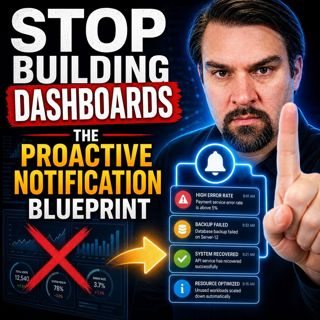

Stop Building Dashboards: The Proactive Notification Blueprint

Stop Building Dashboards: The Proactive Notification Blueprint

Your dashboard looks perfect on launch day. Clean visuals, aligned KPIs, and a sense that everything is finally “visible.” But the decay starts immediately. Because dashboards depend on one fragile assumption: someone will open them at the exact moment something matters. That rarely happens. In this episode, we challenge one of the most accepted patterns in modern BI—the idea that dashboards are the end product. Instead, we reframe analytics as an intervention system, where insight doesn’t wait to be discovered. It shows up at the right moment, in the right place, with a clear path to action. This is the shift from pull-based analytics to push-based decision systems.

THE HIDDEN FAILURE OF DASHBOARD-DRIVEN THINKING

Dashboards don’t fail because they’re poorly designed. They fail because they rely on human timing. People check data:
  • When they remember
  • When they have time
  • When they already suspect a problem
But high-impact decisions fail in the gap between signal and attention. The chart existed—but nobody saw it when it mattered. That’s the break. And once you see it, dashboards stop looking like a solution. They start looking like delay infrastructure.

THE RISE OF THE DATA GRAVEYARD

Most dashboards don’t die dramatically. They fade. They sit in tabs. They get opened less. Eventually, they become storage instead of insight. This is what we call the data graveyard. The data might still be fresh. The visuals might still be accurate. But the system around them is broken. It depends on users stopping their work, navigating to a report, interpreting the data, and acting—fast enough for it to matter. In real organizations, that sequence collapses. People are overloaded with tools, messages, and decisions. Analytics becomes just another place to check. And once something becomes optional, it becomes ignored.

WHY VISIBILITY IS NOT THE SAME AS ACTION

A dashboard gives you awareness. But awareness is passive. It tells you something could be known—if someone goes looking. But it doesn’t intervene. It doesn’t interrupt. It doesn’t create urgency. That’s the gap between:
  • Exploration (what dashboards do well)
  • Intervention (what modern systems require)
Executives don’t need more charts. They need fewer missed moments.

THE SHIFT FROM PULL TO PUSH

The real transformation isn’t better dashboards. It’s a different operating model. Instead of asking: “How do we visualize this data?” You ask: “What business moment deserves a response?” This is event-first thinking. You stop designing pages. You start designing moments of action:
  • A budget crosses a threshold
  • An SLA starts drifting
  • A risk pattern emerges
  • A process stalls
These are not reporting artifacts. They are operating events.

FROM DASHBOARDS TO EVENT-DRIVEN SYSTEMS

Once you adopt event thinking, everything changes. Instead of building reports, you define:
  • Signals (what changed)
  • Thresholds (when it matters)
  • Owners (who is responsible)
  • Routes (where it shows up)
  • Actions (what happens next)
This transforms analytics from a passive layer into an active decision engine.

WHY MOST ALERTING STRATEGIES FAIL

Many teams try to evolve by adding alerts. That usually makes things worse. Why? Because most alerts:
  • Trigger on raw numbers
  • Ignore context
  • Lack clear action paths
This creates alert fatigue. The problem isn’t just volume—it’s ambiguity. If a notification forces the recipient to investigate, interpret, and decide from scratch, it hasn’t reduced friction. It has just moved it. A good notification should arrive pre-processed:
  • What changed
  • Why it matters now
  • What action is expected
Without that, it’s noise.

THE PROACTIVE NOTIFICATION BLUEPRINT

To fix this, you need a structured architecture—not just alerts. A true proactive system includes six layers:
  1. SOURCE SYSTEMS
    Where truth lives (ERP, CRM, service, finance, etc.)
  2. EVENT DETECTION
    Identifying meaningful change (thresholds + anomalies)
  3. AI REASONING
    Adding context, summarization, and pattern understanding
  4. ORCHESTRATION
    Coordinating actions via Power Automate
  5. DELIVERY
    Sending to the right place (Teams, approvals, tasks, etc.)
  6. FEEDBACK LOOP
    Tracking outcomes and improving the system over time
In this model, Power BI becomes a sensor, not the final destination.

WHY FEEDBACK LOOPS CHANGE EVERYTHING

Without feedback, your system is blind. It keeps sending notifications without learning:
  • Was it useful?
  • Was it noise?
  • Did anyone act?
A closed-loop system:
  • Detects
  • Routes
  • Tracks
  • Improves
This is what transforms notifications into an operating layer, not just messaging.

HIGH-VALUE USE CASES TO START WITH

Don’t try to replace everything. Start where delay already hurts. Finance
  • Budget drift detection with immediate approval workflows
  • Cash flow anomalies with routed decision paths
Operations
  • SLA risks with owner assignment and escalation
  • Inventory thresholds triggering replenishment
Security & Compliance
  • Risk signals routed with context and triage paths
  • DLP or insider risk alerts with structured response
Service
  • Customer sentiment shifts triggering intervention
  • Stuck cases automatically reassigned
Executive Layer
  • One-line decision alerts with clear next steps
GOVERNANCE, LIMITS, AND COST CONTROL

As systems scale, discipline matters. Key considerations:
  • AI usage must be monitored (costs scale fast)
  • Notification volume must be controlled (avoid noise)
  • Delivery limits (Teams, APIs, payload sizes) must be respected
  • Duplicate and unused alerts must be cleaned regularly


Become a supporter of this podcast: https://www.spreaker.com/podcast/m365-fm-modern-work-security-and-productivity-with-microsoft-365--6704921/support.

Denne episoden er hentet fra en åpen RSS-feed og er ikke publisert av Podme. Den kan derfor inneholde annonser.

Episoder(868)

The Future of IT Is Agentic: Inside Windows 365, Intune & Microsoft's AI Vision with Christiaan Brinkhoff

The Future of IT Is Agentic: Inside Windows 365, Intune & Microsoft's AI Vision with Christiaan Brinkhoff

Christiaan Brinkhoff shares the remarkable career path that took him from speaking at community events and writing technical blogs to becoming one of the key people behind Microsoft's modern cloud des...

29 Jul 1h 29min
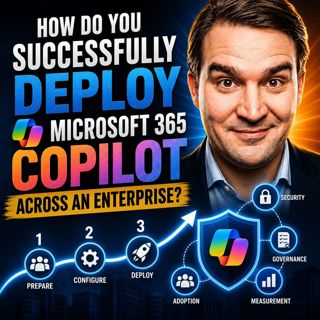
How Do You Successfully Deploy Microsoft 365 Copilot Across an Enterprise?

How Do You Successfully Deploy Microsoft 365 Copilot Across an Enterprise?

A successful Microsoft 365 Copilot deployment begins long before licenses are assigned. Organizations should first define measurable business outcomes, identify high-value use cases, and secure execut...

29 Jul 1h 32min

From Pilot to Production: Building Enterprise AI That Actually Delivers with Leon Gordon [MVP]

From Pilot to Production: Building Enterprise AI That Actually Delivers with Leon Gordon [MVP]

Leon Gordon explains why most enterprise AI initiatives never reach production and introduces the concept of the Pilot Tax—the hidden cost organizations pay when AI projects remain stuck in proof-of-c...

28 Jul 59min

Microsoft Purview is a Trap: The Hard Truth About Data Governance

Microsoft Purview is a Trap: The Hard Truth About Data Governance

Microsoft Purview is included with many Microsoft 365 subscriptions, making it incredibly easy to enable. That convenience is also its biggest danger. Because there is no procurement process or large ...

28 Jul 1h 1min

From Excel Expert to Microsoft MVP: Empowering Millions with Data, Dashboards & AI with Karen Abecia [Microsoft MVP]

From Excel Expert to Microsoft MVP: Empowering Millions with Data, Dashboards & AI with Karen Abecia [Microsoft MVP]

aren Abecia shares the remarkable journey that transformed a passion for Microsoft Excel into a global career as one of the world's best-known Excel educators. She explains how discovering creative sp...

27 Jul 59min
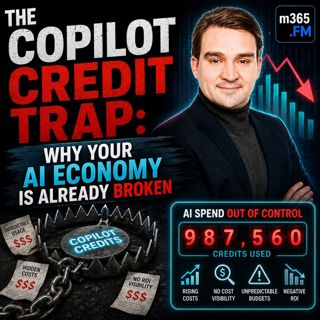
The Copilot Credit Trap- Why Your AI Economy is Already Broken

The Copilot Credit Trap- Why Your AI Economy is Already Broken

For decades, enterprise software followed a predictable financial model. Organizations purchased licenses, assigned them to users, and budgeted annual IT spending with confidence. AI changes that comp...

26 Jul 1h 12min
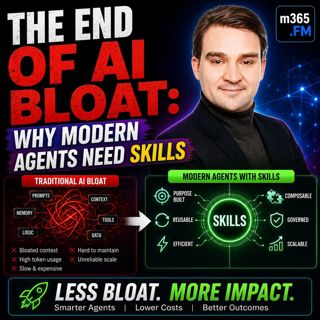
The End of AI Bloat: Why Modern Agents Need Skills

The End of AI Bloat: Why Modern Agents Need Skills

Many AI agents start out fast, responsive, and surprisingly intelligent. But after a few months of real-world use, something changes. Response times increase, costs rise, prompts become enormous, and ...

26 Jul 1h 13min

THE DEATH OF THE PROXY: Architecting Dataverse for the Agent Fabric

THE DEATH OF THE PROXY: Architecting Dataverse for the Agent Fabric

For years, Microsoft's recommended architecture for connecting AI assistants like Claude Desktop to Dataverse relied on a local STDIO proxy. It was simple, easy to install, and perfectly suited for in...

26 Jul 59min

Populært innen Politikk og nyheter

giver-og-gjengen-vg
aftenpodden
forklart
stopp-verden
popradet
rss-gukild-johaug
aftenpodden-usa
fotballpodden-2
dine-penger-pengeradet
rss-ness
hanna-de-heldige
aftenbla-bla
det-store-bildet
e24-podden
rss-penger-polser-og-politikk
lydartikler-fra-aftenposten
unitedno
rss-utenrikskomiteen-med-bogen-og-grasvik
liverpoolno-pausepraten
oppdatert