

Beyond the Firewall: Why Your Azure SQL Security Is Obsolete

Beyond the Firewall: Why Your Azure SQL Security Is Obsolete

Your Azure SQL firewall is no longer protecting your data. It is protecting outdated assumptions. In this episode of the M365FM Podcast, we expose the structural collapse of perimeter-based security and explain why traditional Azure SQL firewall strategies are failing in today’s AI-driven threat landscape. Most organizations still believe that static IP rules, trusted VNets, and service principals create a secure boundary around their databases. In reality, those controls were designed for a world that no longer exists. Attackers are no longer trying to break through the perimeter. They are bypassing it entirely through compromised identities, leaked credentials, over-privileged service principals, and lateral movement inside trusted environments. The network itself is no longer the source of trust. Identity is. We break down why “set and forget” firewall rules are becoming one of the biggest causes of modern compliance failures and security breaches in Azure SQL environments. From the dangerous misconception behind the “Allow Azure Services” checkbox to the growing risks of standing privileges and credential sprawl, this episode reveals why static security models are fundamentally incompatible with Zero Trust architecture in 2026. If your production databases still rely on connection strings, long-lived secrets, or unrestricted service principals, your environment may already contain invisible attack paths waiting to be exploited.

THE COLLAPSE OF THE TRADITIONAL SECURITY PERIMETER

For decades, infrastructure security depended on one core assumption: if traffic came from the “right” network, it could be trusted. Firewalls, IP whitelists, VPNs, and subnet isolation became the foundation of enterprise architecture. But cloud computing destroyed that model. Modern workloads move dynamically across regions, services, pipelines, APIs, containers, and AI-driven automation layers. Applications no longer operate from fixed locations, and users no longer access systems from predictable networks. Yet many Azure SQL deployments are still protected by security models built for a 1990s data center. We explain why static IP-based trust is now a liability instead of a defense mechanism, and how attackers exploit over-trusted network paths to move laterally through cloud environments without triggering traditional perimeter alerts. This episode also examines the dangerous illusion created by Azure SQL firewall rules and why network-level trust becomes meaningless the moment a privileged identity is compromised.

WHY SERVICE PRINCIPALS HAVE BECOME A SECURITY CRISIS

Service principals were supposed to enable secure automation. Instead, they created one of the largest unmanaged attack surfaces in Azure. We dive deep into the hidden risks of non-human identities, leaked client secrets, connection strings, orphaned credentials, and persistent standing privileges that never expire. With millions of secrets leaked publicly through GitHub repositories and CI/CD pipelines, attackers increasingly target service principals because they provide silent, persistent access that often bypasses human security controls entirely. This episode explores:
  • Why long-lived credentials are structurally insecure
  • How orphaned service principals survive long after applications are retired
  • Why password rotation alone cannot solve identity sprawl
  • How attackers weaponize leaked database secrets for persistent access
  • Why Managed Identities are rapidly replacing traditional service principal models
We also explain how modern Azure architectures are shifting toward passwordless authentication and why eliminating static secrets is now considered mandatory for secure enterprise deployments.

MANAGED IDENTITIES AND THE MOVE TO PASSWORDLESS SECURITY

The future of Azure SQL security is not stronger passwords. It is removing passwords from the equation entirely. We break down how Managed Identities fundamentally change the security model for Azure workloads by binding identity directly to the workload itself instead of relying on manually managed secrets. Unlike traditional service principals, Managed Identities eliminate secret storage, reduce operational overhead, and drastically limit credential theft scenarios. You’ll learn:
  • The difference between System-Assigned and User-Assigned Managed Identities
  • Why short-lived identity tokens reduce blast radius
  • How Managed Identities prevent credential reuse from external systems
  • Why passwordless architectures improve both resilience and security
  • How Azure handles token rotation automatically behind the scenes
We also discuss why many organizations hesitate to migrate legacy applications—and why delaying that transition increases both operational risk and audit exposure.

JUST-IN-TIME ACCESS AND THE DEATH OF STANDING PRIVILEGES

Permanent access is one of the greatest security failures in modern cloud environments. Most Azure SQL environments still grant administrators, developers, and automation pipelines continuous high-level permissions even when they are not actively performing privileged tasks. This creates massive windows of opportunity for attackers. In this episode, we explore how Just-In-Time (JIT) access using Microsoft Entra Privileged Identity Management (PIM) dramatically reduces attack surface by limiting privilege activation to approved, time-bound sessions. We explain:
  • Why standing privileges enable lateral movement
  • How PIM-enabled groups simplify Azure SQL access governance
  • Why MFA and approval workflows are essential for privileged access
  • How JIT reduces exposure windows from years to hours
  • Why temporary elevation is becoming mandatory under Zero Trust principles
We also cover how modern PIM enhancements now incorporate AI-driven risk scoring and contextual verification to automatically reject suspicious privilege activations.

IDENTITY-BASED MICRO-SEGMENTATION

Traditional network segmentation is no longer enough. Modern attackers operate inside trusted environments, moving east-west across workloads after compromising a single identity or endpoint. This episode explores why micro-segmentation based on identity—not IP address—is becoming the new foundation of secure Azure SQL architecture. We discuss:
  • Why VLANs and subnet isolation fail against identity compromise
  • How workload identities create granular trust boundaries
  • The role of User-Assigned Managed Identities in workload isolation
  • Why Row-Level Security matters in Zero Trust environments
  • How identity-aware segmentation limits breach propagation
We also explain the importance of “Monitor Mode” deployments before enforcement and how organizations baseline SQL traffic patterns to avoid breaking production workloads during segmentation rollouts.

THE COPILOT MULTIPLIER: AI AND DATA EXPOSURE RISKS

Microsoft Copilot does not create new permissions. It amplifies the permissions you already failed to control. One of the biggest security risks in the AI era is not the AI itself—it is the underlying access model feeding it. Over-permissioned Azure SQL environments become dramatically more dangerous when AI tools can instantly discover, summarize, and expose sensitive data through natural language prompts. This episode explores:
  • Why AI removes the “technical friction” that once protected hidden data
  • How Copilot accelerates permission sprawl into searchable exposure
  • Why overshared SQL tables create massive AI governance risks
  • The role of Row-Level Security and Ledger Tables in AI governance
  • How Microsoft Purview helps classify sensitive SQL workloads
We explain why organizations must treat AI governance as an extension of identity governance and why traditional “good enough” access models collapse under AI-assisted discovery.


Become a supporter of this podcast: https://www.spreaker.com/podcast/m365-fm-modern-work-security-and-productivity-with-microsoft-365--6704921/support.

Denne episoden er hentet fra en åpen RSS-feed og er ikke publisert av Podme. Den kan derfor inneholde annonser.

Episoder(865)

Microsoft Purview is a Trap: The Hard Truth About Data Governance

Microsoft Purview is a Trap: The Hard Truth About Data Governance

Microsoft Purview is included with many Microsoft 365 subscriptions, making it incredibly easy to enable. That convenience is also its biggest danger. Because there is no procurement process or large ...

28 Jul 1h 1min

From Excel Expert to Microsoft MVP: Empowering Millions with Data, Dashboards & AI with Karen Abecia [Microsoft MVP]

From Excel Expert to Microsoft MVP: Empowering Millions with Data, Dashboards & AI with Karen Abecia [Microsoft MVP]

aren Abecia shares the remarkable journey that transformed a passion for Microsoft Excel into a global career as one of the world's best-known Excel educators. She explains how discovering creative sp...

27 Jul 59min

The Copilot Credit Trap- Why Your AI Economy is Already Broken

The Copilot Credit Trap- Why Your AI Economy is Already Broken

For decades, enterprise software followed a predictable financial model. Organizations purchased licenses, assigned them to users, and budgeted annual IT spending with confidence. AI changes that comp...

26 Jul 1h 12min
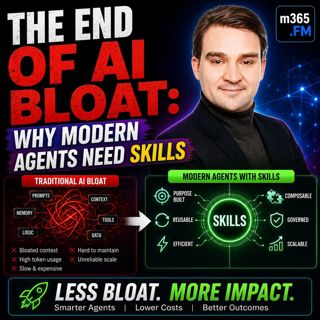
The End of AI Bloat: Why Modern Agents Need Skills

The End of AI Bloat: Why Modern Agents Need Skills

Many AI agents start out fast, responsive, and surprisingly intelligent. But after a few months of real-world use, something changes. Response times increase, costs rise, prompts become enormous, and ...

26 Jul 1h 13min

THE DEATH OF THE PROXY: Architecting Dataverse for the Agent Fabric

THE DEATH OF THE PROXY: Architecting Dataverse for the Agent Fabric

For years, Microsoft's recommended architecture for connecting AI assistants like Claude Desktop to Dataverse relied on a local STDIO proxy. It was simple, easy to install, and perfectly suited for in...

26 Jul 59min
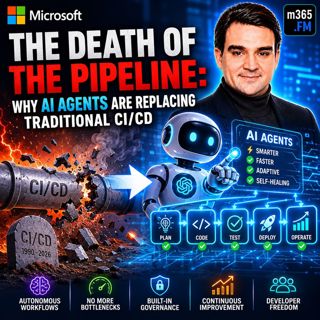
The Death of the Pipeline: Why AI Agents are Replacing Traditional

The Death of the Pipeline: Why AI Agents are Replacing Traditional

For more than two decades, CI/CD pipelines have been the backbone of modern software delivery. Developers commit code, automated builds run, tests execute, security scans complete, someone approves th...

25 Jul 1h 9min
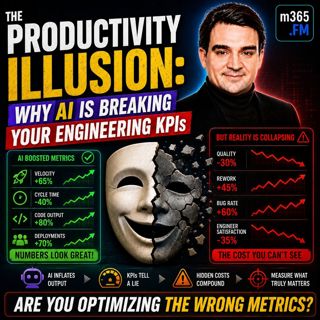
The Productivity Illusion: Why AI is Breaking Your Engineering KPIs

The Productivity Illusion: Why AI is Breaking Your Engineering KPIs

At first glance, the numbers look incredible. Deployment frequency is increasing, pull requests are being merged faster than ever, AI is generating more code, and engineering teams appear dramatically...

25 Jul 1h 15min
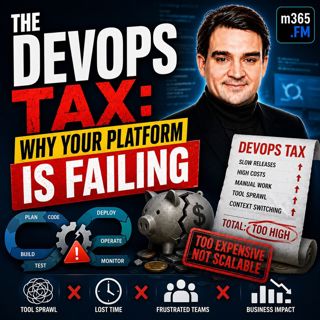
The DevOps Tax: Why Your Platform is Failing

The DevOps Tax: Why Your Platform is Failing

Welcome to another episode of Knowledge Nuggets with Mirko Peters. Today we're exploring The DevOps Tax—the hidden cost that silently reduces engineering productivity, increases cognitive overload, an...

25 Jul 1h 18min

Populært innen Politikk og nyheter

giver-og-gjengen-vg
aftenpodden
forklart
popradet
stopp-verden
rss-gukild-johaug
fotballpodden-2
aftenpodden-usa
hanna-de-heldige
dine-penger-pengeradet
rss-ness
aftenbla-bla
det-store-bildet
nokon-ma-ga
e24-podden
lydartikler-fra-aftenposten
unitedno
oppdatert
bt-dokumentar-2
liverpoolno-pausepraten