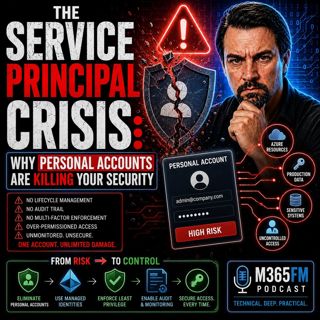

The Service Principal Crisis: Why Personal Accounts Are Killing Your Security

The Service Principal Crisis: Why Personal Accounts Are Killing Your Security

Your Microsoft 365 automation environment is probably running on borrowed identity. In this episode of the M365FM Podcast, we expose one of the biggest hidden risks inside modern cloud architecture: enterprise workflows tethered to personal user accounts. It starts innocently enough. An engineer builds a Power Automate flow, connects a Logic App, configures a Power BI refresh, or deploys a SharePoint integration using their own credentials because it is fast and convenient. But the moment that person changes roles, resets a password, triggers Conditional Access, loses MFA access, or leaves the company entirely, the entire automation chain collapses. This is identity rot. Organizations across the world are unknowingly building mission-critical infrastructure on top of human dependencies instead of infrastructure identities. The result is brittle automation, failed workflows, silent outages, security gaps, and operational chaos that often goes unnoticed until production systems fail. As Microsoft moves toward the 2026 identity model, the era of service-principal-less automation is ending. Legacy authentication patterns are being deprecated, old Azure AD Graph integrations are disappearing, and modern workloads are being forced toward identity-first architecture. This episode breaks down why Service Principals, Managed Identities, Federated Credentials, and Zero-Secret authentication are no longer optional modernization projects. They are now foundational requirements for operational survival. If your automation breaks when an employee resigns, your architecture is already unstable.

THE SHADOW ACCOUNT TRAP

Most identity problems begin with convenience. An engineer connects a workflow using their own Microsoft 365 account because the permissions already exist and the deployment is faster. The automation works immediately, the project launches successfully, and nobody realizes they just embedded a hidden human dependency into critical infrastructure. Until the password changes. Until Conditional Access blocks the sign-in. Until MFA expires. Until the employee leaves the company. This episode explores why modern enterprises are trapped in what we call the Shadow Account Model:
  • Personal accounts acting as infrastructure identities
  • MFA incompatibility with headless automation
  • Authentication rot across Power Automate and Logic Apps
  • Offboarding failures causing workflow collapse
  • Service accounts operating as unsecured ghost users
We explain why Microsoft 365 security policies are designed for humans while enterprise automation requires non-human identity architecture.

WHY MICROSOFT IS FORCING THE SHIFT

Microsoft has officially recognized the structural flaw of user-based automation. As we move toward 2026:
  • Legacy SharePoint 2013 workflows are being retired
  • Azure AD Graph is being deprecated
  • Service-principal-less authentication is disappearing
  • App-only modern authentication is becoming mandatory
The message from Microsoft is clear:
Automation must have its own identity. This episode explains why organizations are no longer fighting technical debt alone. They are now fighting the direction of the platform itself. The old model asked:
“Which person is running this automation?” The new model asks:
“Which workload is authorized to perform this action?” That architectural shift changes everything.

IDENTITY AS INFRASTRUCTURE

Modern identity is no longer a human construct. It is infrastructure. In this episode, we explore how Service Principals function as non-interactive runtime identities that represent workloads instead of employees. We break down:
  • The Decoupling Principle in enterprise security
  • Why workloads need independent identity boundaries
  • The shift from human-centric to resource-centric authorization
  • Why identity must become a deployment artifact
  • How infrastructure-native authentication improves resilience
We also explain why Managed Identities represent the highest form of cloud-native identity architecture.

MANAGED IDENTITIES AND ZERO-SECRET AUTHENTICATION

The strongest credential is the one nobody ever handles. Managed Identities fundamentally change how enterprise authentication works because Azure manages the entire lifecycle automatically:
  • Credential generation
  • Rotation
  • Storage
  • Expiration
  • Trust enforcement
This episode explores:
  • Why Managed Identities eliminate secret sprawl
  • How Zero-Secret authentication reduces breach risk
  • Why workload-bound identity changes operational security
  • How Azure ties identity directly to resource lifecycle
  • The security benefits of infrastructure-native trust
We also explain why organizations are aggressively moving away from static client secrets and passwords toward short-lived trust-based authentication models.

FEDERATED CREDENTIALS AND THE END OF STATIC SECRETS

Static secrets are one of the largest liabilities in enterprise automation. This episode explores how Federated Credentials and OpenID Connect (OIDC) are replacing long-lived secrets inside GitHub Actions, CI/CD pipelines, and multi-cloud integrations. You’ll learn:
  • Why client secrets become long-term attack surfaces
  • How OIDC token exchange works with Entra ID
  • Why workload federation eliminates stored credentials
  • How temporary trust outperforms permanent passwords
  • Why federated identity is the future of automation security
We explain how modern automation environments are moving toward fully ephemeral identity models where no reusable credential exists at rest.

THE PERMISSION CREEP CRISIS

A resilient identity with excessive permissions becomes a high-speed weapon. One of the biggest architectural failures in Microsoft 365 automation is permission creep. Engineers frequently assign massive Graph API scopes like Application.ReadWrite.All or Directory.ReadWrite.All simply to eliminate deployment friction. The result:
Overprivileged Service Principals operating silently across the tenant. This episode explores:
  • Why app-only permissions are extremely dangerous
  • The hidden blast radius of over-scoped principals
  • How attackers target machine identities for persistence
  • Why compromised tokens move faster than compromised humans
  • How broad Graph permissions enable tenant-wide takeover
We explain why Service Principals must be treated with the same caution as root access on production infrastructure.

Become a supporter of this podcast: https://www.spreaker.com/podcast/m365-fm-modern-work-security-and-productivity-with-microsoft-365--6704921/support.

Denne episoden er hentet fra en åpen RSS-feed og er ikke publisert av Podme. Den kan derfor inneholde annonser.

Episoder(865)

Microsoft Purview is a Trap: The Hard Truth About Data Governance

Microsoft Purview is a Trap: The Hard Truth About Data Governance

Microsoft Purview is included with many Microsoft 365 subscriptions, making it incredibly easy to enable. That convenience is also its biggest danger. Because there is no procurement process or large ...

28 Jul 1h 1min

From Excel Expert to Microsoft MVP: Empowering Millions with Data, Dashboards & AI with Karen Abecia [Microsoft MVP]

From Excel Expert to Microsoft MVP: Empowering Millions with Data, Dashboards & AI with Karen Abecia [Microsoft MVP]

aren Abecia shares the remarkable journey that transformed a passion for Microsoft Excel into a global career as one of the world's best-known Excel educators. She explains how discovering creative sp...

27 Jul 59min

The Copilot Credit Trap- Why Your AI Economy is Already Broken

The Copilot Credit Trap- Why Your AI Economy is Already Broken

For decades, enterprise software followed a predictable financial model. Organizations purchased licenses, assigned them to users, and budgeted annual IT spending with confidence. AI changes that comp...

26 Jul 1h 12min
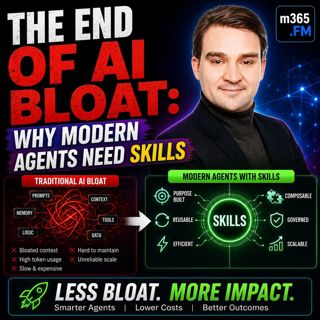
The End of AI Bloat: Why Modern Agents Need Skills

The End of AI Bloat: Why Modern Agents Need Skills

Many AI agents start out fast, responsive, and surprisingly intelligent. But after a few months of real-world use, something changes. Response times increase, costs rise, prompts become enormous, and ...

26 Jul 1h 13min
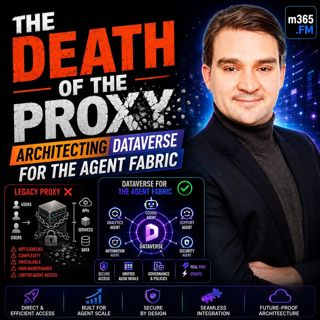
THE DEATH OF THE PROXY: Architecting Dataverse for the Agent Fabric

THE DEATH OF THE PROXY: Architecting Dataverse for the Agent Fabric

For years, Microsoft's recommended architecture for connecting AI assistants like Claude Desktop to Dataverse relied on a local STDIO proxy. It was simple, easy to install, and perfectly suited for in...

26 Jul 59min
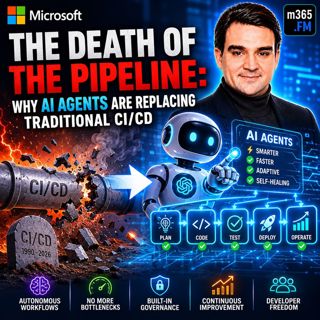
The Death of the Pipeline: Why AI Agents are Replacing Traditional

The Death of the Pipeline: Why AI Agents are Replacing Traditional

For more than two decades, CI/CD pipelines have been the backbone of modern software delivery. Developers commit code, automated builds run, tests execute, security scans complete, someone approves th...

25 Jul 1h 9min
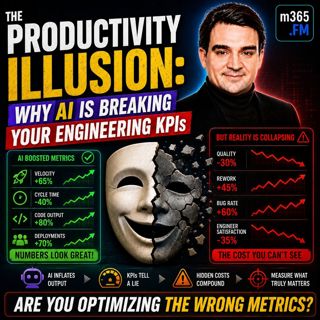
The Productivity Illusion: Why AI is Breaking Your Engineering KPIs

The Productivity Illusion: Why AI is Breaking Your Engineering KPIs

At first glance, the numbers look incredible. Deployment frequency is increasing, pull requests are being merged faster than ever, AI is generating more code, and engineering teams appear dramatically...

25 Jul 1h 15min
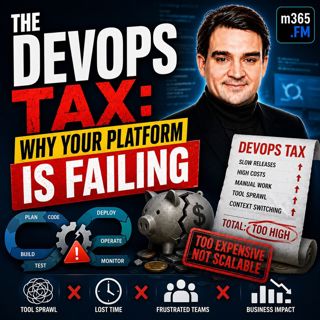
The DevOps Tax: Why Your Platform is Failing

The DevOps Tax: Why Your Platform is Failing

Welcome to another episode of Knowledge Nuggets with Mirko Peters. Today we're exploring The DevOps Tax—the hidden cost that silently reduces engineering productivity, increases cognitive overload, an...

25 Jul 1h 18min

Populært innen Politikk og nyheter

giver-og-gjengen-vg
aftenpodden
forklart
popradet
stopp-verden
rss-gukild-johaug
fotballpodden-2
aftenpodden-usa
hanna-de-heldige
dine-penger-pengeradet
rss-ness
aftenbla-bla
det-store-bildet
nokon-ma-ga
e24-podden
lydartikler-fra-aftenposten
unitedno
oppdatert
bt-dokumentar-2
liverpoolno-pausepraten