NASA’s Webb Investigates Eternal Sunrises, Sunsets on Distant World

NASA’s Webb Investigates Eternal Sunrises, Sunsets on Distant World

Researchers using NASA’s James Webb Space Telescope have finally confirmed what models have previously predicted: An exoplanet has differences between its eternal morning and eternal evening atmosphere. WASP-39 b, a giant planet with a diameter 1.3 times greater than Jupiter, but similar mass to Saturn that orbits a star about 700 light-years away from Earth, is tidally locked to its parent star. This means it has a constant dayside and a constant nightside—one side of the planet is always exposed to its star, while the other is always shrouded in darkness. Using Webb’s NIRSpec (Near-Infrared Spectrograph), astronomers confirmed a temperature difference between the eternal morning and eternal evening on WASP-39 b, with the evening appearing hotter by roughly 300 Fahrenheit degrees (about 200 Celsius degrees). They also found evidence for different cloud cover, with the forever morning portion of the planet being likely cloudier than the evening. Astronomers analyzed the 2- to 5-micron transmission spectrum of WASP-39 b, a technique that studies the exoplanet’s terminator, the boundary that separates the planet’s dayside and nightside. A transmission spectrum is made by comparing starlight filtered through a planet’s atmosphere as it moves in front of the star, to the unfiltered starlight detected when the planet is beside the star. When making that comparison, researchers can get information about the temperature, composition, and other properties of the planet’s atmosphere. “WASP-39 b has become a sort of benchmark planet in studying the atmosphere of exoplanets with Webb,” said Néstor Espinoza, an exoplanet researcher at the Space Telescope Science Institute and lead author on the study. “It has an inflated, puffy atmosphere, so the signal coming from starlight filtered through the planet’s atmosphere is quite strong.” Previously published Webb spectra of WASP-39b’s atmosphere, which revealed the presence of carbon dioxide, sulfur dioxide, water vapor, and sodium, represent the entire day/night boundary – there was no detailed attempt to differentiate between one side and the other. Now, the new analysis builds two different spectra from the terminator region, essentially splitting the day/night boundary into two semicircles, one from the evening, and the other from the morning. Data reveals the evening as significantly hotter, a searing 1,450 degrees Fahrenheit (800 degrees Celsius), and the morning a relatively cooler 1,150 degrees Fahrenheit (600 degrees Celsius). “It’s really stunning that we are able to parse this small difference out, and it’s only possible due Webb’s sensitivity across near-infrared wavelengths and its extremely stable photometric sensors,” said Espinoza. “Any tiny movement in the instrument or with the observatory while collecting data would have severely limited our ability to make this detection. It must be extraordinarily precise, and Webb is just that.” Extensive modeling of the data obtained also al This content was created in partnership and with the help of Artificial Intelligence AI.

Denne episoden er hentet fra en åpen RSS-feed og er ikke publisert av Podme. Den kan derfor inneholde annonser.

Episoder(150)

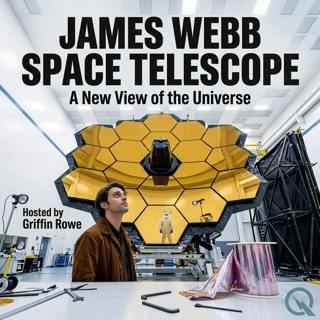
James Webb Space Telescope - A New View of the Universe - Quasar Impostors and Little Red Dots

James Webb Space Telescope - A New View of the Universe - Quasar Impostors and Little Red Dots

Join your host as James Webb Space Telescope: A New View of the Universe unpacks six stunning discoveries—quasar impostors revealed as massive star-forming galaxies, ancient reionization bubbles, blac...

19 Sep 14min

James Webb Space Telescope Reveals Brown Dwarfs, Early Black Holes, and Dynamic Ring Systems in Latest Discoveries

James Webb Space Telescope Reveals Brown Dwarfs, Early Black Holes, and Dynamic Ring Systems in Latest Discoveries

# The Space Cowboy: Riding the Cosmic Range with James Webb's Latest Discoveries **Podcast Episode Description:** Saddle up for another journey across the cosmic frontier with The Space Cowboy as we...

19 Sep 9min

James Webb Space Telescope - A New View of the Universe - Fake Quasars, Neptune's Reborn Moons

James Webb Space Telescope - A New View of the Universe - Fake Quasars, Neptune's Reborn Moons

James Webb Space Telescope reveals surprises: early quasars are star-blazing galaxies, a mysterious black hole star, Neptune's moon origins, tiny trans-Neptunian objects, and a distant planet losing i...

12 Sep 10min

James Webb Space Telescope Discovers Massive Star Forming Galaxies and Exotic Exoplanet Atmospheres

James Webb Space Telescope Discovers Massive Star Forming Galaxies and Exotic Exoplanet Atmospheres

# The Space Cowboy Show: Riding Through JWST's Latest Cosmic Discoveries **Episode Description:** Saddle up for another wild ride through the cosmos! In this episode of The Space Cowboy Show, we exp...

12 Sep 11min

James Webb Space Telescope - A New View of the Universe - Black Hole Stars and Hidden Galaxies

James Webb Space Telescope - A New View of the Universe - Black Hole Stars and Hidden Galaxies

Join our AI host on James Webb Space Telescope: A New View of the Universe as we explore hidden faint stars reshaping galaxy mass estimates, a mysterious "black hole star" at cosmic dawn, an archival ...

5 Sep 12min

James Webb Space Telescope Discovers Exoplanet Atmospheres and Early Universe Black Holes in Latest Cosmic Findings

James Webb Space Telescope Discovers Exoplanet Atmospheres and Early Universe Black Holes in Latest Cosmic Findings

# The Space Cowboy: James Webb Space Telescope's Latest Cosmic Discoveries **Episode Description:** Ride along with The Space Cowboy on a journey through the universe's most fascinating recent disco...

5 Sep 11min

James Webb Space Telescope - A New View of the Universe - The Black Hole Star and Cosmic Mysteries

James Webb Space Telescope - A New View of the Universe - The Black Hole Star and Cosmic Mysteries

Host Griffin Rowe explores JWST's latest discoveries: a mysterious "black hole star" in Cetus, undercounted galaxies with hidden planet-forming potential, an "early galaxy crisis" resolved, heavy wate...

29 Aug 14min

James Webb Space Telescope Reveals Hidden Stars in Early Galaxies and Accelerates Planet Formation Timeline

James Webb Space Telescope Reveals Hidden Stars in Early Galaxies and Accelerates Planet Formation Timeline

# Episode Description **Riding the Infrared Frontier: James Webb's Latest Cosmic Discoveries** Join The Space Cowboy for an action-packed journey through the newest James Webb Space Telescope discov...

29 Aug 10min

Populært innen Vitenskap

fastlegen
romkapsel
tingenes-tilstand
jss
forskningno
liberal-halvtime
villmarksliv
sinnsyn
rekommandert
rss-paradigmepodden
fjellsportpodden
grunnstoffene
nordnorsk-historie
rss-nysgjerrige-norge
smart-forklart
rss-rekommandert
tidlose-historier
vett-og-vitenskap-med-gaute-einevoll
rss-inn-til-kjernen-med-sunniva-rose
rss-overskuddsliv