Inside Microsoft Foundry: Building the Next Generation of AI Apps with Jannik Reinhard [MVP]

Inside Microsoft Foundry: Building the Next Generation of AI Apps with Jannik Reinhard [MVP]

Artificial Intelligence is moving faster than most organizations can keep up with. Every week introduces new models, new frameworks, new AI agents, and entirely new ways to build applications. But beyond the hype, one question matters most: how do enterprises actually build secure, scalable, production-ready AI solutions that create real business value? In this episode of the m365.fm podcast, Mirko Peters sits down with Jannik Reinhard — Microsoft MVP, architect, author, speaker, and AI innovator — for an in-depth conversation about Microsoft Foundry, enterprise AI architecture, agentic workflows, orchestration, governance, and the future of AI-powered applications. Jannik is deeply embedded in both the AI and security worlds. He has published more than 200 technical blog posts, speaks internationally at major conferences, contributes heavily to the community, and has built enterprise-grade AI systems used by over 120,000 employees inside BASF. His experience spans Microsoft Azure, Security, Endpoint Management, AI architecture, automation, and next-generation enterprise development. This episode is not another surface-level AI conversation. Instead, it explores the real technical and strategic challenges organizations face when moving from AI demos to fully operational enterprise AI platforms.

WHY MICROSOFT FOUNDRY MATTERS

For many people, Microsoft Foundry is still a relatively new concept. Jannik explains Foundry in simple but powerful terms: it provides organizations with a secure, enterprise-ready way to deploy and manage AI models inside Microsoft’s trusted cloud ecosystem. Through Foundry, organizations can:
  • Deploy OpenAI and Anthropic models securely
  • Use enterprise-grade networking and encryption
  • Integrate with Azure services and managed identities
  • Protect against prompt injection attacks
  • Build AI agents and workflows
  • Connect models to business data securely
  • Monitor AI applications at scale
Jannik emphasizes that Foundry is not just about model hosting. It becomes the orchestration layer that enables organizations to safely operationalize AI inside enterprise environments.

AI IS NOT THE STRATEGY

One of the strongest messages throughout the episode is that simply buying AI tools does not equal digital transformation. Jannik explains that many companies mistakenly believe purchasing Copilot licenses automatically gives them an AI strategy. In reality, organizations need much deeper thinking around business processes, governance, security, data quality, orchestration, and automation. According to Jannik, the most successful organizations are not the ones blindly following hype. They are the ones asking:
  • Which business problems should AI solve?
  • Where does AI create measurable value?
  • How can AI improve workflows?
  • Which processes should become autonomous?
  • How can governance and security scale with AI adoption?
This shift in thinking is what separates experimentation from transformation.

THE FUTURE IS AGENTIC WORKFLOWS

A major focus of this episode is the evolution from simple AI chat experiences toward autonomous AI agents. Jannik explains that true AI agents are fundamentally different from reactive chatbot experiences. Instead of simply responding to prompts, modern AI agents can understand goals, execute actions, orchestrate workflows, interact with tools, retrieve information, and operate independently. This creates an entirely new category of enterprise software. Rather than manually completing repetitive work, employees increasingly delegate tasks to intelligent systems capable of:
  • Researching information
  • Automating workflows
  • Interacting with APIs
  • Managing infrastructure
  • Writing code
  • Generating documentation
  • Monitoring systems
  • Executing business processes autonomously
Jannik believes orchestration is now becoming one of the most important competitive differentiators in AI application development.

WHY ORCHESTRATION IS THE REAL SECRET

Throughout the discussion, Jannik repeatedly highlights orchestration as the “secret sauce” behind high-quality AI systems. The models themselves are already incredibly powerful. The challenge now is:
  • Providing the right context
  • Reducing unnecessary information
  • Coordinating multiple agents
  • Managing memory effectively
  • Routing tasks intelligently
  • Connecting the correct tools dynamically
According to Jannik, bad orchestration overwhelms models with excessive context, while good orchestration delivers only the exact information and capabilities needed for a specific task. This becomes especially important in enterprise environments where agents may interact with hundreds of tools, APIs, systems, and data sources simultaneously.

SECURITY, GOVERNANCE, AND COMPLIANCE IN AI

As both an AI and Security MVP, Jannik brings a unique perspective to one of the biggest enterprise AI challenges: governance. He explains why organizations cannot separate AI strategy from security strategy. Without strong governance, data protection, and compliance frameworks, enterprise AI adoption quickly becomes dangerous. The episode explores:
  • AI governance models
  • Zero Trust principles for AI agents
  • Prompt injection protection
  • Identity management for AI systems
  • Microsoft Purview integrations
  • Secure AI architectures
  • Data exposure risks
  • Enterprise compliance requirements
  • European AI regulations
Jannik also explains how Microsoft’s ecosystem provides unique advantages because organizations can integrate security, compliance, networking, Purview, Global Secure Access, and AI governance into a unified platform.

DEMO APPS VS PRODUCTION-GRADE AI SYSTEMS

One of the most practical parts of the conversation focuses on the massive difference between demo AI applications and production-ready enterprise solutions. According to Jannik, building a proof-of-concept today is incredibly easy. AI coding tools can generate working applications in minutes. But moving those solutions into production introduces an entirely different set of challenges:
  • Security validation
  • Governance approval
  • Worker councils
  • Regulatory compliance
  • Monitoring
  • Identity management
  • Risk mitigation
  • AI safety testing
  • Infrastructure hardening
  • Operational scalability
This is where many organizations underestimate the complexity of enterprise AI deployment.

Become a supporter of this podcast: https://www.spreaker.com/podcast/m365-fm-modern-work-security-and-productivity-with-microsoft-365--6704921/support.

Denne episoden er hentet fra en åpen RSS-feed og er ikke publisert av Podme. Den kan derfor inneholde annonser.

Episoder(864)

From Excel Expert to Microsoft MVP: Empowering Millions with Data, Dashboards & AI with Karen Abecia [Microsoft MVP]

From Excel Expert to Microsoft MVP: Empowering Millions with Data, Dashboards & AI with Karen Abecia [Microsoft MVP]

aren Abecia shares the remarkable journey that transformed a passion for Microsoft Excel into a global career as one of the world's best-known Excel educators. She explains how discovering creative sp...

27 Jul 0s

The Copilot Credit Trap- Why Your AI Economy is Already Broken

The Copilot Credit Trap- Why Your AI Economy is Already Broken

For decades, enterprise software followed a predictable financial model. Organizations purchased licenses, assigned them to users, and budgeted annual IT spending with confidence. AI changes that comp...

26 Jul 0s
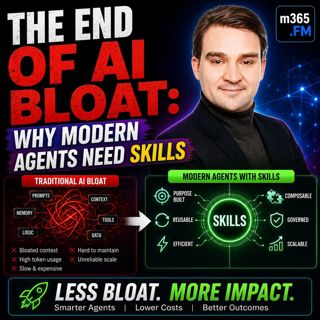
The End of AI Bloat: Why Modern Agents Need Skills

The End of AI Bloat: Why Modern Agents Need Skills

Many AI agents start out fast, responsive, and surprisingly intelligent. But after a few months of real-world use, something changes. Response times increase, costs rise, prompts become enormous, and ...

26 Jul 0s
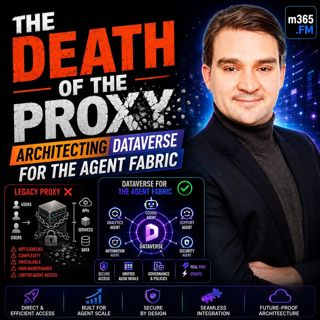
THE DEATH OF THE PROXY: Architecting Dataverse for the Agent Fabric

THE DEATH OF THE PROXY: Architecting Dataverse for the Agent Fabric

For years, Microsoft's recommended architecture for connecting AI assistants like Claude Desktop to Dataverse relied on a local STDIO proxy. It was simple, easy to install, and perfectly suited for in...

26 Jul 0s
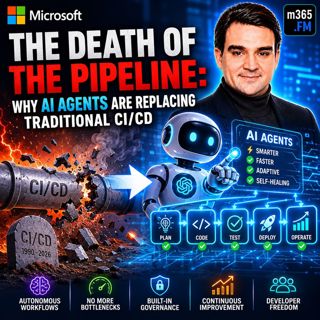
The Death of the Pipeline: Why AI Agents are Replacing Traditional

The Death of the Pipeline: Why AI Agents are Replacing Traditional

For more than two decades, CI/CD pipelines have been the backbone of modern software delivery. Developers commit code, automated builds run, tests execute, security scans complete, someone approves th...

25 Jul 0s
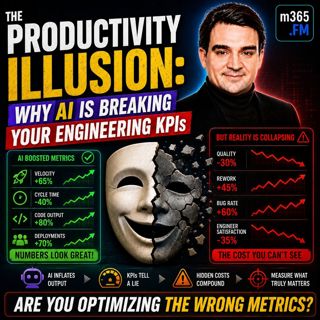
The Productivity Illusion: Why AI is Breaking Your Engineering KPIs

The Productivity Illusion: Why AI is Breaking Your Engineering KPIs

At first glance, the numbers look incredible. Deployment frequency is increasing, pull requests are being merged faster than ever, AI is generating more code, and engineering teams appear dramatically...

25 Jul 0s
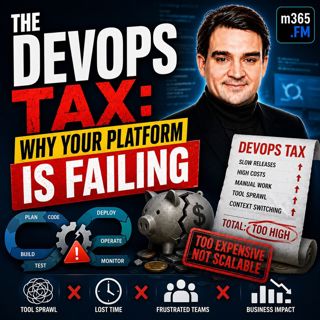
The DevOps Tax: Why Your Platform is Failing

The DevOps Tax: Why Your Platform is Failing

Welcome to another episode of Knowledge Nuggets with Mirko Peters. Today we're exploring The DevOps Tax—the hidden cost that silently reduces engineering productivity, increases cognitive overload, an...

25 Jul 0s

Microsoft Purview Insider Risk Management - Simply Explained

Microsoft Purview Insider Risk Management - Simply Explained

Welcome to another episode of Knowledge Nuggets with Mirko Peters. Today we're exploring Microsoft Purview Insider Risk Management, Microsoft's intelligent solution for identifying risky user behavior...

24 Jul 0s

Populært innen Politikk og nyheter

giver-og-gjengen-vg
aftenpodden
forklart
popradet
fotballpodden-2
stopp-verden
rss-gukild-johaug
aftenpodden-usa
hanna-de-heldige
dine-penger-pengeradet
rss-ness
aftenbla-bla
det-store-bildet
lydartikler-fra-aftenposten
nokon-ma-ga
unitedno
e24-podden
rss-penger-polser-og-politikk
bt-dokumentar-2
oppdatert