
The Greatest Act of Political and Economic Spite in History

The Greatest Act of Political and Economic Spite in History

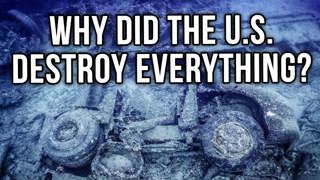
Nations can often be petty and spiteful when it comes to post-war relations, but rarely, if ever, in history did one nation get more petty with not an enemy, but their former ally than when the U.S. military created what is known today as "Million Dollar Point" out of sheer spite. 1,750 kilometres or 1,090 miles off the coast of Australia in the South Pacific Ocean lies the island nation of Vanuatu. Just off the southeast coast of the island, on the outskirts of the main settlement of Luganville, lies a truly remarkable sight: a giant underwater junkyard containing thousands upon thousands of pieces of WWII American military equipment, from tanks, artillery pieces, and bulldozers down to rifles, pistols, food tins and Coca-Cola bottles- all slowly rusting away on the ocean floor. Known as “Million Dollar Point”, every year this submerged museum of wartime logistics attracts hundreds of curious snorkelers and scuba divers from around the world. But what is all this abandoned equipment doing here? Are these the remains of an epic naval battle? A tragic shipwreck? Some gigantic whoopsie-doodle? Nope! The origins of Million Dollar Point are far, far sillier - and pettier - than that! This is the story of one the greatest acts of political and economic spite in modern history and how it helped inspire a Naked Cult that in turn helped lead this region to independence. The islands that make up modern Vanuatu, formerly New Hebrides, were first settled around 1300 BCE by peoples from Melanesian islands to the west such as New Guinea and the Solomons, followed by successive waves of migration by Polynesian peoples from the East, with later European overlords arriving and variously controlling the islands. For example, at one point the region had a complex and unwieldy bureaucracy, with separate British and French police forces and a judicial system presided over by a neutral judge appointed by the King of Spain - and by the way, while most commonly used today to describe a building with multiple individually-owned living units, the term condominium can also refer to a geographic area where multiple sovereign powers agree to share administrative duties. But for most of its history, Vanuatu remained a quiet colonial backwater, subsisting mainly on the trade of coconut meat, fish, sandalwood, and other natural resources. However, in the wake of the Imperial Japanese Navy’s surprise attack on Pearl Harbor on the morning of December 7, 1941 and the subsequent Japanese blitzkrieg across southeast Asia and the Pacific, the archipelago suddenly found itself in danger of invasion. In May 1942, American forces arrived on the islands, setting up a command post on Efate. Engineers from the U.S. Navy’s 1st Construction Batallion - better known as the Seabees - were soon dispatched to Espiritu Santo to construct a crushed-coral airstrip to support the then-ongoing battle on Guadalcanal. In an incredible feat of wartime logistics the Seabees, working round-the-clock, constructed Turtle Bay Airfield in only 20 days. Soon more CB detachments arrived and constructed three more airstrips, one of which is Santo International Airport today. Throughout the war, thousands of bombers, fighters, and other aircraft from the U.S. Navy, Marine Corps, and Army Air Corps as well as the Royal New Zealand Air Force operated from these airfields in support of operations throughout the South Pacific. In addition to the airstrips themselves, the Seabees also built extensive supporting infrastructure including barracks, repair shops, hangars, hospitals, fuel and ammunition depots, and water desalination plants. Espiritu Santo also served as a major supply and repair depot for U.S. Navy ships, stocking millions of tons of the fuel, food, ammunition, spare parts, and other materiel needed to fuel the gruelling island-hopping campaign against Imperial Japan. In particular, Espiritu Santo Naval Base was home to USS AFD-1, one of four Auxiliary Floating Dry Docks stationed in the South Pacific to repair and maintain U.S. Navy ships. Author: Gilles Messier Host/Editor: Daven Hiskey Producer: Caden Nielsen Learn more about your ad choices. Visit megaphone.fm/adchoices

Denne episoden er hentet fra en åpen RSS-feed og er ikke publisert av Podme. Den kan derfor inneholde annonser.

Episoder(305)

Why Don't Vultures Get Sick?

Why Don't Vultures Get Sick?

⁠⁠In this episode of The Brain Food Show, we start by looking at the mind blowing things caterpillars get up to while in the chrysalis. Next up we begin by looking at the fascinating way in which hon...

22 Aug 54min

WTF is Up with the Tea Bag?

WTF is Up with the Tea Bag?

Legend says that brewing tea dates back to around 2737 BC, when tea leaves fell into water being boiled for Emperor Shennong of China. There does not appear to be any hard evidence of tea being discov...

20 Aug 12min

Why the Heck Did Goose Die Ejecting in Top Gun, but Maverick Didn't at Mach 10 in Top Gun: Maverick?

Why the Heck Did Goose Die Ejecting in Top Gun, but Maverick Didn't at Mach 10 in Top Gun: Maverick?

During the 1986 beach volleyball film Top Gun, U.S. Navy aviators and ultimate bros Lt. Pete “Maverick” Mitchell and Nick “Goose” Bradshaw are flying dogfight exercises in a Grumman F-14 Tomcat when t...

19 Aug 50min

How Did Edgar Allan Poe Die?

How Did Edgar Allan Poe Die?

Edgar Allan Poe is probably best known for his raven that squawks “Nevermore,” but he’s also one of the first American short story writers and is often credited with being the “inventor” of detective ...

18 Aug 19min

NASA’s Most Hilarious Failure

NASA’s Most Hilarious Failure

On April 11, 2026, the Orion spacecraft Integrity splashed down in the Pacific Ocean, bringing astronauts Victor Glover, Reid Wiseman, Jeremy Hansen, and Christina Koch (cook) safely back to earth aft...

17 Aug 32min

Can You Actually Tip a Cow?

Can You Actually Tip a Cow?

⁠⁠In this episode of The Brain Food Show, we start by looking at a rather fascinating fact about dogs and cats that you probably didn’t know. Next up we begin by debunking a variety of common whale ...

15 Aug 54min

The U.S.'s Biological Warfare Against Its Own Citizens, the Nazi Breeding Program and Much More

The U.S.'s Biological Warfare Against Its Own Citizens, the Nazi Breeding Program and Much More

In the "Forgotten History" compilation video today, we're looking at the United States' biological warfare program tested on its own citizens, the women who were used for breeding by the Nazis, the am...

14 Aug 2h 55min

The Forgotten American Civil War Death Camp

The Forgotten American Civil War Death Camp

On November 10, 1865, Henry Wirz, the commander of Andersonville prison in Georgia (a.k.a. Camp Sumter), was executed for his actions during the Civil War. A Swiss immigrant, Wirz was the only Confede...

13 Aug 14min

Populært innen Fakta

fastlegen
dine-penger-pengeradet
relasjonspodden-med-dora-thorhallsdottir-kjersti-idem
treningspodden
foreldreradet
rss-orjasater
jakt-og-fiskepodden
rss-kunsten-a-leve
rss-strid-de-norske-borgerkrigene
tomprat-med-gunnar-tjomlid
sinnsyn
mikkels-paskenotter
rss-var-forste-kaffe
hverdagspsyken
gravid-uke-for-uke
smart-forklart
fryktlos
rss-impressions-2
dopet
hagespiren-podcast