Navio: The Roman Fort in the Mist

Navio: The Roman Fort in the Mist

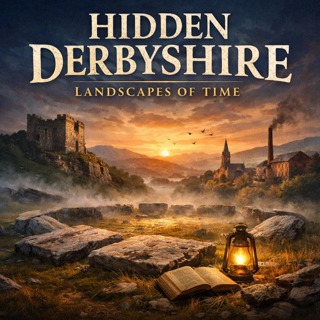
High above the Hope Valley lie the remains of Navio — a Roman fort built not for spectacle, but for logistics. Positioned among lead mines, roads, and rugged frontier landscapes, Navio reveals how the Roman Empire functioned at its edges: through supply chains, administrators, and auxiliary soldiers far from home.


In this episode, we explore Rome’s quiet machinery in Derbyshire: the roads, the ore, the soldiers, the civilians, and the slow decline that turned an imperial outpost into grass.


*Hidden Derbyshire: Landscapes of Time*

A documentary storytelling podcast about the places where history, archaeology, and landscape intersect.

**Primary Archaeological & Excavation Sources**


* **St. Joseph, J.K.** (1955). *Air Reconnaissance of Roman Britain*.

— Early aerial photography confirming fort layout & ditch systems.

* **Derbyshire Archaeological Journal** (various vols., late 19th–20th c.).

— Excavation notes, measurements, fort plan interpretations.

* **Jones, G.D.B. & Mattingly, D.J.** (1990). *Atlas of Roman Britain*.

— Regional context; positioning of Navio in northern frontier network.

* **Hart, Cyril** (1981). *North Derbyshire Archaeology*.

— Site-specific synthesis; lead industry + Roman infrastructure.

* **Historic England Scheduling Records** — Navio / Brough Fort.

— Official designation, phase notes, earthwork mapping.


**Roman Roads & Infrastructure Sources**


* **Margary, I.D.** (1967). *Roman Roads in Britain*.

— Numbering system & proposed routes linking Navio to Buxton, Chesterfield, Manchester.

* **Webster, G.** (1985). *The Roman Imperial Army*.

— Fort typologies & logistical rationale for frontier placements.

* **Shotter, D.** (2004). *Roman Britain*.

— Short but useful synthesis, logistics > conquest framing.


**Lead Mining & Industrial Context**


* **Willies, Lynn** (1999). *Lead Mining in the Peak District*.

— Industry continuity from pre-Roman through post-medieval.

* **Barnatt, John & Smith, K.** (2004). *The Peak District: Landscapes Through Time*.

— Integrates mining, settlement, and military impact.


**Frontier & Garrison Culture**


* **Mattingly, D.** (2006). *An Imperial Possession: Britain in the Roman Empire*.

— Crucial for understanding frontier hybridity & provincial identity.

* **Simpkins, J.** (2018). *Auxiliaries in Roman Britain*.

— Material culture + mixed-garrison ethnography.


**Religion, Identity & Cultural Blending**


* **Henig, Martin** (1995). *Religions in Roman Britain*.

— Altars, syncretism & local cult integration; relevant to Buxton context (Aquae Arnemetiae).

* **Hingley, Richard** (2000). *Roman Officers and English Gentlemen*.

— Reception studies + imagined frontiers.


**Chronological Context**


* Fort phases:

✔ **Late 1st century AD** timber/turf

✔ Later **stone rebuilds**

✔ **Gradual contraction** in late empire

* Withdrawal from Britain: early **5th century AD** (approx.)


### **Consensus Statements**


Most archaeologists agree:

✔ Navio’s primary purpose = **logistics + administration + mineral control**

✔ Fort sits within Peak District lead-mining network

✔ Roads linked Navio ↔ Buxton ↔ Chester ↔ northern routes

✔ Garrison included **auxiliaries**, not legionaries

✔ Decline was gradual, not catastrophic

✔ Little monumental architecture expected at a frontier cog


**Open Questions / Interpretive Gaps**


Still debated:

• exact scale of mining operations supplying Rome

• proportion of civilian vs military population in vicus

• role of local tribes in ore extraction (labour vs taxation)

• religious footprint inside the principia (altars now lost)


### **Accessible Public Sources**


For general listeners:


* Peak District NPA heritage notes

* Buxton Museum & Art Gallery (Roman + mining exhibits)

* Derbyshire Archaeological Society publications

* Local walking trails with Roman heritage overlays


Advertising Inquiries: https://redcircle.com/brands

Privacy & Opt-Out: https://redcircle.com/privacy

Denne episoden er hentet fra en åpen RSS-feed og er ikke publisert av Podme. Den kan derfor inneholde annonser.

Episoder(12)

The Ghost of Anne Stanhope: Hardwick Hall’s Lingering Presence

The Ghost of Anne Stanhope: Hardwick Hall’s Lingering Presence

Hardwick Hall stands as one of Derbyshire’s most striking historic houses—built to display power, wealth, and permanence. But behind its symmetry and glass-lined walls lies a more unsettled story.Anne...

16 Apr 9min

The Devil’s Arse of Castleton: Echoes Beneath the Peak

The Devil’s Arse of Castleton: Echoes Beneath the Peak

At the edge of Castleton lies a vast opening in the earth—one of the largest cave entrances in Britain, and a place once known by a name few would use today.For centuries, Peak Cavern was called the “...

16 Apr 12min

The Nine Ladies of Stanton Moor: A Dance Turned to Stone

The Nine Ladies of Stanton Moor: A Dance Turned to Stone

High on Stanton Moor, a small circle of weathered stones stands quietly among the heather. Known as the Nine Ladies, their origins lie deep in prehistory—but their meaning has long been shaped by stor...

16 Apr 14min

Cromford: The Mill That Invented Time

Cromford: The Mill That Invented Time

On the banks of the Derwent, Richard Arkwright built a new kind of landscape — one powered not by feudal obligation or aristocratic prestige, but by water, machinery, capital, and the disciplined mana...

27 Jan 6min

Peveril Castle: Stone, Feudalism & the View from the Edge

Peveril Castle: Stone, Feudalism & the View from the Edge

High above Castleton, the ruins of Peveril Castle overlook the Hope Valley — a fortress less defined by battles than by law, revenue, and administration. Built in the aftermath of the Norman Conquest,...

27 Jan 6min

Haddon Hall: Stone, Marriage & Power

Haddon Hall: Stone, Marriage & Power

Haddon Hall stands above the River Wye as one of England’s finest surviving medieval houses. From the Peverils to the Vernons and the Manners, the hall became a stage for marriage, inheritance, religi...

22 Jan 7min

Eyam: The Village That Chose to Stay

Eyam: The Village That Chose to Stay

In 1665, the plague arrived in the Derbyshire village of Eyam inside a parcel of cloth from London. Faced with contagion, fear, and the risk of spreading disease across the region, the villagers made ...

21 Jan 7min

Populært innen Samfunn

rss-spartsklubben
giver-og-gjengen-vg
aftenpodden
aftenpodden-usa
rss-nesten-hele-uka-med-lepperod
konspirasjonspodden
popradet
rss-henlagt-andy-larsgaard
bokmerket-2
alt-fortalt
rss-espen-lee-usensurert
wolfgang-wee-uncut
sophie-leser
grenselos
lydartikler-fra-aftenposten
synnve-og-vanessa
frokostshowet-pa-p5
fladseth
rss-dette-ma-aldri-skje-igjen
rss-siktet