
Cosmic Accelerators: Unlocking the Secrets of Microquasar GRS 1915+105

Cosmic Accelerators: Unlocking the Secrets of Microquasar GRS 1915+105

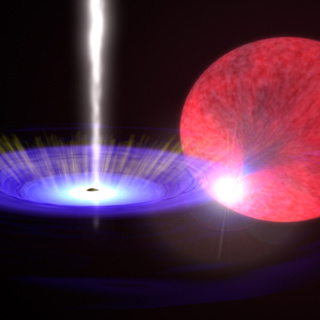
In this episode, we dive into the extreme and fascinating world of microquasars—binary systems where a compact object, like a black hole, feeds off a companion star and launches powerful, relativistic jets. Our spotlight is on GRS 1915+105, one of the most dynamic and powerful microquasars known in the Milky Way.


Recent groundbreaking observations from the LHAASO and Fermi-LAT observatories have mapped broadband gamma-ray emissions from this system, revealing that it operates as an extreme "PeVatron"—an accelerator capable of pushing particles to multi-PeV (peta-electron volt) energies. We break down the evidence pointing to a "hadronic scenario," which suggests that these mind-boggling energies are produced when highly accelerated protons from the jet smash into the dense ambient gas surrounding the system.


Join us as we discuss how this discovery proves that microquasars are exceptionally efficient particle accelerators and how they might be the missing link to understanding the origins of the most energetic cosmic rays in our galaxy.


Key Takeaways:

  • What is a Microquasar? A look at the anatomy of GRS 1915+105, a system featuring a black hole pulling material from a small K-type star and firing off jets at 80% the speed of light.
  • The Power of LHAASO & Fermi-LAT: How a joint analysis of 4 years of LHAASO data and 17 years of Fermi-LAT data finally detected persistent gamma-ray emissions from this source.
  • The Hadronic Accelerator: Why the shifted centroid of the gamma-ray emission suggests that protons (rather than electrons) are being accelerated by the jet's mechanical power and colliding with surrounding interstellar gas.
  • Solving a Galactic Mystery: How just a handful of microquasars like GRS 1915+105 could be responsible for supplying the entire Milky Way with PeV-level cosmic rays.


Reference:

Cao, Z., Aharonian, F., Bai, Y.X., et al. (The LHAASO Collaboration). "Extreme PeV accelerator associated with GRS 1915+105." (Preprint: 2606.25054v1).


Acknowledements: Podcast prepared with Google/NotebookLM. Illustration credits: NASA/CXC/A.Hobart

Denne episoden er hentet fra en åpen RSS-feed og er ikke publisert av Podme. Den kan derfor inneholde annonser.

Episoder(123)

Supernovae, TDEs, and Scintillation: How ASKAP and Rubin Are Mapping the Variable Universe

Supernovae, TDEs, and Scintillation: How ASKAP and Rubin Are Mapping the Variable Universe

In this episode, we dive into how astronomers are combining the power of the Australian Square Kilometre Array Pathfinder (ASKAP) and the Vera C. Rubin Observatory to capture the dynamic, ever-changin...

16 Okt 20min

JWST and MeerKAT Team Up: Uncovering the Most Distant Fast Radio Burst Yet

JWST and MeerKAT Team Up: Uncovering the Most Distant Fast Radio Burst Yet

Fast Radio Bursts (FRBs) are millisecond-duration radio signals originating from deep space. In this episode, we explore the groundbreaking discovery of FRB 20240304B, detected by the MeerKAT radio te...

12 Okt 20min

GRB 221009A: Measuring Relativistic Jets using Radio Interferometry

GRB 221009A: Measuring Relativistic Jets using Radio Interferometry

In this episode, we explore high-precision Very Long Baseline Interferometry (VLBI) radio observations of GRB 221009A, the brightest gamma-ray burst ever detected. Using the Global-VLBI network at 5 G...

8 Okt 21min

Unveiling GRB 240825A: Cosmic Dust, JWST, and a Supernova in Hiding

Unveiling GRB 240825A: Cosmic Dust, JWST, and a Supernova in Hiding

In this episode, we explore the cosmic mystery of GRB 240825A, a gamma-ray burst detected at redshift z = 0.659. Its short rest-frame duration and hard prompt emission initially pointed toward a compa...

5 Okt 14min

From GeV to EeV: A Data-Driven View of Cosmic Rays

From GeV to EeV: A Data-Driven View of Cosmic Rays

How do high-energy particles traveling across the universe reach Earth, and what are they made of? In this episode, we explore the Global Spline Fit (GSF), a comprehensive framework that unifies cosmi...

2 Okt 24min

From Blazars to Supernovae: Fermi’s Deepest High-Energy Sky Survey

From Blazars to Supernovae: Fermi’s Deepest High-Energy Sky Survey

In this episode, we dive into the release of the Fourth Catalog of Hard Fermi-LAT Sources (4FHL). Utilizing 16 years of continuous data from NASA's Fermi Gamma-ray Space Telescope, this catalog provid...

29 Sep 23min

GRB 220706A: The Longest-Lived Gamma-Ray Burst Engine Ever Seen

GRB 220706A: The Longest-Lived Gamma-Ray Burst Engine Ever Seen

In this episode, we explore the extraordinary discovery of GRB 220706A, a record-shattering cosmic explosion at redshift z = 0.8577. While most gamma-ray burst engines die down within minutes, X-ray f...

24 Sep 19min

Chasing Kilonovae: How LIGO-India Multiplies Multimessenger Discoveries

Chasing Kilonovae: How LIGO-India Multiplies Multimessenger Discoveries

In this episode, we explore the future of multimessenger astronomy as neutron star–black hole (NSBH) mergers take center stage. While binary neutron star collisions have delivered iconic multimessenge...

18 Sep 21min

Populært innen Vitenskap

fastlegen
tingenes-tilstand
romkapsel
sinnsyn
dekodet-2
liberal-halvtime
rss-nysgjerrige-norge
forskningno
rekommandert
fjellsportpodden
rss-paradigmepodden
rss-rekommandert
grunnstoffene
tidlose-historier
villmarksliv
nordnorsk-historie
rss-bondevennen
hva-er-greia-med
vett-og-vitenskap-med-gaute-einevoll
noen-har-snakket-sammen