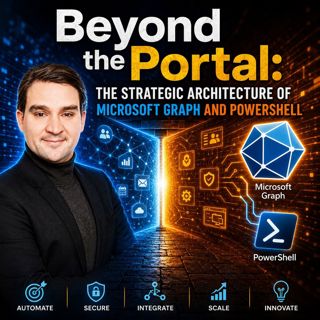
Beyond the Portal: The Strategic Architecture of Microsoft Graph and PowerShell

Beyond the Portal: The Strategic Architecture of Microsoft Graph and PowerShell

For years, Microsoft 365 administration has been defined by portals. Administrators spend their days inside the Microsoft 365 Admin Center, Exchange Admin Center, SharePoint Admin Center, Teams Admin Center, and Intune. They click through dashboards, configure policies, manage identities, assign licenses, and respond to support tickets one task at a time. But beneath every portal lies a deeper reality. Every action performed in a Microsoft portal ultimately translates into a Microsoft Graph API call. The portal is simply a user interface layered on top of the actual control plane that powers Microsoft 365. In this episode, we explore why Microsoft Graph and PowerShell are becoming the foundation of modern Microsoft 365 administration, how organizations can move beyond manual operations toward large-scale automation, and why Graph knowledge is rapidly becoming one of the most valuable skills for Microsoft professionals.

WHY THE PORTAL IS BECOMING A BOTTLENECK
Portals are excellent for individual tasks. Creating a user, assigning a license, or reviewing a policy can all be completed quickly through a graphical interface. The challenge emerges when organizations need to operate at scale. Managing thousands of users, devices, groups, Teams, SharePoint sites, applications, and security controls through manual clicks creates operational overhead that compounds over time. The discussion explores how portal-driven administration often hides inefficiencies, limits visibility, and prevents organizations from leveraging the full automation capabilities available within Microsoft 365.

MICROSOFT GRAPH: THE REAL OPERATING SYSTEM OF MICROSOFT 365
Many professionals think of Microsoft Graph as simply another API. The reality is far more significant. Microsoft Graph serves as the unified access layer for Microsoft 365, connecting identities, collaboration, communication, security, compliance, and business data through a single platform. Topics discussed include:
  • Microsoft Graph architecture
  • Unified endpoint design
  • REST APIs
  • Microsoft Graph PowerShell SDK
  • Identity-driven access
  • Enterprise automation
Rather than viewing Graph as an API, organizations should view it as the operational backbone of the entire Microsoft ecosystem.

THE STRATEGIC IMPORTANCE OF GRAPH IN THE AI ERA
Microsoft's future is increasingly built on Graph. Copilot uses Graph to retrieve organizational data. AI agents use Graph to perform actions. Copilot Studio relies on Graph-based integrations. Agentic workflows depend on Graph permissions and access controls. The episode explores why organizations investing in Graph capabilities today are simultaneously preparing for the next generation of AI-powered business systems.

AUTHENTICATION, PERMISSIONS, AND ENTERPRISE SECURITY
Every Graph request starts with identity. Understanding authentication and authorization is essential for building secure automation. The discussion covers:
  • Delegated permissions
  • Application permissions
  • Service principals
  • OAuth authentication
  • Consent models
  • Least privilege design
A major focus is placed on avoiding excessive permissions and understanding how overprivileged applications create significant enterprise security risks.

WHY PERMISSION DEBT BECOMES AN AI PROBLEM
Many organizations have accumulated years of permission sprawl. SharePoint sites with broad access. Teams workspaces shared too widely. Applications with unnecessary permissions. Before AI, these issues often remained hidden. Copilot changes that. The episode explores how AI systems surface existing permission problems by making organizational data easier to discover and access through natural language interactions. Permission governance is no longer just a security initiative. It has become a prerequisite for successful AI adoption.

AUTOMATING THE COMPLETE USER LIFECYCLE
One of the most practical applications of Microsoft Graph is identity lifecycle management. Instead of manually processing onboarding and offboarding requests, organizations can automate the entire lifecycle. Topics include:
  • User provisioning
  • License assignment
  • Group membership management
  • Team provisioning
  • Employee transfers
  • Offboarding automation
The discussion demonstrates how Graph PowerShell can transform repetitive identity management tasks into reliable, repeatable workflows that execute consistently across thousands of users.

THE IDEMPOTENT PRINCIPLE: BUILDING SAFE AUTOMATION
Successful automation is not just about executing tasks. It is about executing tasks safely. The episode introduces the concept of idempotency, one of the most important principles in enterprise automation. An idempotent script can run repeatedly without causing duplicate actions, configuration drift, or unintended side effects. Key concepts include:
  • State validation
  • Safe execution patterns
  • Error handling
  • Recovery workflows
  • Automated remediation
  • Operational resilience
This approach enables organizations to build automation that can operate continuously without constant human oversight.

MANAGING TEAMS, SHAREPOINT, AND ONEDRIVE AT SCALE
Collaboration platforms generate enormous amounts of data and governance complexity. The episode explores how Graph enables organizations to manage collaboration workloads programmatically. Topics discussed include:
  • Teams lifecycle management
  • SharePoint governance
  • OneDrive administration
  • Site provisioning
  • External sharing audits
  • Retention enforcement
Rather than manually reviewing thousands of collaboration resources, organizations can use Graph to automate governance and maintain compliance continuously.

GRAPH AS A SECURITY OPERATIONS PLATFORM
Security teams increasingly rely on Graph for visibility and automation. The discussion explores how Graph provides access to critical security signals across Microsoft 365. Areas covered include:
  • Defender integration
  • Security APIs
  • Service principal monitoring
  • Conditional Access analysis
  • MFA coverage audits
  • Risk detection
Graph enables organizations to move beyond reactive security and toward continuous monitoring and automated response capabilities.

GOVERNANCE, COMPLIANCE, AND POLICY ENFORCEMENT
Governance is often misunderstood as documentation. In reality, governance is about enforcement. The episode examines how organizations can leverage Graph to operationalize compliance requirements and ensure policies are consistently applied across Microsoft 365 environments. Topics include:
  • Sensitivity labels
  • Retention policies
  • eDiscovery readiness
  • Microsoft Purview integration
  • Audit evidence collection
  • Data residency controls


Become a supporter of this podcast: https://www.spreaker.com/podcast/m365-fm-modern-work-security-and-productivity-with-microsoft-365--6704921/support.

Denne episoden er hentet fra en åpen RSS-feed og er ikke publisert av Podme. Den kan derfor inneholde annonser.

Episoder(690)

Everything Microsoft Didn't Tell You About Teams with Everything Microsoft Didn't Tell You About Teams with Josh Blalock [MVP]

Everything Microsoft Didn't Tell You About Teams with Everything Microsoft Didn't Tell You About Teams with Josh Blalock [MVP]

Microsoft Teams has evolved from a simple collaboration platform into the digital workplace at the heart of modern business. But behind every successful Teams meeting lies far more than software. In t...

3 Jul 45min

Think Like an Attacker: Microsoft Security Exposure Management with Uros Babic [MVP-MCT]

Think Like an Attacker: Microsoft Security Exposure Management with Uros Babic [MVP-MCT]

Traditional cybersecurity focuses on vulnerabilities, alerts, and dashboards. Attackers don't. They look for opportunities, weak identities, exposed cloud resources, excessive permissions, forgotten e...

2 Jul 1h 9min

Stop Building Bots, Start Building Runtimes: A Field Guide to Microsoft Agents

Stop Building Bots, Start Building Runtimes: A Field Guide to Microsoft Agents

Everyone is calling Build 2026 the AI conference. Most of the attention went toward new copilots, voice experiences, and increasingly capable models. But beneath the headlines, Microsoft quietly intro...

2 Jul 1h 16min

EXTENSIBILITY FIRST: Building .NET Systems That Survive Change with Miguel Castro [MVP]

EXTENSIBILITY FIRST: Building .NET Systems That Survive Change with Miguel Castro [MVP]

Software rarely fails because developers cannot write code. It fails because applications are designed for today's requirements instead of tomorrow's changes. In this episode of the m365.fm Podcast, M...

1 Jul 1h 4min

The Death of the UI: Why CUA is the End of SaaS as We Know It

The Death of the UI: Why CUA is the End of SaaS as We Know It

For more than forty years, enterprise software has been built around one fundamental assumption: humans need graphical interfaces to interact with machines. Dashboards, forms, navigation menus, search...

1 Jul 1h 8min

Microsoft Copilot Adoption: What Actually Works - With Chris Hinch [Microsoft]

Microsoft Copilot Adoption: What Actually Works - With Chris Hinch [Microsoft]

Artificial Intelligence has moved beyond experimentation and into the heart of modern business. Yet while organizations are investing heavily in Microsoft Copilot, many struggle to achieve meaningful ...

30 Jun 54min
The Agentic Operating Model: Beyond the Copilot Hype

The Agentic Operating Model: Beyond the Copilot Hype

Most organizations believe they are implementing AI transformation. In reality, many are simply deploying chat interfaces on top of existing systems. While copilots and retrieval-based AI solutions ha...

30 Jun 1h 14min

Populært innen Politikk og nyheter

giver-og-gjengen-vg
aftenpodden
aftenpodden-usa
fotballpodden-2
forklart
stopp-verden
popradet
det-store-bildet
nokon-ma-ga
rss-gukild-johaug
lydartikler-fra-aftenposten
hanna-de-heldige
rss-ness
rss-espen-lee-usensurert
rss-penger-polser-og-politikk
aftenbla-bla
dine-penger-pengeradet
ukrainapodden
ta-dokumentar
frokostshowet-pa-p5