S9 Ep38: Europe in the Middle

S9 Ep38: Europe in the Middle

China cannot sell as much as it used to in the United States. That trade has to go somewhere, and somewhere might be Europe.

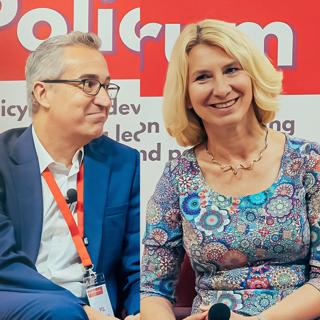
In this week's VoxTalk, Tim Phillips asks Pol Antràs (Harvard) and Beata Javorcik (EBRD, Oxford) what this means for European producers and consumers.

Antràs and Andrea Presbitero have mapped which countries and sectors face the sharpest competition from redirected Chinese exports, and which stand to gain. Does cheap Chinese tech ease Europe's energy cost crisis, or squeeze European manufacturers of wind turbines and electric cars?

If Europe decides to take the gains where consumers and firms can get them, and compensate the producers who are legitimately hurt, how do they go about it? And can raising tariffs in a world of global value chains protecting one sector without damaging others?

New episode, recorded at the PSE-CEPR Policy Forum 2026 in Paris.

The research behind this episode:

Antràs, Pol, and Andrea F. Presbitero. 2026. "The Remains of the Trade: The U.S.-China Trade War and its Aftermath." Preliminary version

To cite this episode:

Phillips, Tim, Pol Antràs, and Beata Javorcik. 2026. "Europe in the Middle." VoxTalks Economics (podcast).

About the guests:

Pol Antras is Robert G. Ory Professor of Economics at Harvard University, a Research Associate at the National Bureau of Economic Research, and a Research Affiliate at the Centre for Economic Policy Research. His research spans global value chains, the organisation of multinational firms, and, most recently, the intersection of trade policy and geopolitics.

Beata Javorcik is Chief Economist of the European Bank for Reconstruction and Development, on leave from her position as Professor of Economics at the University of Oxford and Fellow of All Souls College. She is Director of the International Trade Programme at the Centre for Economic Policy Research. Her research spans foreign direct investment, industrial policy, and, increasingly, the economics of geopolitical fragmentation.

Research cited in this episode:

The Great Reallocation is the term coined by Laura Alfaro and Davin Chor for the reorganisation of United States sourcing away from direct imports from China and toward alternative suppliers such as Vietnam, Mexico, and Taiwan. Antràs and Presbitero's paper extends this idea to third countries, showing that Chinese exports displaced from the American market are increasingly landing in Europe and Asia rather than disappearing.

Geopolitical externality is a concept developed by Laura Alfaro, Maggie Chen, and Beata Javorcik in their working paper "The Battle over Knowledge: Multinationals, Diffusion, and Governance." It describes how knowledge transferred abroad by multinational firms can strengthen a rival state's strategic capability in ways the firm never intended and the market never prices, which is why governments increasingly restrict flows of codified, tacit, and organisational knowledge that would once have passed unremarked.

Voluntary export restraints were the mechanism used to defuse the United States' trade conflict with Japanese carmakers in the 1980s. Rather than imposing tariffs, Japan agreed to limit its car exports, and Japanese manufacturers responded by building plants directly in the United States. Javorcik cites this as the precedent for how the current standoff over Chinese electric vehicles and knowledge transfer might eventually be resolved.

The Draghi report on European competitiveness, published by the European Commission in September 2024, recommended conditioning Chinese investment in the European electric vehicle sector on mandatory knowledge transfer. Javorcik notes the difficulty of calibrating such requirements: demand too little and Europe gains nothing from the technology; demand too much and Chinese investors have no reason to come at all.

"Industrial Policies for Multi-stage Production: The Battle for Battery-powered Vehicles," by Keith Head, Thierry Mayer, Marc Melitz, and Chenying Yang, models how tariffs and subsidies reshape the location of battery and vehicle assembly plants across a multi-stage supply chain. Antràs cites the paper's finding that protecting the electric vehicle sector through tariffs can produce worse outcomes than the problem it was meant to solve.

Export controls and innovation, discussed by Javorcik with reference to Chinese firms such as DeepSeek and Huawei, illustrate a pattern in which restricting a country's access to a technology, in this case advanced semiconductors, can accelerate that country's innovation in adjacent areas rather than simply constraining it. She draws a parallel with rare earth export restrictions, which have historically spurred substitute technologies rather than suppressing them.

More VoxTalks Economics episodes:

In a conversation recorded at the CEPR Annual Forum in Paris called "What should Europe do about Trump?" Tim Phillips spoke to Beatrice Weder di Mauro and Ugo Panizza of the Graduate Institute Geneva, about how Europe should respond to the second Trump administration's trade policies.

Listeners interested in how firms navigate geopolitical trade disruption should also hear "Trading around geopolitics," in which Giancarlo Corsetti, Banu Demir, and Beata Javorcik discuss how Turkish exporters filled the gap left by sanctions on Russia.

Related reading on VoxEU:

"An update on the great reallocation in US supply chain trade" uses detailed United States import data through 2025 to track the scope and pace of the reallocation discussed in this episode.

"From tariffs to trade flows: Diversion effects and China's exports to the EU" examines the evidence for and against the trade deflection story that Antras and Javorcik discuss, and finds the picture more mixed than a simple diversion narrative suggests.

"China shock 2.0 and the euro area: Cheaper imports, tougher competition" decomposes the recent surge in Chinese exports to the euro area and argues that structural forces within China, rather than diversion from the American market, explain most of it.

"The impact of trade wars on firms in third countries" proposes a model of how bilateral trade shocks spill over to bystander economies, applying it to Italian firms during the 2018 to 2019 trade war.

Denne episoden er hentet fra en åpen RSS-feed og er ikke publisert av Podme. Den kan derfor inneholde annonser.

Episoder(465)

S9 Ep37: Addressing Global Imbalances

S9 Ep37: Addressing Global Imbalances

Episode recorded on 19 June 2026 at the PSE-CEPR Policy Forum in Paris.Twice before, the world's savings and debts have piled up in the wrong places, and twice the imbalance broke something. The first...

3 Jul 24min

S9 Ep36: Helping the over-50s find work

S9 Ep36: Helping the over-50s find work

Lose your job at 25 and someone will help you find another. Lose it at 55 and the talk quietly turns to how you might wind down towards retirement.Policymakers tend to assume job search training works...

1 Jul 19min

S9 Ep35: The success of the embedded state

S9 Ep35: The success of the embedded state

Who kept the courts sitting and the streetlights lit when the state had almost no money to pay anyone?Two hundred years ago, British local government ran on unpaid labour. In a parliamentary survey of...

26 Jun 20min

S9 Ep34: Making defence spending pay

S9 Ep34: Making defence spending pay

Defence spending is rising whether voters like it or not. The UK has committed to 2.5% of national income and aims for nearer 3.5% over the next decade, £30bn a year for each percentage point. What do...

19 Jun 26min

S9 Ep33: Did the sewing machine liberate women?

S9 Ep33: Did the sewing machine liberate women?

In January 1860 the New York Times gave its blessing to a new machine: the sewing machine. These "iron needle-women", it wrote, were the only invention that could be claimed “chiefly for women's benef...

12 Jun 19min

S9 Ep32: The digital money supply

S9 Ep32: The digital money supply

Every day, billions of transactions settle between strangers who have no idea which bank the other uses. That lack of friction is not automatic. Nine-tenths of the money in daily circulation has been ...

5 Jun 27min

S9 Ep31: How well does patent screening work?

S9 Ep31: How well does patent screening work?

Someone once held a patent on the swing. A piece of wood. Two ropes. The US Patent Office granted it. How often does that actually happen, and what does it cost when the system gets it wrong? Or, how ...

29 Mai 32min

Populært innen Business og økonomi

stopp-verden
lydartikler-fra-aftenposten
dine-penger-pengeradet
e24-podden
rss-penger-polser-og-politikk
rss-borsmorgen-okonominyhetene
rss-skravla-gar
pengepodden-2
livet-pa-veien-med-jan-erik-larssen
finansredaksjonen
utbytte
okonomiamatorene
rss-pa-konto
tid-er-penger-en-podcast-med-peter-warren
morgenkaffen-med-finansavisen
liberal-halvtime
lederpodden
pengesnakk
rss-impressions-2
stormkast-med-valebrokk-stordalen