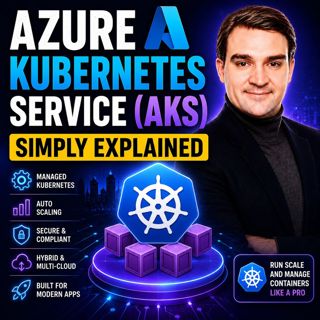
Azure Kubernetes Service (AKS) - Simply Explained

Azure Kubernetes Service (AKS) - Simply Explained

Azure Kubernetes Service (AKS) is Microsoft's fully managed Kubernetes platform that makes it easier to deploy, manage, and scale containerized applications in Azure. Instead of building and maintaining your own Kubernetes cluster, Microsoft operates the control plane while you focus on deploying your applications. AKS combines the power of open-source Kubernetes with deep Azure integrations, allowing organizations to build resilient, cloud-native applications without spending countless hours maintaining infrastructure. Whether you're running microservices, APIs, AI workloads, or enterprise applications, AKS provides a production-ready platform that automates many of the operational challenges of Kubernetes.

WHY KUBERNETES MATTERS FOR MODERN APPLICATIONS
Containers revolutionized software development by packaging applications together with their dependencies into portable, consistent units that run the same everywhere. While managing a handful of containers manually is simple, enterprise environments often require hundreds or even thousands of containers running across multiple servers. Kubernetes solves this challenge by automatically scheduling workloads, restarting failed applications, scaling resources during traffic spikes, and distributing workloads across available infrastructure. Azure Kubernetes Service removes the complexity of operating Kubernetes itself by managing the control plane, upgrades, backups, and patching, allowing development teams to focus on building software instead of maintaining clusters.

HOW AZURE KUBERNETES SERVICE WORKS AKS
consists of two primary components: the Microsoft-managed control plane and your worker nodes. The control plane acts as the brain of the cluster, making scheduling decisions, maintaining cluster health, and storing Kubernetes configuration. Microsoft manages these components automatically, ensuring high availability and regular updates. Your applications run on worker nodes, which are standard Azure Virtual Machines organized into node pools that can scale automatically based on workload demand. AKS also integrates seamlessly with Azure services like Microsoft Entra ID for authentication, Azure Monitor for observability, Azure Policy for governance, and Azure Container Registry for secure image storage, creating a complete cloud-native platform for enterprise applications.

NETWORKING, SECURITY, AND HIGH AVAILABILITY
Enterprise workloads require secure and reliable networking, and AKS provides multiple networking models to suit different deployment scenarios. Azure CNI enables secure communication between pods, services, and external resources while supporting both overlay and flat networking architectures. Applications can be exposed through Azure Load Balancer or Ingress Controllers, making it easy to publish APIs and web applications securely. On the security side, AKS integrates with Microsoft Entra ID for authentication, Kubernetes Role-Based Access Control (RBAC) for authorization, Azure Key Vault for secrets management, and Microsoft Defender for Containers to continuously monitor workloads for vulnerabilities and suspicious behavior. Together, these features help organizations build Zero Trust container platforms that meet modern security and compliance requirements.

COSTS, SCALING, AND PERFORMANCE
One of the biggest advantages of AKS is its flexibility. While the Kubernetes control plane is free in the Free tier, organizations primarily pay for the Azure Virtual Machines, storage, networking, and optional premium features that power their workloads. AKS supports automatic cluster scaling, allowing node pools to grow during peak demand and shrink during quieter periods to reduce costs. Businesses can further optimize expenses using Reserved Instances, Azure Savings Plans, or Spot Virtual Machines for non-critical workloads. Combined with rolling updates, automated health monitoring, and self-healing capabilities, AKS delivers enterprise-grade scalability while giving organizations full control over performance and infrastructure costs.

WHEN SHOULD YOU CHOOSE AKS?
Azure Kubernetes Service is the ideal choice for organizations running microservices, enterprise APIs, AI and machine learning platforms, DevOps pipelines, SaaS applications, and large-scale cloud-native workloads that require maximum flexibility and control. It is particularly valuable when applications need advanced networking, custom Kubernetes features, multiple node pools, or sophisticated deployment strategies. Smaller applications or simple container workloads may be better suited to Azure Container Apps or Azure App Service, but when your business demands full Kubernetes capabilities with significantly reduced operational overhead, AKS provides one of the most powerful and mature managed Kubernetes platforms available. By combining open-source Kubernetes with Azure's security, automation, and scalability, AKS enables organizations to build reliable, secure, and highly available applications that are ready for production at any scale

Become a supporter of this podcast: https://www.spreaker.com/podcast/m365-fm-modern-work-security-and-productivity-with-microsoft-365--6704921/support.

Denne episoden er hentet fra en åpen RSS-feed og er ikke publisert av Podme. Den kan derfor inneholde annonser.

Episoder(783)

Azure Files - Simply Explained

Azure Files - Simply Explained

Azure Files is Microsoft's fully managed cloud file sharing service that allows you to create secure, scalable file shares without maintaining a traditional file server. Instead of purchasing hardware...

17 Jul 15min

Azure Container Apps - Simply Explained

Azure Container Apps - Simply Explained

Azure Container Apps make it possible to run modern containerized applications without the operational complexity of managing Kubernetes clusters. Instead of worrying about virtual machines, node pool...

17 Jul 15min
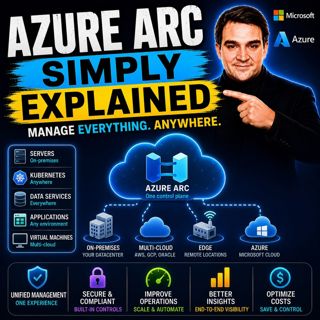
Azure Arc - Simply Explained

Azure Arc - Simply Explained

Modern IT environments rarely exist in a single cloud. Most organizations run Windows and Linux servers across on-premises data centers, Microsoft Azure, Amazon Web Services (AWS), Google Cloud Platfo...

17 Jul 17min
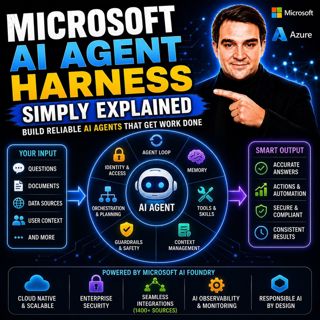
Microsoft AI Agent Harness - Simply Explained

Microsoft AI Agent Harness - Simply Explained

Writing the perfect AI prompt used to be the goal of every AI developer. But as businesses began asking AI to perform increasingly complex tasks—analyzing code, researching topics, coordinating workfl...

17 Jul 16min
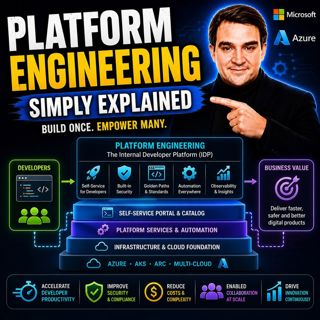
Platform Engineering - Simply Explained

Platform Engineering - Simply Explained

For years, DevOps promised to break down the barriers between development and operations by giving teams greater ownership over the software they build. While the idea was powerful, reality became far...

16 Jul 16min
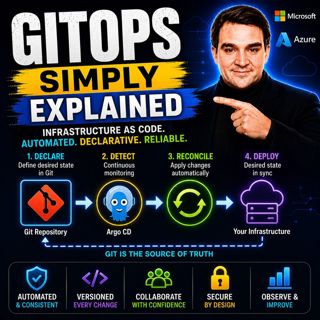
GitOps - Simply Explained

GitOps - Simply Explained

Managing Kubernetes manually quickly becomes a nightmare as environments grow. One engineer updates a deployment directly using kubectl, another changes a ConfigMap through the Azure portal, and sudde...

16 Jul 16min
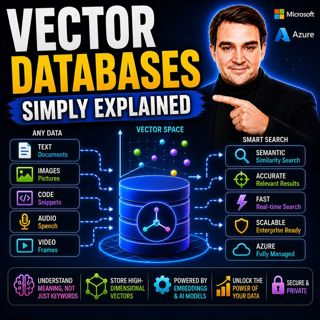
Vector Databases - Simply Explained

Vector Databases - Simply Explained

Large Language Models like GPT-4o, Microsoft Copilot, and ChatGPT are incredibly powerful, but they all depend on one critical technology that most people never hear about: vector databases. Tradition...

16 Jul 14min

Populært innen Politikk og nyheter

giver-og-gjengen-vg
aftenpodden-usa
fotballpodden-2
aftenpodden
forklart
stopp-verden
popradet
det-store-bildet
rss-gukild-johaug
hanna-de-heldige
rss-ness
aftenbla-bla
nokon-ma-ga
dine-penger-pengeradet
rss-penger-polser-og-politikk
lydartikler-fra-aftenposten
rss-utenrikskomiteen-med-bogen-og-grasvik
rss-hor-na-krim-2
e24-podden
unitedno