398E-439-Big and Close

398E-439-Big and Close

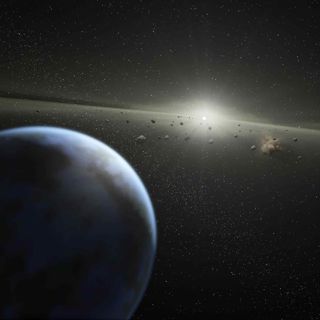
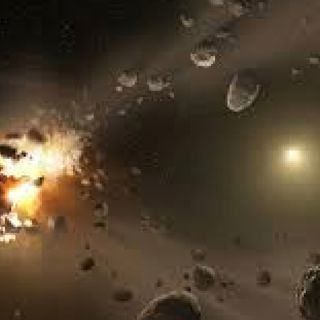
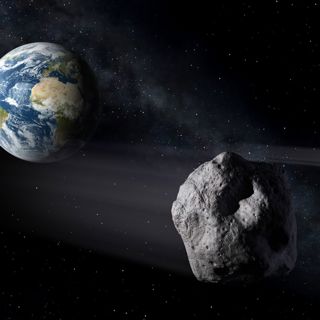
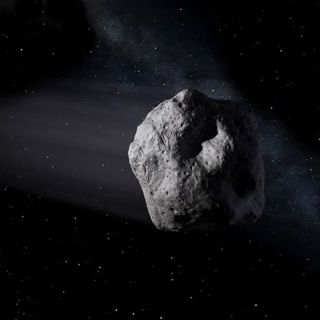
Using our Schmidt telescope on Mt. Bigelow, Arizona, my Catalina Sky Survey teammate Richard Kowalski was searching for Earth approaching asteroids in the constellation of Virgo when he discovered a moving point of light which had suddenly appeared and was about 40 times brighter than is typical for a near Earth asteroid. 75 hours later, scientists at the Minor Planet Center used data from 17 different observatories around the globe to calculate it's orbit around the Sun, estimate it's size to be 630 feet in diameter, and give it the name 2018 BT6. Three weeks before Richard discovered 2018 BT6, it was very dim with less than 1% of it's illuminated side facing us as it came from the direction of the Sun giving humans little advance notice as it approached us at a speedy 16.4 mi/s. In 2018 this relatively large space rock came to about 18 times the Moon's distance from us. In the future it's orbit can bring it to about 0.6 of the Moon's distance from us. According to the Purdue University and Imperial College of London's impact calculator, one it's size impacts the Earth every 300,000 years or so creating a crater in sedimentary rock 7 miles in diameter and 2,000 feet deep. Fortunately 2018 BT6 will not strike the Earth in the foreseeable future, however, it's discovery presents us with the fact that currently humans would have little advance warning of the impact of a relatively large space rock if it approached us from the direction of our Sun.

Denne episoden er hentet fra en åpen RSS-feed og er ikke publisert av Podme. Den kan derfor inneholde annonser.

Episoder(1000)

401E-442-Brian's Debut

401E-442-Brian's Debut

During the only 3 clears hours of his first night solo as an asteroid hunter, my new Catalina Sky Survey teammate Brian Africano discovered two new Earth approaching asteroids with our Schmidt Telesco...

11 Aug 2min

911-Comet Brightness Explosion

911-Comet Brightness Explosion

Comet 220P/McNaught orbits the Sun once every 5.5 years on a path which is between Mars and Jupiter. At that extreme distance, more than 1.5 times the Earth’s distance from the Sun, it still receives ...

7 Aug 2min

400E-441-Carson's Pair

400E-441-Carson's Pair

My Catalina Sky Survey teammate Carson Fuls was observing, in the constellation Lynx, with our Schmidt telescope on Mt. Bigelow, Arizona , when within the space of only 35 minutes, he discovered two s...

4 Aug 2min

910-Mega Constellations

910-Mega Constellations

In an experiment that will involve all of the residents of planet Earth SpaceX has asked the FCC for permission to launch 1 million satellites into low Earth orbit to create a solar powered data cente...

31 Jul 2min

399E-440-Tracking Elon's Car

399E-440-Tracking Elon's Car

Elon Musk decided not to use a traditional mundane concrete block dummy payload for the first launch of the SpaceX Falcon Heavy launch vehicle to test his rockets lifting capabilities. After orbiting ...

28 Jul 2min

909- 2026 JH2

909- 2026 JH2

My Catalina Sky Survey teammates  Josh Hogan and Alessandra Serrano were asteroid hunting in the constellation of Ursa Major when they discovered a fast moving point of light in the night sky. My team...

24 Jul 2min

908-Head On

908-Head On

Asteroid hunters find asteroids by looking for objects which change their position relative to the stars.  If an asteroid happened to match the Earth’s motion it might appear stationary and thus be vi...

17 Jul 2min

Populært innen Vitenskap

fastlegen
tingenes-tilstand
abels-tarn
liberal-halvtime
romkapsel
jss
rekommandert
vett-og-vitenskap-med-gaute-einevoll
sinnsyn
dekodet-2
villmarksliv
fjellsportpodden
rss-rekommandert
tomprat-med-gunnar-tjomlid
rss-inn-til-kjernen-med-sunniva-rose
rss-nysgjerrige-norge
rss-overskuddsliv
diagnose
abid-nadia-skyld-og-skam
forskningno