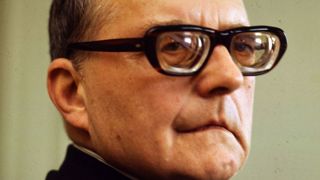

Shostakovich String Quartet No. 8

Shostakovich String Quartet No. 8

What did Dmitri Shostakovich intend to portray in his music? There is probably no more debated a question in all of 20th century Western Classica lMusic than this one. On the surface, it seems to have an easy answer. Shostakovich portrayed his own thoughts and feelings in his music, just as any other composer would. And that is certainly true. Shostakovich, above anything else, was truly one of the great composers in history. HIs mastery of form, meldoy, strcuture, pacing, and his ability to find a near universal expression of grief and passion is practically unparalelled among composers. That much is clear to those of us who love Shostakovich's music. But everything else, including that thorny question of what his music MEANS, is much, much, much less clear. Practically Shostakovich's entire life was lived under the shadow of Soviet Russia, and naturally his musical career was lived under that shadow as well. This means that a sometimes impenetrable layer of secrecy, mystery, and doubt always lies under the surface of Shostakovich's music.

In 1960, Kruschev, who had been loudly trumpetting Shostakovich's name to Western Press as an example of a free Soviet artist post the excesses of the Stalin regime, decided that Shostakovich should be the new head of the Russian Union of Composers. The catch was that Shostakovich would need to join the Communist Party in order to take the job. Shostakovich, who had long resisted becoming a full Party member, agreed. Shostakovich was clearly disappointed in himself, as his friend Lev Lebedinsky wrote this: "I will never forget some of the things he said that night [before his induction into the Party], sobbing hysterically: 'I'm scared to death of them.'

Why does all this matter? Because just a few days after joining the Commhnist party and after meeting with his friends Isaac Glikman and Lev Lebedinsky, Shostakovich traveled to East Germany -- specifically to Dresden — to work on a film which would commemorate the destruction of the city during World War II. He was supposed to write music for this film, but instead, Shostakovich sat down, and in THREE DAYS, he wrote his 8th string quartet. He would later write to Glikman: "However much I've tried to draft my obligations for the film, I just couldn't do it. Instead I wrote an ideologically deficient quartet that nobody needs. I reflected that if I die it's not likely anyone will write a quartet dedicated to my memory. So I decided to write it myself. You could even write on the cover: 'Dedicated to the memory of the composer of this quartet." Today on the show we're going to explore this remarkable piece together - join us!

Episoder(284)

Sticky Notes meets You'll Hear It

Sticky Notes meets You'll Hear It

I had such a wonderful time joining the jazz podcast You'll Hear It! We talked about the meeting of jazz and classical music, a topic I've explored before, but never in this much depth and never with ...

22 Aug 20251h 10min
Impressions in Blue: Ravel & Gershwin

Impressions in Blue: Ravel & Gershwin

In the mid-1920s, Maurice Ravel wrote a letter to the legendary composition teacher Nadia Boulanger. Boulanger's class was a mecca for composers, both young and old, and musicians from all over the wo...

7 Aug 202544min
Beethoven Piano Sonata in B Flat Major, Op. 106, "Hammerklavier" - Part 2

Beethoven Piano Sonata in B Flat Major, Op. 106, "Hammerklavier" - Part 2

There is a special category when it comes to Beethoven; a catalogue that doesn't include complete symphonies, sonatas, concerti, string quartets, etc., but just single movements. This is the catalogue...

24 Jul 202553min
Beethoven Piano Sonata in B♭ major, Op. 106, "Hammerklavier" - Part 1

Beethoven Piano Sonata in B♭ major, Op. 106, "Hammerklavier" - Part 1

Beethoven once wrote to his publisher: "What is difficult, is also beautiful, good, great, and so forth. Hence everyone will realize that this is the most lavish praise that can be bestowed, since wha...

10 Jul 202544min
Weill: The Seven Deadly Sins

Weill: The Seven Deadly Sins

The collaboration between Kurt Weill and Bertolt Brecht is rightly legendary. The two men could not have been more different from each other, and like the Brahms/Joachim relationship I mentioned in my...

26 Jun 20251h
The Ravel Sound with Norbert Müllemann and Stefan Knüpfer

The Ravel Sound with Norbert Müllemann and Stefan Knüpfer

I so enjoyed making this latest episode in my collaboration with G Henle Publishers. I talked with two absolute experts in their fields, Norbert Mülleman and Stefan Knüpfer, all about how to edit Rave...

12 Jun 202545min
Dvorak Violin Concerto

Dvorak Violin Concerto

Admit it: if you're a fan of classical music—or even just a regular concertgoer—you might have glanced at the title of this episode and done a double take. The Dvořák Violin Concerto? Not the Cello Co...

29 Mai 202549min
Brahms Double Concerto

Brahms Double Concerto

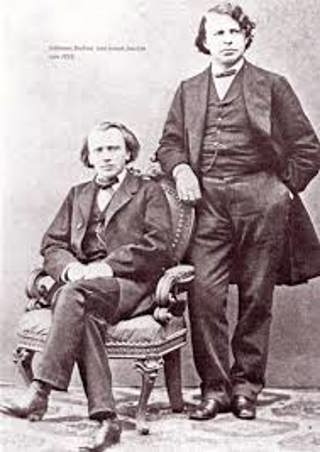
It's entirely possible that we would not know the name of Johannes Brahms very well if Brahms hadn't met Joseph Joachim as a very young man. Joachim, who was one of the greatest violinists of all time...

15 Mai 202558min

Populært innen Underholdning

papaya
harm-og-hegseth
tore-og-haralds-podkast
enkel-servering
storefri-med-mikkel-og-herman
big-5-med-nils-og-harald-2
konspirasjonspodden
topp-3-med-wold-og-fladseth
tusvik-tnne
ma-pa-behandling-med-morten-ramm
hovla
folk-flest-med-linn-og-nils
kjendiscrush-med-sofie-karlstad
nare-venner
vitnemal
gi-meg-alle-detaljene
rss-gammal-maiden
feedback-med-egon-holstad
christine-dancke
rss-backstage-historier-om-legender