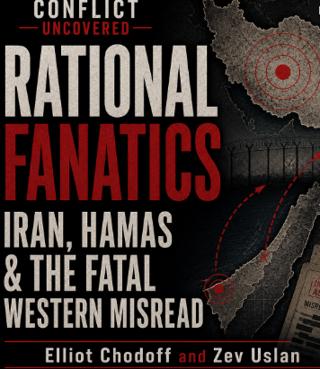
Ep 61- August 4, 2026: Rational Fanatics: Iran, Hamas, and the Fatal Western Misread

Ep 61- August 4, 2026: Rational Fanatics: Iran, Hamas, and the Fatal Western Misread

Episode Description

In this episode of Conflict Uncovered, Elliot Chodoff and Zev Uslan take a detour from The Long Road to October 7 to examine a deeper strategic problem linking Iran, Hamas, Hezbollah, Al Qaeda, and other ideological enemies: the Western failure to understand how fanaticism and rationality can exist at the same time.

The conversation begins with U.S. pressure on Iran and the limits of coercive diplomacy. Elliot argues that recent American attacks and threats failed to move Iran because Washington continues to assume that rational actors will abandon costly policies when the price becomes high enough. But that assumption misses the point. Iran may be rational in how it pursues its goals while holding values and objectives completely opposed to Western interests.

Elliot then connects that same error to Israel’s pre-October 7 policy toward Hamas. For years, Israeli leaders believed that money, work permits, goods, and economic incentives would moderate Hamas. If Hamas accepted Qatari money, allowed workers into Israel, and seemed interested in governing Gaza, then perhaps it had become more pragmatic. That belief spread across the political spectrum, from peace-oriented communities near the Gaza border to Israel’s security establishment and mainstream right-wing leadership.

The episode’s central framework comes from sociologist Max Weber and his distinction between different kinds of rationality. Instrumental rationality is the familiar logic of choosing effective means to reach a goal. Value rationality is the internal logic of a belief system. Elliot argues that Israel and the West mistook Hamas’s instrumental rationality for ideological moderation. Hamas was behaving strategically, but its ultimate objectives had not changed.

That distinction matters. Hamas did not become less dangerous because it became more calculating. It became more dangerous because it learned how to accumulate resources, avoid premature escalation, and build toward a larger objective. Israel saw restraint and interpreted moderation. Hamas saw patience as part of a grand strategy.

The conversation also addresses confirmation bias, wishful thinking, the Israeli desire for quiet, and the painful realization after October 7 that peace-oriented assumptions had not matched the enemy’s actual worldview. Zev presses the psychological question many Westerners struggle with: how can a movement be intelligent, disciplined, and strategic while also committed to murder and death? Elliot answers by pointing to history’s ugliest lesson: education and intellect do not prevent ideological evil. They can make it more effective.

This episode is about one of the most dangerous mistakes in national security: assuming that because an enemy thinks rationally, they must want what we want.

Show Notes

In this episode of Conflict Uncovered, Elliot Chodoff and Zev Uslan explore the failure of Western and Israeli strategic thinking toward Iran and Hamas. The discussion centers on rationality, fanaticism, coercive diplomacy, confirmation bias, and the long-term misreading that helped shape the road to October 7.

Main Themes
  • Why coercive diplomacy often fails against ideological regimes
  • How American pressure against Iran misunderstood the regime’s logic
  • Why rational behavior does not mean moderate goals
  • How Israel misread Hamas before October 7
  • The belief that money, work permits, and goods would moderate Hamas
  • The role of Qatari money and economic incentives in Israeli assumptions
  • Why many Israelis accepted the illusion of quiet
  • Max Weber’s distinction between instrumental rationality and value rationality
  • How Hamas used restraint as part of a long-term strategy
  • Why confirmation bias reinforced Israel’s mistaken reading of Hamas
  • The danger of assuming enemies want stability, prosperity, or peace on Western terms
  • Why intelligence, education, and sophistication do not prevent ideological evil
In This Episode

Elliot opens by linking current U.S.-Iran tensions to the larger road to October 7. He argues that American coercive diplomacy toward Iran has failed because it assumes Iran will respond to costs and pressure in the way Western policymakers expect. The problem is not that Iran is irrational. The problem is that Iran’s objectives are not Western objectives.

The conversation then shifts to Israel’s pre-October 7 policy toward Hamas. For years, Israeli strategy rested on the belief that economic incentives could produce moderation. Money entered Gaza. Work permits were issued. Goods and provisions flowed. Hamas appeared to accept the benefits of governance and stability. Israeli leaders interpreted that behavior as evidence that Hamas had become more pragmatic.

Elliot argues that this was a fundamental mistake. Hamas was rational, but not moderate. It was rationally building power for future use.

To explain the distinction, Elliot introduces Max Weber’s framework of rationality. Instrumental rationality is the logic of choosing effective means to reach an objective. Value rationality is the internal logic of a worldview or belief system. A radical movement can be instrumentally rational while pursuing goals that are morally horrifying and completely opposed to Western values.

This matters because Israel mistook Hamas’s instrumental rationality for a change in values. Hamas accepted money and avoided certain escalations not because it had abandoned its ideology, but because it was accumulating assets, tunnels, weapons, training, and operational capacity for a larger future attack.

The episode also examines how Israeli society broadly wanted to believe the policy was working. Israelis wanted quiet. Border communities wanted coexistence. Netanyahu and the security establishment wanted containment. Periodic clashes were interpreted as manageable rounds of violence rather than warning signs. When Hamas held back and Islamic Jihad fired more of the rockets, Israel saw proof of Hamas moderation. Elliot argues that Hamas played that perception brilliantly.

Zev pushes the emotional and psychological side of the issue: Westerners struggle to accept that people can be educated, intelligent, strategic, and still committed to mass murder. Elliot responds with examples from Nazi Germany, including the Einsatzgruppen commanders and Joseph Goebbels, to show that intellect and education do not neutralize fanaticism. In some cases, they make it more efficient.

The episode closes with the broader warning: the West repeatedly confuses intelligence with moderation, rationality with shared values, and quiet with security.

Key Questions
  • Why did U.S. pressure fail to change Iran’s behavior?
  • Does refusing to respond to Western incentives mean Iran is irrational?
  • How did Israel come to believe Hamas was becoming a responsible governing body?
  • Why did Qatari money, work permits, and economic relief reinforce Israeli assumptions?
  • What is the difference between instrumental rationality and value rationality?
  • How can a fanatical movement act strategically without becoming moderate?
  • Did Hamas become more conservative because it was peaceful, or because it was protecting assets for a future attack?
  • How did confirmation bias shape Israeli policy before October 7?
  • Why is “quiet will be met with quiet” strategically dangerous?
  • Why do Westerners struggle to accept that educated people can commit ideological evil?

Denne episoden er hentet fra en åpen RSS-feed og er ikke publisert av Podme. Den kan derfor inneholde annonser.

Episoder(60)

Ep 60: July 14, 2026: Iran, Escalation, and the Logic of Middle Eastern Power

Ep 60: July 14, 2026: Iran, Escalation, and the Logic of Middle Eastern Power

Iran, Escalation, and the Logic of Middle Eastern Power Episode Description In this episode of Conflict Uncovered, Elliot Chodoff and Zev Uslan examine Iran’s latest escalation in the Strait of Hormuz...

14 Jul 35min

EP 59: July 2, 2026: Iran, Israel, and the Dangerous Middle of a Crisis

EP 59: July 2, 2026: Iran, Israel, and the Dangerous Middle of a Crisis

Iran, Israel, and the Dangerous Middle of a Crisis Episode Description In this episode of Conflict Uncovered, Elliot Chodoff and Zev Uslan examine the unstable middle ground between war, negotiation, ...

2 Jul 37min
Ep 58: June 18th, 2026: Why Western Negotiators Misread Iran

Ep 58: June 18th, 2026: Why Western Negotiators Misread Iran

Episode Description In this episode of Conflict Uncovered, Elliot Chodoff examines the strategic and ideological problems at the heart of negotiations with Iran. The discussion focuses on a recurring ...

18 Jun 32min
Ep 57: June 9, 2026 The Long Road to Oct 7 Part 7

Ep 57: June 9, 2026 The Long Road to Oct 7 Part 7

The Long Road to Oct 7, Part 7 Gaza, Disengagement, and the Limits of Defensive Thinking Episode Description In Part 7 of The Long Road to Oct 7, Elliot Chodoff and Zev Uslan continue tracing the stra...

9 Jun 33min
Ep 56: June 7, 2026 The Long Road to Oct 7 Part 6

Ep 56: June 7, 2026 The Long Road to Oct 7 Part 6

In this episode of Conflict Uncovered, Elliot Chodoff and Zev Uslan continue their series on the long road to October 7 by looking at the period from Israel’s Lebanon withdrawal through the Second Int...

7 Jun 30min
Ep 55: May 15, 2026: The Long Road to October 7 Part 5

Ep 55: May 15, 2026: The Long Road to October 7 Part 5

The Long Road to Oct 7, Part 5 Technology, Mass, and the Limits of the “Small Smart Army” Episode Description In Part 5 of The Long Road to Oct 7, Elliot Chodoff and Zev Uslan examine one of the centr...

18 Mai 34min
Ep 54: May 8th 2026: The Long Road to October 7 Part 4

Ep 54: May 8th 2026: The Long Road to October 7 Part 4

The Long Road to October 7, Part 4 Systemic Failure, Strategic Complacency, and the Illusion of Readiness Episode Description In Part 4 of The Long Road to October 7, Elliot Chodoff and Zev Uslan cont...

8 Mai 32min

Populært innen Politikk og nyheter

giver-og-gjengen-vg
aftenpodden
bt-dokumentar-2
aftenpodden-usa
forklart
stopp-verden
fotballpodden-2
popradet
nokon-ma-ga
det-store-bildet
rss-espen-lee-usensurert
hanna-de-heldige
rss-gukild-johaug
dine-penger-pengeradet
rss-ness
aftenbla-bla
unitedno
saken
frokostshowet-pa-p5
lydartikler-fra-aftenposten