Episode #003 - Carl Jung and the Shadow: The Parts of You That You Don't Claim

Episode #003 - Carl Jung and the Shadow: The Parts of You That You Don't Claim

Think about the person who irritates you most — not someone who has wronged you, but the one whose very presence gets under your skin in a way you can't quite explain. Carl Jung had a theory about that feeling. And it points directly back at you.

In this episode, Shawn and Claire Spainhour unpack one of Jung's most durable and personally confronting ideas: the shadow. Not the pop-psychology version — the real one. The shadow is the unconscious part of the personality that the ego refuses to claim: the anger you were told was unacceptable, the ambition you learned to hide, the spontaneity you traded away to become reliable. It doesn't disappear when you disown it. It accumulates. And eventually, it shows up in your relationships, your reactions, and the patterns you can't seem to break no matter how hard you try.

This episode covers how the shadow forms in childhood; why the qualities that irritate us most in others are often a map of our own interior; what Jung actually meant by "shadow integration" (it's not what social media says it is), and why the shadow contains not just darkness but unlived potential—the capacities and gifts you set aside to become who you are.

Jung said the shadow is ninety percent pure gold. This episode is about how to find it.

25 minutes. No prior knowledge of Jung required.

SHOW NOTES

Primary Sources

  • Jung, C. G. (1959). Aion: Researches into the Phenomenology of the Self (R. F. C. Hull, Trans.). Princeton University Press. (Collected Works Vol. 9ii)
  • Jung, C. G. (1968). The Archetypes and the Collective Unconscious (R. F. C. Hull, Trans.). Princeton University Press. (Collected Works Vol. 9i)
  • Jung, C. G. (1963). Memories, Dreams, Reflections (A. Jaffé, Ed.; R. & C. Winston, Trans.). Pantheon Books. (The most accessible entry point into Jung's own voice — part memoir, part psychology.)

Biographical & Contextual

  • Bair, D. (2003). Jung: A Biography. Little, Brown.
  • Hayman, R. (1999). A Life of Jung. Norton.

Works Referenced in This Episode

  • Johnson, R. A. (1991). Owning Your Own Shadow. HarperOne. (Short, practical, highly recommended as a follow-up to this episode.)
  • Zweig, C., & Abrams, J. (Eds.). (1991). Meeting the Shadow. Tarcher.
  • Von Franz, M.-L. (1995). Shadow and Evil in Fairy Tales (rev. ed.). Shambhala.

Accessible Starting Points

  • Storr, A. (1983). The Essential Jung. Princeton University Press.
  • Sharp, D. (1991). Jung Lexicon: A Primer of Terms and Concepts. Inner City Books.

New episodes every Sunday. Philosophy for Lunch · Big ideas. Human conversations.

Denne episoden er hentet fra en åpen RSS-feed og er ikke publisert av Podme. Den kan derfor inneholde annonser.

Episoder(20)

Episode #020 - Was Mathematics Invented or Discovered?

Episode #020 - Was Mathematics Invented or Discovered?

Here is a question that sounds like it should have an obvious answer. Was mathematics invented or discovered? Did humans create the number two the way we created the word for it? Or did the number two...

24 Aug 40min
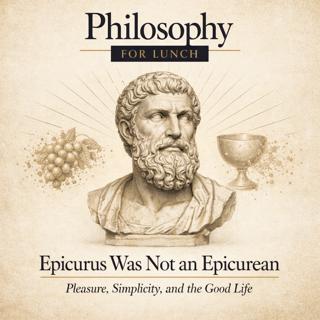
Episode #019 - Epicurus Was Not an Epicurean

Episode #019 - Epicurus Was Not an Epicurean

If someone described a philosophy whose central teachings were: live simply, eat bread and water, cultivate close friendships, manage your desires so they never exceed what is easily available, and sp...

17 Aug 18min
Episode #018 - Probability and Judgment: Why We Get Risk Wrong

Episode #018 - Probability and Judgment: Why We Get Risk Wrong

Here is a medical test scenario. A disease affects one in a thousand people. There is a test that is ninety-nine percent accurate. You take the test. It comes back positive. What is the probability th...

10 Aug 31min

Episode #017 - The Paradox of Tolerance: Can a Free Society Tolerate Intolerance?

Episode #017 - The Paradox of Tolerance: Can a Free Society Tolerate Intolerance?

Karl Popper wrote one of the most widely shared philosophical texts on the internet. It is also one of the most consistently misread.The argument is simple on its surface: a society that tolerates int...

3 Aug 31min

Episode #016 - Nietzsche: God Is Dead — Now What?

Episode #016 - Nietzsche: God Is Dead — Now What?

Nietzsche is probably the most misread philosopher in the Western tradition. He has been claimed by Nazis, nihilists, self-help gurus, and people who have read a sentence or two and decided they under...

27 Jul 31min

Episode #015 - William James and the Will to Believe

Episode #015 - William James and the Will to Believe

Imagine you are standing at the edge of a chasm. You need to get to the other side. The leap is possible — just barely — but you cannot know in advance whether you will make it. Does believing you can...

20 Jul 29min

Episode #014 - Viktor Frankl and the Meaning Made from Suffering

Episode #014 - Viktor Frankl and the Meaning Made from Suffering

There is a question that arrives most forcefully when circumstances are at their worst. Not why is this happening in the causal sense, but the question underneath that one: what does this mean? Is the...

13 Jul 30min

Episode #013 - What Does It Mean to Live Philosophically?

Episode #013 - What Does It Mean to Live Philosophically?

Socrates said the unexamined life is not worth living. That sentence is probably the most quoted in the history of philosophy. But the popular interpretation — that you should think more and be more s...

6 Jul 30min

Populært innen Samfunn

rss-spartsklubben
giver-og-gjengen-vg
aftenpodden
konspirasjonspodden
popradet
rss-nesten-hele-uka-med-lepperod
aftenpodden-usa
rss-henlagt-andy-larsgaard
lydartikler-fra-aftenposten
wolfgang-wee-uncut
rss-espen-lee-usensurert
min-barneoppdragelse
grenselos
fladseth
rss-dette-ma-aldri-skje-igjen
alt-fortalt
synnve-og-vanessa
krisemoter
frokostshowet-pa-p5
relasjonspodden-med-dora-thorhallsdottir-kjersti-idem