Rhetoric Is Not a Dirty Word: How an Ancient Art Can Help You Think for Yourself in a Polarized World

Rhetoric Is Not a Dirty Word: How an Ancient Art Can Help You Think for Yourself in a Polarized World

The discipline of rhetoric was the keystone of Western education for over two thousand years. We stopped teaching it. And it shows.

When most people hear the word "rhetoric" today, they use it as a synonym for manipulation; empty political speech, dishonest framing, words designed to obscure rather than illuminate. And in dismissing it that way, we've lost access to the most powerful intellectual tool we ever had for protecting ourselves from exactly that.

In this episode of Good Is In The Details, Gwendolyn Dolske and Rudy Salo sit down with Dr. Robin Reames, associate professor of English at the University of Illinois Chicago, specializing in rhetorical theory and the history of ideas, and author of The Ancient Art of Thinking For Yourself: The Power of Rhetoric in Polarized Times, named a New York Times Editors' Choice, recommended by the Wall Street Journal, and described by Kirkus as "required reading for any thinking person" in a starred review.

Dr. Reames's central argument is as urgent as it is counterintuitive: rhetoric doesn't teach us what to think. It teaches us how to think, allowing us to understand our own ideological commitments, and those of others, in a way that nothing else can. In a world of misinformation, conspiracy theories, and political acrimony, that is not an academic luxury. It is a survival skill.

What we explore in this episode:

  • What rhetoric actually is — and why the field that was the foundation of Western education for millennia became a word we use to mean "lies"
  • How the ancient Greek Sophists exploited language to manipulate public opinion in Athenian democracy — and why those exact techniques are being used against us right now
  • The problem of bias and self-protection: why we do everything in our power to shield our existing beliefs from challenge — and what that costs us individually and collectively
  • Aristotle's three modes of persuasion — ethos, pathos, and logos — and how recognizing them in the wild changes the way you receive every argument, speech, and news story you encounter
  • How rhetoric connects to the history of democracy — what happened to Athens when it lost its rhetorical tradition, and what that parallel means for us
  • The difference between rhetoric as manipulation and rhetoric as a tool of genuine understanding — and why that distinction is the whole ballgame
  • What it actually means to think for yourself — not just to hold opinions independently, but to understand where your beliefs come from and how they were constructed
  • How Dr. Reames used her understanding of rhetoric to try to bridge the political divide with her own conservative father — and what she learned from the attempt
  • What the Socratic method has to do with all of this — and why Gwendolyn Dolske, Ph.D. found this episode among the most personally revelatory she's recorded

Learning rhetoric, Dr. Reames argues, is about becoming a clearer thinker, one who can see how language is shaping their beliefs before it has already done so.

This is the episode for anyone who has ever lost a friendship over politics, consumed a news story and felt something was off but couldn't name it, or wondered how an entire country can look at the same facts and come to opposite conclusions.

The ancient Greeks had the same problem. And they found an answer.

Guest: Dr. Robin Reames — associate professor of English, University of Illinois Chicago. Author of The Ancient Art of Thinking For Yourself: The Power of Rhetoric in Polarized Times (Basic Books). New York Times Editors' Choice. Wall Street Journal recommendation. Kirkus starred review.

Learn more about Professor Reames and get her book: https://www.hachettebookgroup.com/contributor/robin-reames/?lens=basic-books

Get your Factor meals using offer code Details50: Factormeals.com/details50

Be part of our community where we continue philosophy discussions, have a book club, and share behind-the-scenes moments on Patreon: https://www.patreon.com/GoodIsInTheDetails

Thank you to our sponsor: http://www.avonmoreinc.com

Get in touch: https://www.goodisinthedetails.com

Denne episoden er hentet fra en åpen RSS-feed og er ikke publisert av Podme. Den kan derfor inneholde annonser.

Episoder(203)

Why Women Chose the Bear (and What It Reveals About Everyday Safety)

Why Women Chose the Bear (and What It Reveals About Everyday Safety)

A year ago, a simple question took over TikTok: if you were alone in the forest, would you rather encounter a bear or a man? Women overwhelmingly chose the bear. Some found it funny, some found it off...

15 Okt 46min
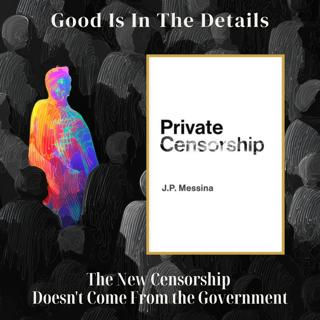
What is Censorship: What Isn't and Why Self Censorship May Sometimes Be A Good Thing

What is Censorship: What Isn't and Why Self Censorship May Sometimes Be A Good Thing

The First Amendment protects you from the government, not from your boss, your university, or a social media platform. J.P. Messina, philosophy professor at Purdue and author of Private Censorship (Ox...

30 Sep 48min
How To See The World Through Your Child's Eyes

How To See The World Through Your Child's Eyes

How do we build stronger relationships with our children, especially when we're tired, overwhelmed, or simply seeing a situation through adult eyes? In this special Podapalooza mini-episode, Gwendolyn...

15 Sep 21min
To Chill or Not To Chill: When Does Perseverance Become Toxic?

To Chill or Not To Chill: When Does Perseverance Become Toxic?

We're taught that perseverance is always a virtue, but what if the very trait we celebrate is quietly costing us our sense of meaning? Michael Scarano, a healthcare veteran turned speaker and coach, j...

1 Sep 50min
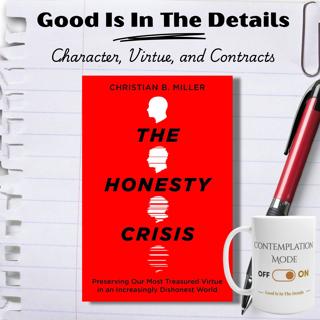
Honest, True, or Authentic? (They're Not the Same Thing)

Honest, True, or Authentic? (They're Not the Same Thing)

Honesty might be the character trait we claim to value most, but what does it actually mean to be honest, and how is that different from simply telling the truth, or "being authentic"? Philosopher Chr...

19 Aug 48min
Cults, Conspiracy Theories & Critical Thinking: The History America Didn't Teach You

Cults, Conspiracy Theories & Critical Thinking: The History America Didn't Teach You

What if the United States was never immune to cult thinking, but was built on it? Journalist Jane Borden joins Gwendolyn and Rudy to unpack her book Cults Like Us: Why Doomsday Thinking Drives America...

31 Jul 41min

Are You Living in an Echo Chamber? The Psychology of Misinformation & Critical Thinking | Matthew Facciani

Are You Living in an Echo Chamber? The Psychology of Misinformation & Critical Thinking | Matthew Facciani

How do echo chambers influence our beliefs? How do you know what is true on the internet? Why does misinformation spread so quickly online? What is an echo chamber, and how does confirmation bias infl...

16 Jul 50min

Rewind, Play, Repeat: Nicole Morrison on Music, Memory, Coming Out, and Memoir

Rewind, Play, Repeat: Nicole Morrison on Music, Memory, Coming Out, and Memoir

The mixtape structural metaphor ushers in a philosophical lens. Because a mixtape (as every Gen X person who ever made one knows) is a curated act of autobiography. It's how you tell someone the truth...

1 Jul 40min

Populært innen Fakta

fastlegen
dine-penger-pengeradet
fryktlos
rss-kunsten-a-leve
relasjonspodden-med-dora-thorhallsdottir-kjersti-idem
rss-strid
rss-bisarr-historie
treningspodden
foreldreradet
jakt-og-fiskepodden
sinnsyn
hverdagspsyken
rss-orjasater
takk-og-lov-med-anine-kierulf
rss-kull
mikkels-paskenotter
lederskap-nhhs-podkast-om-ledelse
gravid-uke-for-uke
hr-podden-2
dopet