
Are We Living Through the Great Innovation Decline? (E216)

Are We Living Through the Great Innovation Decline? (E216)

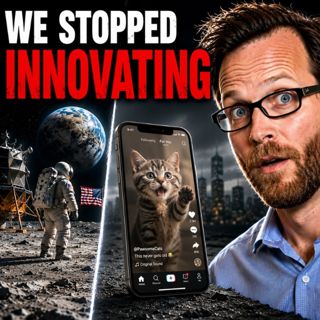
Professor Olof Hallonsten argues that society has never talked more about innovation and entrepreneurship, yet bureaucracy, short-term thinking, risk aversion, and startup mythology may actually be making real innovation harder to achieve.

Guest bio

Olof Hallonsten is Professor of Socioeconomic Technology Studies at Lund University in Sweden and an expert on science, innovation, and research policy. He spent roughly 10–15 years studying innovation and research policy and has consulted for both the European Commission and the Swedish government. He is the author of Empty Innovation: Causes and Consequences of Society’s Obsession with Entrepreneurship and Growth, which challenges modern assumptions about innovation, entrepreneurship, and economic growth.

Topics discussed
  • “Empty innovation” vs. real innovation — why talking, spending, branding, and measuring innovation aren't the same as producing meaningful progress.
  • The rise of managerialism and bureaucracy — how bureaucracy shifted from supporting scientists to increasingly controlling and measuring them.
  • Risk aversion — why modern societies may have become more concerned with preventing technological risks than enabling experimentation.
  • “Economization” — the growing tendency to evaluate education, science, health, and other areas primarily through economic returns.
  • Short-term thinking vs. long-term discovery — major breakthroughs can take decades before their true value becomes apparent; the transistor is a central example.
  • Declining entrepreneurship — whether entrepreneurship has become less attractive and less economically important despite being celebrated culturally.
  • The myth of the entrepreneur — society focuses on Steve Jobs and Mark Zuckerberg even though typical entrepreneurship is far more mundane and financially risky.
  • “Entrepreneurship theater” — people learning to look and talk like entrepreneurs rather than actually building useful things.
  • Problems with modern academia — grant chasing, peer review, publication metrics, career incentives, and administrative bureaucracy.
  • AI hype — why we may simultaneously overestimate AI's short-term impact and underestimate its eventual long-term consequences.
  • Not all innovation is good — technological progress can also produce nuclear weapons, destructive technologies, or potentially socially harmful automation.
  • Government moonshots — why clearly defined goals such as an atomic bomb or COVID vaccine differ from sprawling challenges like climate change.
  • How to restore real innovation — greater academic freedom, less formulaic evaluation, fewer grant-writing burdens, and more room for scientists to pursue uncertain long-term research.
Main points

Main point

What Hallonsten argues

1. Innovation has become a buzzword

Governments, universities and companies spend enormous amounts promoting “innovation,” but rhetoric shouldn't be confused with actual progress.

2. Real innovation is messy

Genuine breakthroughs are uncertain, collaborative and often take decades to reveal their importance.

3. Bureaucracy isn't inherently bad

Bureaucracy can enable discovery when it serves scientists; problems arise when administrators begin directing and controlling creative work.

4. Short-term metrics undermine discovery

Demanding measurable impact today encourages researchers to promise immediate results rather than pursue uncertain discoveries whose value might emerge decades later.

5. Today's technology rests on old breakthroughs

Much of the digital revolution ultimately rests on foundational technologies such as the transistor developed many decades ago.

6. Entrepreneurship has been romanticized

The typical entrepreneur isn't Steve Jobs; most businesses are ordinary, difficult, risky ventures that don't produce extraordinary wealth.

7. We increasingly perform entrepreneurship

Pitch competitions, branding, buzzwords and startup culture can reward people for appearing entrepreneurial rather than creating something genuinely valuable.

8. Politicians may promote innovation because they don't know how to create it

Leaders know technological progress is necessary but cannot reliably manufacture breakthroughs, so visible innovation programs can substitute for actual results.

9. AI's biggest effects are unknowable today

Major technologies often produce consequences their inventors never anticipated; judging AI's ultimate significance now is premature.

10. Give scientists more freedom

Reduce short-term evaluations and grant bureaucracy and give researchers greater independence to pursue work whose payoff cannot be predicted.

Overall takeaway

We may have built an enormous system designed to produce, measure and advertise innovation that increasingly interferes with the unpredictable, long-term creative process through which genuine breakthroughs actually occur.

Top 3 quotes

1. On entrepreneurship culture:

“We are selling a lie to them.”

Hallonsten argues that presenting exceptional figures like Zuckerberg or Jobs as representative entrepreneurs gives young people a deeply distorted picture of entrepreneurship.

2. On what we should tell real innovators:

“Keep up the good work, we depend on you.”

His ultimate message is pro-innovation rather than anti-technology: society genuinely needs innovators, but needs to stop confusing innovation theater with their work.

3. On why innovation is difficult to measure:

“What is going on right now that is comparable to the invention of a transistor? We don't know.”

The most important discoveries may not look revolutionary when they occur, making demands for immediate measurable impact fundamentally misguided.

Misc. podcast info

Guest: Olof Hallonsten
Institution: Lund University, Sweden
Field: Socioeconomic Technology Studies / science, innovation and research policy
Primary book: Empty Innovation: Causes and Consequences of Society’s Obsession with Entrepreneurship and Growth
Book availability: Hallonsten says Empty Innovation is available open access.
Approx. episode length: ~1 hour 13+ minutes
Other works/books discussed: Not Even Trying: The Corruption of Real Science, The Entrepreneurial State, the Moonshots book in which Hallonsten contributed a chapter, and ideas associated with Thorstein Veblen and Ulrich Beck.

🎙 The Pod is hosted by Jesse Wright
💬 For guest suggestions, questions, or media inquiries, reach out at https://elpodcast.media/
📬 Never miss an episode – subscribe and follow wherever you get your podcasts.
⭐️ If you enjoyed this episode, please rate and review the show. It helps others find us.

Thanks for listening!

Denne episoden er hentet fra en åpen RSS-feed og er ikke publisert av Podme. Den kan derfor inneholde annonser.

Episoder(215)

The Rise & Fall of the Hot Girl Service Economy (E215)

The Rise & Fall of the Hot Girl Service Economy (E215)

Swedish demographer and political candidate David Lorentzon explains his controversial theory of the “Hot Girl Service Economy”—how social media, global travel, gender-segregated careers and migration...

25 Aug 1h 54min

What Europeans Get Wrong About America (E214)

What Europeans Get Wrong About America (E214)

A German travel YouTuber shares how visiting America challenged nearly every stereotype she had about the United States—from friendliness and safety to healthcare, food, and quality of life—while comp...

18 Aug 1h 18min

What Happened to Australia? A Warning for the Entire West (E213)

What Happened to Australia? A Warning for the Entire West (E213)

Australian law professor Dr. Augusto Zimmermann argues that Western civilization is in rapid decline due to the erosion of free speech, the rule of law, mass migration, and the growing power of politi...

11 Aug 1h 20min

The Biggest Lies About American History (E212)

The Biggest Lies About American History (E212)

Professor Jeff Fynn-Paul argues that many popular narratives about European colonialism are historically inaccurate, tracing their origins to ideological reinterpretations of history rather than the h...

4 Aug 1h 9min

Everything You Know About Sleep Is Wrong (E211)

Everything You Know About Sleep Is Wrong (E211)

Humans aren't suffering from a sleep epidemic—we're suffering from a circadian rhythm epidemic, and understanding the difference could transform how we think about sleep, health, and human evolution. ...

21 Jul 1h 9min

I Asked a Mexico Real Estate Expert About Retiring in Mexico (E210)

I Asked a Mexico Real Estate Expert About Retiring in Mexico (E210)

Guest Bio Greg Gunter is the Founder and Broker/Owner of Berkshire Hathaway HomeServices Mexico. A 17-year resident of San Miguel de Allende, he specializes in helping Americans and Canadians relocate...

15 Jul 1h

Britain's Collapse Is Happening Faster Than You Think (E209)

Britain's Collapse Is Happening Faster Than You Think (E209)

Dr. Ben Jones explains how mass migration, multiculturalism, and declining free speech are reshaping Britain—and why he believes the country's future is at a turning point. Guest Bio Dr. Ben Jones is...

7 Jul 59min

Populært innen Business og økonomi

stopp-verden
lydartikler-fra-aftenposten
dine-penger-pengeradet
e24-podden
rss-borsmorgen-okonominyhetene
rss-penger-polser-og-politikk
rss-skravla-gar
pengepodden-2
utbytte
rss-pa-konto
livet-pa-veien-med-jan-erik-larssen
rss-orjasater
lederpodden
tid-er-penger-en-podcast-med-peter-warren
finansredaksjonen
stormkast-med-valebrokk-stordalen
liberal-halvtime
pengesnakk
morgenkaffen-med-finansavisen
okonomiamatorene