
Rhode Island & North Dakota: Who Killed the King?

Rhode Island & North Dakota: Who Killed the King?

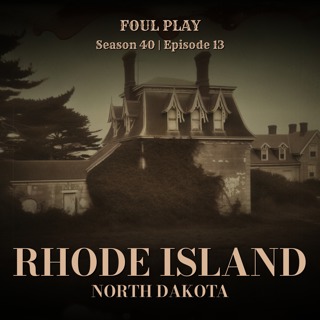
Season 40: America's 250th Anniversary -- 50 states, 25 double-feature episodes. This is Episode 13, covering

Rhode Island and North Dakota with two true crime cases from the 1880s and 1890s that circle the same

question: who do you believe when the dead cannot speak?

October 1885. A wealthy Black businessman in Newport, Rhode Island, is found dead at his kitchen table -- two

gunshot wounds, unchewed bread still in his mouth. The city calls it suicide before the day is over. Eight years

later, a hired hand in North Dakota murders six members of the family that trusted him, and a fifteen-year-old

girl walks barefoot to town to report it.

Both killers were inside the circle. Both were trusted. Both destroyed the people who let them in. This episode

examines what trust costs in a country still deciding which lives deserve investigation and which can be dismissed

with a shrug from the mayor's office.

The Victims

Benjamin J. Burton was the wealthiest Black businessman in Rhode Island when he was killed in October 1885.

He had arrived in Newport around 1845 from Connecticut and spent four decades building a baggage transfer

empire -- the Original Express and the Bellevue Avenue Express Line -- moving trunks between the wharves

and the Gilded Age mansions. Burton was a civil rights organizer who helped desegregate Rhode Island's public

schools in 1866, working alongside Isaac Rice and George T. Downing. He was fifty-nine years old. He had been

eating breakfast when he was shot.

Daniel and Barbara Kreider were a Mennonite farming family who had relocated from Lancaster County, Penn-

sylvania, to a homestead southeast of Cando, North Dakota. Daniel was born in 1856; Barbara came from one

of Lancaster County's most established Mennonite families -- the Rissers, whose meeting house had been in

continuous operation since the 1700s. By summer 1893, they had eight children. Four of those children -- Bernice,

thirteen; Murbey, eleven; Mary, nine; and David, seven -- were killed alongside their parents on the morning of

July 7, 1893.

The Crimes

In Newport, Burton's son-in-law Allen Dorsey -- a medical student at the University of Pennsylvania, one year from

finishing his degree -- shot Burton at 63 Levin Street on October 6, 1885. The wound sequence was medically

damning: a shot to the head first, a shot to the heart second. No powder burns. Unchewed bread in the victim's

mouth. The city ruled it suicide anyway. The coroner signed off. The mayor ridiculed the idea of murder.

In North Dakota, Albert Bomberger -- a twenty-two-year-old hired hand who had lived with the Kreider family for

five years -- killed six family members with a shotgun in thirty minutes after the eldest daughter, Annie, rejected

his advances and her father told him to leave. After the killings, Bomberger forced fifteen-year-old Annie to cook

his breakfast while the bodies lay in the rooms around her. He ate, ransacked the house, beat Annie with a rope,

and fled toward Canada on a stolen pony.

The Investigation

In the Burton case, Newport's official investigation went nowhere. The community Burton had spent forty years

building ran a parallel investigation through church and civic networks. Seven weeks later, Burton's younger

daughter Emmie came forward and named Allen Dorsey as the killer and Maria Dorsey as complicit. Her testimony

made prosecution possible. The trial began in late June 1886. Allen and Maria Dorsey were convicted and

sentenced to life. Emmie was also convicted -- she had served as lookout -- and died of consumption in the prison

infirmary within six months. In June 1887, the Burton case was presented to the American Medical Association

at their 38th Annual Meeting as an example of physical evidence clearly indicating murder that official authority

chose to read otherwise.

Annie Kreider walked to Cando barefoot. No shoes, no horse, no telephone. Her testimony was the entire

foundation of the prosecution. Bomberger was captured at Deloraine, Manitoba, three days later. The threat of

lynching was immediate -- the Grand Forks County sheriff moved Bomberger to a more secure jail. On November

21, 1893, Bomberger was arraigned. Two days later, he was sentenced to death. The entire court proceeding

lasted fifteen minutes. He was hanged on January 19, 1894 -- the first legal execution in North Dakota history.

Historical Context

These two historical murder cases sit at the edges of American justice in the Gilded Age. In Rhode Island, the

system initially failed a Black man whose physical evidence was dismissed by the same city he had served for

decades. In North Dakota, a state just four years old produced a fifteen-minute guilty plea and a death sentence

in two days -- justice delivered under the shadow of a lynch mob. Allen Dorsey was pardoned in 1912, moved to

New York City, worked as a waiter, and died in 1918. Annie Kreider lived until 1960, carrying that July morning for

sixty-seven years.


Our Sponsors:
* Check out Kensington Publishing: https://www.kensingtonbooks.com


Advertising Inquiries: https://redcircle.com/brands

Privacy & Opt-Out: https://redcircle.com/privacy

Denne episoden er hentet fra en åpen RSS-feed og er ikke publisert av Podme. Den kan derfor inneholde annonser.

Episoder(322)

Hawaii and Louisiana: The Plantation's Shadow, 1887-1889

Hawaii and Louisiana: The Plantation's Shadow, 1887-1889

This episode is part of Season 40: America's 250th Anniversary -- 50 states, 25 double-feature episodesexploring the cases that shaped American history from every corner of the country.Hawaii, 1889. A...

15 Sep 35min
Wyoming and New York: Children in the Dock, 1892

Wyoming and New York: Children in the Dock, 1892

Season 40: America's 250th Anniversary — fifty true crime stories from fifty states. Wyoming, 1892. A fiftee-n-year-old orphan train rider murders two young men in a boxcar and becomes the first perso...

8 Sep 34min
New Mexico & Illinois: Two Political Murders, No Justice

New Mexico & Illinois: Two Political Murders, No Justice

Season 40: America's 250th Anniversary. Fifty states. Fifty crimes. Two hundred and fifty years of Americanhistory, told through the true crime cases that other shows leave behind.New Mexico, 1892. A ...

1 Sep 35min

The Keepers, Where Are They Now

The Keepers, Where Are They Now

Shane Waters and Gemma Hoskins close out their reunion by going down the list of the people who appeared in the Netflix documentary The Keepers, where they are today, who is still fighting, who has fo...

17 Jun 46min

The Suspects and the Silence

The Suspects and the Silence

Shane Waters and Gemma Hoskins continue their first sit-down in over a year, working through the second half of the questions listeners submitted through the show's Facebook community. This is the fol...

11 Jun 50min
California & Alabama: When the Mob Decided to Be the Law

California & Alabama: When the Mob Decided to Be the Law

This episode contains descriptions of murder, mob violence, historical racial violence, and the execution of a convicted killer. If you need to skip this content, advance past the 18:00 mark. Support ...

2 Jun 36min
New Hampshire & Colorado: Two Forgotten Murders, 1886-1897

New Hampshire & Colorado: Two Forgotten Murders, 1886-1897

This episode contains discussions of murder, execution, racial violence, and a botched public hanging. If you need to skip any section, the chapter markers below will help you find your way around. Su...

26 Mai 40min

Populært innen Samfunn

rss-spartsklubben
giver-og-gjengen-vg
aftenpodden
konspirasjonspodden
popradet
aftenpodden-usa
rss-nesten-hele-uka-med-lepperod
rss-henlagt-andy-larsgaard
min-barneoppdragelse
wolfgang-wee-uncut
rss-espen-lee-usensurert
grenselos
bokmerket-2
synnve-og-vanessa
alt-fortalt
fladseth
rss-dette-ma-aldri-skje-igjen
frokostshowet-pa-p5
krisemoter
opptur-med-annette-og-ingeborg