S9 Ep56: Decoupling from China after Trump's Trade Wars

S9 Ep56: Decoupling from China after Trump's Trade Wars

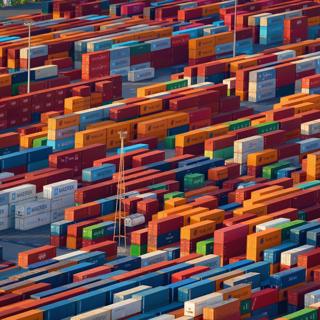
In March 2025, Apple chartered cargo flights to deliver 600 tonnes of iPhones from India to the United States. A year earlier, four in five smartphones that imported to the US came from China.

One of the aims of US trade policy has been to decouple the US economy from China. So is the strategy working? Chad Bown (PIIE, CEPR) tells Tim Phillips how he examined the US import data product by product to see how American importers coped with Trump's second trade war. In consumer electronics, many firms quietly built a second supply chain in tariff-exempt countries before 2025, and switched sourcing away from China almost overnight in 2025. But clothing and footwear did not switch, because alternative source countries like Vietnam faced tariffs almost as high. When the US taxes imports from every country, the decoupling strategy gets lost.

The research behind this episode:

Bown, Chad P. 2026. "How Did Trump's 2025 Trade War Affect the Decoupling of US-China Supply Chains?" CEPR Discussion Paper DP21801 (gated). Forthcoming in Asian Economic Policy Review.

To cite this episode:

Phillips, Tim, and Chad P. Bown. 2026. "Decoupling from China after Trump's Trade Wars." VoxTalks Economics (podcast).

About the guest

Chad P. Bown is the Reginald Jones Senior Fellow at the Peterson Institute for International Economics and a Fellow in the International Trade and Regional Economics programme of the Centre for Economic Policy Research. He was chief economist at the US Department of State from January 2024 to January 2025, and senior economist for international trade and investment on President Obama's Council of Economic Advisers. His research spans trade policy, industrial policy, economic security and supply chains. He co-created the Trade Talks podcast with Soumaya Keynes in 2017, and with Keynes he is co-author of How to Win a Trade War (Simon & Schuster, 2026).

Research cited in this episode

The 2018-19 Section 301 tariffs. In Trump's first term the US imposed tariffs on imports from China in stages, on product lists set under Section 301 of the Trade Act of 1974. Lists 1, 2 and 3, mostly intermediate inputs such as auto parts, ended at 25%. List 4A began at 15% and was cut to 7.5% in February 2020 under the Phase One agreement. List 4B, mostly consumer goods such as smartphones, laptops and toys, was delayed "for Christmas season" and never imposed. By the end of the first trade war, roughly two thirds of US imports from China faced new tariffs. Bown's point is that the goods spared in 2018-19 were the ones hit hardest in 2025.

The 2025 IEEPA tariffs on China. In February and March 2025, before Liberation Day, the US imposed two rounds of 10% tariffs on all imports from China under the International Emergency Economic Powers Act, justified by concerns over fentanyl. For the first time this covered smartphones and other List 4B goods. One of the two was removed in November 2025 after Presidents Trump and Xi met in South Korea.

Liberation Day. On 2 April 2025 the US announced tariffs on most of its trading partners, at rates that varied by country. A long list of products, including smartphones, was exempt under Annex II. On 9 April the country rates were paused and a 10% baseline applied while countries negotiated. China's rates escalated after retaliation on both sides; the Liberation Day actions on China alone reached 125% before a truce in Geneva in May. The exemptions matter to the episode. A tariff on China changes sourcing only if the alternatives face a lower one.

The August 2025 tariffs on India. The US raised tariffs on India by a further 25 percentage points in August 2025, citing India's purchases of Russian oil. Smartphones were again exempt, so Apple's Indian supply chain stayed tariff free. For some clothing, India ended up facing a larger tariff increase than China.

The Supreme Court ruling on IEEPA tariffs. On 20 February 2026 the US Supreme Court ruled that the country-level tariffs imposed under IEEPA were illegal. The Section 232 sectoral tariffs and the Section 301 tariffs on China were not part of the case. The administration removed the IEEPA tariffs and began imposing new ones under other legal authorities, which is why Bown warns that some of the 2025 effects may yet reverse.

Apple's alternative supply chain in India. Apple and its contract manufacturers, including Foxconn and Tata Electronics, spent several years building iPhone assembly in India. Patrick McGee tells the story in Apple in China: The Capture of the World's Greatest Company (Simon & Schuster, 2026). Over the last nine months of 2025, 40% of US smartphone imports came from China and 46% from India. Laptops, monitors and video game consoles moved in a similar way, mostly to Vietnam.

Inputs for AI. The paper defines AI inputs using the product codes that Nvidia publishes for export control compliance: certain semiconductors, printed circuit boards, servers and other data centre hardware. These made up about 14% of US imports in 2025. They grew by $183 billion that year, more than the $144 billion rise in total US goods imports. A separate classification by Michael Waugh (2026) finds a larger share, at 23%.

US tariffs on Chinese electric vehicles. In 2024 the Biden administration raised US tariffs on electric vehicles from China to 100%, using the authority of the 2018 Section 301 action. China exported 40% of the world's electric vehicles in 2024, according to the International Energy Agency, but almost none to the United States.

China's export restrictions on rare earths. In April 2025 China restricted exports of rare earths and permanent magnets, of which it produces about 90% of world supply. Bown did not include these products in the paper, but they are the reverse of the decoupling story. They are goods for which the US found no alternative supplier.

Tariff pass-through to consumer prices. Bown suggests that firms with an alternative supplier may explain why some prices, such as the iPhone's, did not rise. He points to work by Alberto Cavallo, Paola Llamas and Franco Vazquez (2025), "Tracking the Short-Run Price Impact of U.S. Tariffs," NBER Working Paper 34496, which tracks how the 2025 tariffs reached retail prices.

How to Win a Trade War. Soumaya Keynes and Chad P. Bown. 2026. How to Win a Trade War: An Optimistic Guide to an Anxious Global Economy. New York: Simon & Schuster. The authors argue that the conflict with China will not reverse, and that other economies are now dealing with China-related shocks of their own.

More VoxTalks Economics episodes

Making sense of the US-China trade war, in which Bown explained the first trade war in 2021, as it ended. It is the "before" to this episode's "after".

Tariff Confusion, in which Kalina Manova explains how the frequency of tariff announcements in 2025 cut trade by more than the tariffs themselves.

Related reading on VoxEU.org

US-China decoupling: Rhetoric and reality, a VoxEU column showing that after the first trade war US imports from China slowed, but supply chains for strategic products stayed intertwined with China.

What comes next for global supply chains might be complicated, a VoxEU column on why a falling Chinese share of US imports does not mean Chinese firms have left the supply chain.

Tariff confusion, a VoxEU column by Kalina Manova, Dennis Novy, Thomas Sampson and Aaron Tang on how confusion about current US tariffs reduced trade in 2025.

Denne episoden er hentet fra en åpen RSS-feed og er ikke publisert av Podme. Den kan derfor inneholde annonser.

Episoder(483)

S9 Ep55: Loosening inheritance law

S9 Ep55: Loosening inheritance law

In most of the world you do not get to choose who inherits your money. Across continental Europe, Latin America, and countries governed by Islamic law, a minimum share of your estate will be reserved ...

18 Sep 25min

S9 Ep54: Does sacking the manager work?

S9 Ep54: Does sacking the manager work?

Your football team keeps losing. The season is slipping away. One thing can be changed by Friday, and the crowd is already singing about it: sack the manager.Jan van Ours (Erasmus School of Economics,...

11 Sep 18min

S9 Ep53: Lessons from Populism in Latin America

S9 Ep53: Lessons from Populism in Latin America

The new episode of VoxTalks Economics traces the effects of South Americans populism, left and right. Alejandro Werner (Georgetown Americas Institute) is one of the authors of a new paper that traces ...

4 Sep 33min

S9 Ep52: The Dollar Anchor Is Slipping

S9 Ep52: The Dollar Anchor Is Slipping

April 2025: Liberation Day. President Trump announces sweeping new tariffs. And then, the dollar did something a safe haven currency is not supposed to do: it fell.Tarek Hassan (Boston University, CEP...

2 Sep 26min

S9 Ep51: Fiscal Populism and Monetary Policy

S9 Ep51: Fiscal Populism and Monetary Policy

There is a saying in Spanish: get burned by hot milk, and the sight of a cow makes you cry. New research implies that, decades after a populist government leaves office, the central bank it once tried...

28 Aug 16min
S9 Ep50: Tariffs, Uncertainty, and the Exchange Rate

S9 Ep50: Tariffs, Uncertainty, and the Exchange Rate

Textbook economics says a tariff should strengthen a country's currency. Since the start of 2025, as US tariffs rose ... and the dollar fell.In the first of four episodes of Voxtalks based on papers p...

26 Aug 24min

S9 Ep49: Combatting sexual harassment in the military

S9 Ep49: Combatting sexual harassment in the military

Norwegian conscripts arrive at boot camp straight out of school. They are assigned at random to a shared room and they live in it for the next eight weeks. Whatever the culture of that room turns out ...

21 Aug 21min

Populært innen Business og økonomi

stopp-verden
dine-penger-pengeradet
rss-penger-polser-og-politikk
e24-podden
rss-borsmorgen-okonominyhetene
rss-pa-konto
rss-skravla-gar
pengepodden-2
lederpodden
livet-pa-veien-med-jan-erik-larssen
tid-er-penger-en-podcast-med-peter-warren
stormkast-med-valebrokk-stordalen
pengesnakk
utbytte
rss-orjasater
morgenkaffen-med-finansavisen
finansredaksjonen
liberal-halvtime
rss-markedspuls-2
rss-fa-makro