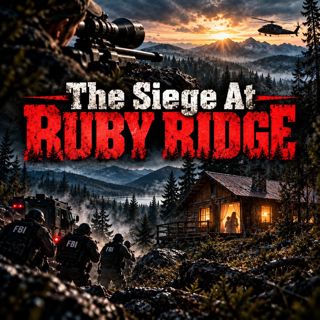

The Siege At Ruby Ridge

The Siege At Ruby Ridge

Listener discretion is advised. This episode contains descriptions of real-life violence and death, including the shooting deaths of a fourteen-year-old boy, his mother, and a federal law enforcement officer. It also includes direct quotations expressing racist and extremist beliefs. Some listeners may find this material disturbing or offensive.

On August 22, 1992, an FBI sniper positioned roughly two hundred yards above a remote cabin in northern Idaho fired two shots. The first struck Randy Weaver as he moved near the shed where the body of his fourteen-year-old son, Sammy, had been placed after being killed the previous day. The second bullet passed through the curtained window of the cabin door and killed Weaver’s wife, Vicki, as she stood inside holding their ten-month-old daughter.

At the time, no one had formally told the family who surrounded the cabin or ordered them to surrender. Federal authorities would not learn that Vicki Weaver had been killed until days later.

This episode of Disturbing History takes a deep look at Ruby Ridge—not the simplified version that became a political slogan, but the complicated chain of decisions, mistakes, intelligence failures, disputed gunfire, and deadly consequences documented in the government’s own investigations.

Brian traces the story back years before the siege, beginning with Randy and Vicki Weaver’s decision to leave Iowa and move their family into the mountains of Idaho. From there, the episode follows the growing interest of federal authorities, allegations made by a neighbor, Weaver’s contact with white separatist circles, and an undercover ATF investigation involving two illegally shortened shotguns. Government investigators would later question parts of that operation and acknowledge they could not completely rule out whether Weaver had been improperly encouraged into committing the offense.

Then came the bureaucratic mistake that helped transform a firearms case into a federal fugitive operation.A probation officer sent Weaver a letter listing the wrong trial date—March 20 instead of February 20. By the time the mistake was discovered, a bench warrant had already been issued. Despite knowing Weaver had received incorrect information, the warrant remained active, and prosecutors later indicted him for failure to appear before the erroneous date he had been given had even arrived.

The Justice Department would later describe the situation as creating an “appearance of governmental overreaching.” The episode also examines how letters written by Vicki Weaver and references to extremist figures helped shape the government’s threat assessment of the family, eventually contributing to comparisons between Weaver and violent white supremacist organizations.

Then, on August 21, 1992, six deputy U.S. marshals conducting surveillance encountered the Weaver family’s dog, Striker. What followed at a trail junction known as “the Y” remains one of the most disputed moments of the entire case.Within seconds, Deputy U.S. Marshal William Degan and fourteen-year-old Sammy Weaver were dead. Investigators were ultimately unable to conclusively determine who fired the first shot.

The next day, the FBI arrived.Special rules of engagement were drafted during the flight to Idaho—rules that would later become one of the most controversial aspects of the operation. Within hours, FBI sniper Lon Horiuchi fired the shots that wounded Randy Weaver and killed Vicki Weaver.

From there, the episode reconstructs the extraordinary details of the siege: failed communications, surrender announcements broadcast after Vicki was already dead, FBI snipers suffering from exposure because they were not equipped for the mountain weather, armored vehicles approaching the cabin, negotiations conducted over loudspeakers, and the eventual arrival of former Green Beret and presidential candidate Bo Gritz, who helped establish direct contact with the family.

The final portion of the episode examines what happened when Ruby Ridge reached the courtroom and eventually Congress. The forty-two-day criminal trial resulted in acquittals on most of the major charges.

A Justice Department task force concluded that the sniper’s second shot did not meet constitutional standards. An FBI official later went to prison for destroying an internal report related to the case. The Weaver family received a $3.1 million civil settlement from the federal government.

Years later, FBI sniper Lon Horiuchi would face a state manslaughter charge over Vicki Weaver’s death, leading to a lengthy legal fight in the federal courts before the case was ultimately dropped.

And in 1995, Randy Weaver appeared before the United States Senate carrying the cabin door through which the bullet that killed his wife had passed.


Email Brian


Get Brian's Books

Leave Us A Voicemail

Visit Our Website


Have a forgotten historical mystery, disturbing event, unsolved crime, or hidden conspiracy you think deserves investigation?

Send your suggestions to brian@paranormalworldproductions.com.

Disturbing History is a dark history podcast exploring unsolved mysteries, secret societies, historical conspiracies, lost civilizations, and the shadowy stories buried beneath the surface of the past.

Follow the show and enable automatic downloads so you never miss a deep dive into history’s most unsettling secrets.

Because sometimes the truth is darker than fiction.

Denne episoden er hentet fra en åpen RSS-feed og er ikke publisert av Podme. Den kan derfor inneholde annonser.

Episoder(154)

The 1990's

The 1990's

On July 16, 1990, Time magazine put a group of young adults on its cover beneath the word “twentysomething” and asked whether they were laid back, late blooming, or simply lost. The story said they st...

30 Sep 1h 12min

The 1980's

The 1980's

The 1980s began with 52 Americans still being held hostage in Tehran and ended with crowds tearing open the Berlin Wall. Between those two moments came one of the most turbulent, contradictory decades...

25 Sep 1h 9min
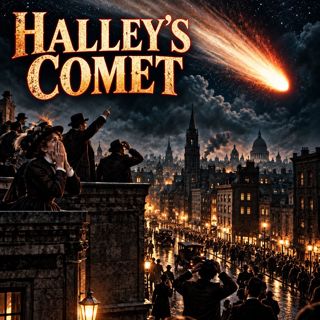
Halley's Comet

Halley's Comet

On the night of May 18, 1910, people across the world waited for Halley’s Comet to kill them.Hotels in New York opened their rooftops. Miners in Pennsylvania refused to go underground. A religious sec...

23 Sep 1h 1min
The Freeway Killer

The Freeway Killer

This episode discusses sexual violence against children and teenagers, torture, and murder and is not suitable for younger audiences. Listener discretion is strongly advised. On the night of June 11, ...

21 Sep 1h 19min
The 1970's

The 1970's

The 1970s opened in conflict.On April 30, 1970, President Richard Nixon announced the expansion of U.S. military operations into Cambodia.Days later, four students were killed by the Ohio National Gua...

18 Sep 1h 2min
The Bystander Effect

The Bystander Effect

On March 27, 1964, The New York Times published a story that would become one of the most famous examples of human indifference ever told. According to the report, 38 people in Queens watched as 28-ye...

16 Sep 1h
The 1960's

The 1960's

Everybody knows the line: “Don’t trust anyone over thirty.” It became shorthand for an entire generation, even though the man who said it was a 24-year-old Berkeley graduate student who would turn thi...

13 Sep 1h 2min

Populært innen Samfunn

rss-spartsklubben
giver-og-gjengen-vg
aftenpodden
konspirasjonspodden
aftenpodden-usa
rss-nesten-hele-uka-med-lepperod
popradet
rss-henlagt-andy-larsgaard
rss-espen-lee-usensurert
alt-fortalt
wolfgang-wee-uncut
min-barneoppdragelse
grenselos
synnve-og-vanessa
fladseth
frokostshowet-pa-p5
rss-herrepanelet
opptur-med-annette-og-ingeborg
rss-dette-ma-aldri-skje-igjen
rss-chit-chat-med-rakel-og-helle