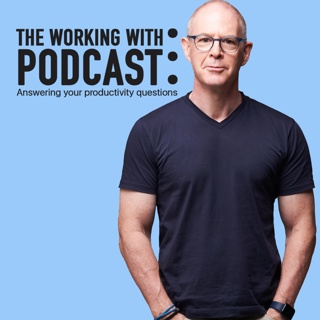

A Few Of My Favourite Productive Habits.

A Few Of My Favourite Productive Habits.

This week’s question is about all those little secrets I’ve discovered over the years that make getting work done on time, every time, easy.

You can subscribe to this podcast on:

Podbean | Apple Podcasts | Stitcher | Spotify | TUNEIN

Links:

Email Me | Twitter | Facebook | Website | Linkedin

Email Mastery Course

The Time Blocking Course

The Working With… Weekly Newsletter

The Time And Life Mastery Course

The FREE Beginners Guide To Building Your Own COD System

Carl Pullein Learning Centre

Carl’s YouTube Channel

Carl Pullein Coaching Programmes

The Working With… Podcast Previous episodes page

Episode 259 | Script

Hello, and welcome to episode 260 of the Working With Podcast. A podcast to answer all your questions about productivity, time management, self-development and goal planning. My name is Carl Pullein, and I am your host for this show.

Over the years, I’ve picked up a few tips and tricks that have adopted have helped me to fine-tune my system and greatly improve my overall effectiveness and productivity. This week’s question asked me directly about some of my lesser-known secrets.

It was an interesting question because many of the things I do each day I’ve absorbed into my system and never really think about it anymore. It’s a little like learning to drive a car. At first, you have to consciously remember to put the key in the ignition, or to put your foot on the brake and press the start button; after a while, those steps are done unconsciously. And BOOM! I’ve just given you the first tip, and I haven’t even revealed the question.

The secret to mastering productivity or anything else is repetition. However, before I explain that a little more, let me hand you over to the Mystery Podcast Voice for this week’s question.

This week’s question comes from Craig. Craig asks, Hi Carl, I’ve followed you for a while now, and I have always wondered, beyond what you share through your YouTube and blog if there are any other little nuggets you use every day that you haven’t revealed in some form or another?

Hi Craig, good question. I’ve never thought of that before. I’m sure there are things I do do every day that I do unconsciously that help my overall productivity. You set me quite a challenge here.

Well, let me return to what I was saying in the introduction. “The mother of mastery is repetition”. The more you do something, the better and faster you will get at it.

Take, for example, the humble weekly planning session. When you first do one, it will take you a long time. There are a lot of things you need to go through for the first time, and you will have to consciously think about what you are looking at and will likely read through everything.

Over time though, you learn what needs looking at and what can be skipped. If you come from a GTD background, you will feel you must go through all your open projects. And again, if you are a GTDer, pretty much everything you want to do will be a project—the anything involving two or more steps being a project idea.

That means you are going to have to go through hundreds of projects each and every week. Good luck with that one, my friends.

Now a more pragmatic way of doing your weekly planning session is to look through only your active projects. And here, you really only need to ask yourself what needs to happen next and when do I need to do it.

This dramatically reduces the amount of time you need for a weekly planning session, and as you get consistent with it, i.e. you do one every week, you know exactly what needs looking at. It just becomes natural. You know where to start, and that triggers everything else.

Incidentally linked to your weekly planning session is timing. When should you do yours? Now, over the years, I’ve tried all sorts of different times. I discovered the worst time to do your weekly planning is Sunday night. Yes, I know many of will be shouting at whatever device you are listening to this on. But bear with me.

Doing your weekly planning on a Sunday night is akin to leaving your exercise until the evening. You are going to be inconsistent. Your willpower is at its lowest in the evening, and worse, you will have pretty much forgotten a lot of what happened in the week just gone by.

The best time for a weekly planning session is first thing Saturday morning. Hear me out. Firstly, you’re doing it in the morning and therefore, your willpower is at its highest. It’s also a time where you likely do not have wake up early for work and you can wake up refreshed.

Next, no matter what you are doing on a Saturday morning, there’s no excuses. If you need to set off early for an adventure day, you can wake up thirty or forty minutes earlier and get it done. AND… The icing on the cake… getting your weekly planning done first thing Saturday morning, leaves you worry free for the rest of weekend knowing that you’ve got the week ahead planned and you can now relax and enjoy the weekend.

Next tip. Turn everything you do repeatedly into a process. What I mean here is whether you are replying to your actionable emails, preparing for a meeting, or doing follow-up calls, create a process for doing it.

For example, when I clear my actionable emails, I make a cup of tea, turn on BBC Radio 2 and listen to Ken Bruce on the BBCs Sounds App—well I do at the moment, sadly we learned this week that Ken Bruce will be leaving at the end of March and I don’t know what I will be listening to from April. But that’s something I can deal with another day.

The tea, the music and the time of day (5pm to 6pm) sets an atmosphere and I open up my Action This Day folder and start at the top and work my way down (my email’s in reverse order—oldest at the top). I resist the temptation to cherry pick. I just start at the top and work my way down.

Sometimes, the top two or three are quick replies, sometimes they are longer replies. Either way, I start there and work my way down the list.

I would say five or six days a week I clear them all, and on the day or two I don’t, no worries, the ones I did not get to will be the first ones I deal with tomorrow.

It’s a process that begins in the morning when I clear my inbox. There’s usually 80 to 120 emails in my inbox in a morning (I live on the other side of the world, so most of my mail comes in through the night) So, I clear that first—I need to know about cancelled appointments and any “fires” before I start my day, and then email is pushed to the side until later in the day when I clear the actionable mail.

If you want to learn more about my process, I have a couple YouTube videos on it, and if you want to go much deeper, you can always enrol in my Email Mastery course. (Details as usual in the show notes)

Speaking of email and other forms of communication, here’s another tip I follow. Set rules for how and when you will respond to the various inputs. And I can assure you this works whether you are the CEO or the newest recruit if, and you need to courage to do this, you spell out your rules to everyone.

My rules are: Emails will be responded to within 24 hours. Instant messages within two hours and phone calls immediately.

I remember those laughable days when companies tried to apply rules such as phone calls will be answered within five rings. These kind of rules are ridiculous because they are unsustainable. It left staff on edge because every time the phone rang they started counting. Terrible if you were trying to do some focused work.

I’ve come across some companies that still think this is a good idea. Respond to customer or client emails and messages immediately. Not only is this impossible, but it’s terrible for your customers and staff. You set unrealistic expectations for both.

Set your own rules and communicate these to everyone. People don’t care whether you respond immediately or not, what they want is consistency so once you set your rules. Be consistent.

I can assure you, once you have these in place, you are much less jumpy when you get a message or an email. You know you have time to finish what you are doing before having the need to look at it. (That’s also hard to do, but again, with practice it does get easier)

One of the most powerful productivity habits I have is never going to bed without knowing what two things I must do tomorrow. This is so ingrained in me now that I cannot sleep until I know.

Most days, I will do this leisurely in front of Todoist before I close the lid on my computer. Other days, when I am a bit rushed, or not in my office, I’ll do it from my phone. Just open up Todoist, look at my tasks assigned for tomorrow and flag the two I must do tomorrow.

The beauty of this is I know once my morning routines are complete what I need to do and instead of not looking around for what to do, I get straight onto it. And that saves me a huge amount of time cumulatively through the week.

Ideally, I like to sit down and do this in front of my computer with my calendar open. It’s a ten minute daily ritual, if you like, that saves me hours each week. I think this is why I cannot understand why so few people do it and why I preach so much about it.

As I was thinking about this question, the biggest thing I do is to create processes for doing my core work—the work that is essential each week. That’s this podcast, my YouTube videos, blog post and newsletters as well as writing client feedback and of course doing my coaching calls. I know exactly how much time I need for these activities each week and that time is blocked out in my calendar.

It’s a non-negotiable part of my work life. Each part has a process, and from time to time, I look at my processes to see where I can improve them.

One final tip, whenever Todoist or Evernote update their apps, I always have a play with the new features. I want to know if the new features will enhance my processes or not. The only way to learn that is to play. Likewise, when Apple do their OS updates, I will watch the event, again to see where I can improve my processes.

I also resist the temptation to look at new apps. Todoist and Evernote have served me very well for the last ten years or so. I know them, they are familiar and they have never let me down.

And that’s about it, Craig. I think I’ve covered quite a few tricks I use that I may not have covered here or in my YouTube videos. I hope they can be useful to you.

Thanks, Craig, for your question. And thank you to you, too, for listening.

It just remains for me now to wish you all a very, very productive week.

Episoder(200)

Hobby-Less and Stressed: Why We Need Real Activities Again

Hobby-Less and Stressed: Why We Need Real Activities Again

"Think of yourself in a concert hall listening to the strains of the sweetest music when you suddenly remember that you forgot to lock your car. You are anxious about the car, you cannot walk out of t...

17 Aug 202514min

Stop Competing with Computers: Why Slower is Actually Faster

Stop Competing with Computers: Why Slower is Actually Faster

"Slow down and enjoy life. It's not only the scenery you miss by going too fast - you also miss the sense of where you are going and why."  Eddie Cantor This week, I’m answering a question about why i...

10 Aug 202516min

Plans vs. Planning: The Churchill Principle for Real Productivity

Plans vs. Planning: The Churchill Principle for Real Productivity

“Plans are of little importance, but planning is essential” That quote from Winston Churchill perfectly captures the dilemma we face when it comes to planning.  You can subscribe to this podcast on:  ...

3 Aug 202513min

From 600 Tasks to 8: How Paper Planning Saved My Sanity

From 600 Tasks to 8: How Paper Planning Saved My Sanity

“Word-processing is a normative, standardised tool. Obviously, you can change the page layout and switch fonts, but you cannot invent a form not foreseen by the software. Paper allows much greater gra...

27 Jul 202514min

The Vacation Productivity Paradox: How to Rest AND Get Ahead

The Vacation Productivity Paradox: How to Rest AND Get Ahead

“If you want rest, you have to take it. You have to resist the lure of busyness, make time for rest, take it seriously, and protect it from a world that is intent on stealing it.”  That’s a quote from...

20 Jul 202513min

The Power of Mundane: Simple Systems for Complex Lives

The Power of Mundane: Simple Systems for Complex Lives

“Every morning in SEAL training, my instructors, who at the time were all Vietnam veterans, would show up in my barracks room and the first thing they'd do is inspect my bed. If you did it right, the ...

29 Jun 202513min

The Time-Based Productivity Revolution: Stop Counting Tasks, Start Managing Time

The Time-Based Productivity Revolution: Stop Counting Tasks, Start Managing Time

”But the fact remains, with all the changes that have happened in our lifetime—whether we’re “boomers,” “Gen Xers,” “Millennials,” “Gen Zers” or whatever comes next—one thing has never changed nor wil...

22 Jun 202515min

Finding Your Direction When Life Feels Chaotic

Finding Your Direction When Life Feels Chaotic

“Alice: Would you tell me, please, which way I ought to go from here? The Cheshire Cat: That depends a good deal on where you want to get to. Alice: I don't much care where. The Cheshire Cat: Then it ...

15 Jun 202515min

Populært innen Business og økonomi

stopp-verden
lydartikler-fra-aftenposten
dine-penger-pengeradet
e24-podden
rss-penger-polser-og-politikk
rss-borsmorgen-okonominyhetene
pengepodden-2
livet-pa-veien-med-jan-erik-larssen
pengesnakk
finansredaksjonen
utbytte
morgenkaffen-med-finansavisen
rss-politisk-preik
lederpodden
liberal-halvtime
rss-pa-konto
tid-er-penger-en-podcast-med-peter-warren
stormkast-med-valebrokk-stordalen
rss-sunn-okonomi
rss-markedspuls-2