Mahler Symphony No. 4, Part 1

Mahler Symphony No. 4, Part 1

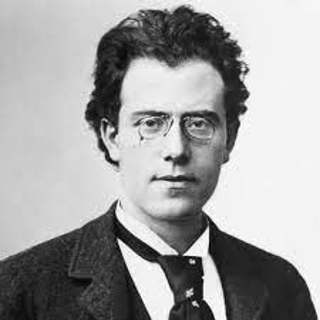
After the truly heavenly slow movement of Mahler's 4th symphony, a soprano emerges and sings a song literally called "The Heavenly Life." It is a symphonic ending like no other, one that leaves the listener peaceful and contented after taking a long(but not as long as usual) and winding journey with Gustav Mahler and his 4th symphony. The 4th symphony is a symphony of moments, like the famous sleigh bells that begin the piece, and a symphony of long, massive, and momentous arcs, like in the timeless 3rd movement, which might be my single favorite movement of any Mahler symphony. But this symphony, so renowned for its contentedness and beauty also features complicated emotions, drama that clouds the blue skies, and a dark side that we never truly escape, perhaps not until the very end of the symphony. Mahler said that his symphony was "divinely serene, yet profoundly sad, it can only have you laughing and crying at the same time." What a perfect way to define Mahler's music, always full of dualisms, contradictions, ironies, and complexities, but that's what makes Mahler's music so irresistible; its ability to plumb the depths of not only the human spirit but also its psyche. Mahler's music is truly musical therapy, and if there's one of his symphonies that really exemplifies that, it's this fourth symphony. With all that said, this is also his simplest and most easily grasped symphony in terms of its purely musical content. I've gotten a lot of emails in the past from folks who are skeptical or confused about Mahler and his appeal, so if you're one of those people, than this symphony MIGHT just be the one that changes your mind. As always with Mahler, his symphonies get multi-part episodes, so this week I'll go through the first two movements of the symphony, from the sleigh bells and brilliant sunshine of the first movement, to the devilish and ironic second movement. We'll talk all about Mahler's brilliant orchestration, his use(and deliberate misuse) of form, the pure beauty of this music, and the oddly negative reception that this symphony got when it was first performed. Join us!

Denne episoden er hentet fra en åpen RSS-feed og er ikke publisert av Podme. Den kan derfor inneholde annonser.

Episoder(296)

Grieg: Peer Gynt

Grieg: Peer Gynt

Grieg's Peer Gynt suites are among the best-known and best-loved works of classical music in the world. They are practically embedded into popular culture, being used in a dizzying number of cartoons,...

3 Sep 1h 7min
Mozart Clarinet Concerto

Mozart Clarinet Concerto

When it comes to a piece like the Mozart Clarinet Concerto, a few words or phrases regularly come up: the concerto is described as "mellow" or Mozart's "swan song," but most often it is described as "...

20 Aug 51min
Bohuslav Martinu Symphony No. 1

Bohuslav Martinu Symphony No. 1

It took a lot to make the composer and critic Virgil Thomson happy. He was famous for savaging new works he didn't like, and the truth is, he didn't like very many new works at all. One exception was ...

6 Aug 1h 1min
Scriabin Poem of Ecstasy

Scriabin Poem of Ecstasy

Thence the universe resounds
 With a joyful cry  I AM. These are the final lines of Alexander Scriabin's epic Poem of Ecstasy, a 300-line poem that takes nearly 10 minutes to read aloud and is one of ...

23 Jul 51min
Sibelius Tapiola

Sibelius Tapiola

Ancient, mysterious, brooding savage dreams; Within them dwells the Forest's mighty God, And wood-sprites in the gloom weave magic secrets. These lines are affixed to the first page of Sibelius' tone...

10 Jul 47min
Arthur Honneger, Symphony No. 3, "Liturgique"

Arthur Honneger, Symphony No. 3, "Liturgique"

In the aftermath of World War II, the Swiss composer Arthur Honegger, who had been living in occupied Paris throughout the war, wrote a new symphony entitled "Liturgical." He wrote an extended comment...

25 Jun 53min
Dvorak Piano Quintet, Op. 81

Dvorak Piano Quintet, Op. 81

In 1872, at the age of 31, Dvořák wrote a Piano Quintet designated as Opus 5. Dvořák was not a prodigy like some other famous composers; instead, his development as a composer was slow and steady. Lat...

11 Jun 49min
Mozart String Quartet, K. 465, "Dissonance"

Mozart String Quartet, K. 465, "Dissonance"

You might be wondering: why on earth would I choose a piece that is literally called "Dissonance" when I was looking for something a bit simpler or cleaner to talk about on the show today? Actually, M...

28 Mai 49min

Populært innen Underholdning

papaya
storefri-med-mikkel-og-herman
enkel-servering
harm-og-hegseth
tusvik-tnne
konspirasjonspodden
folk-flest-med-linn-og-nils
topp-3-med-wold-og-fladseth
tore-og-haralds-podkast
big-5-med-nils-og-harald-2
kjendiscrush-med-sofie-karlstad
hovla
ma-pa-behandling-med-morten-ramm
gi-meg-alle-detaljene
vitnemal
rss-gammal-maiden
nare-venner
rss-kulturnorge
feedback-med-egon-holstad
singel